Writing a truly great sales letter is like having a one-on-one conversation with your ideal customer. It’s your chance to grab their attention with a killer headline, tell a story that hits on a real problem they have, and then seal the deal with an offer they can’t refuse.
The goal? To build trust and drive a specific response, all in a single, focused piece of writing.
Why Sales Letters Still Crush It in a Digital World
With all the noise from social media ads and endless email blasts, you might think the old-school sales letter is dead. But you'd be wrong. In fact, its power has only grown.
A physical letter or a well-crafted, long-form email cuts through the digital clutter. It feels personal and tangible in a way a fleeting Instagram post never could. It commands attention because it’s a direct conversation, not just another piece of content broadcast to the masses.
This direct line gives you the space to build your case, tell a compelling story, and guide your prospect toward a decision without all the usual distractions. It’s a focused, intimate medium that respects the reader's intelligence.
The Undeniable ROI of a Direct Approach
This isn't just a feeling; the numbers back it up. Direct mail, in particular, has a track record that's hard to ignore.
A staggering 84% of marketers agree that direct mail delivers the highest ROI of any channel they use. Even better, 85% of those same pros say their direct mail campaigns pull in the best conversion rates. When done right, it flat-out works.
"A sales letter is a substitute for a personal visit from a salesman. It has the same job to do, and should be judged by the same standards." – Robert Collier, Legendary Copywriter
Collier’s point is timeless. These letters aren't just ads; they're personal envoys for your brand, doing the hard work of a salesperson.
The process is simple but incredibly effective. You move a reader from an initial spark of interest to a final decision to buy.
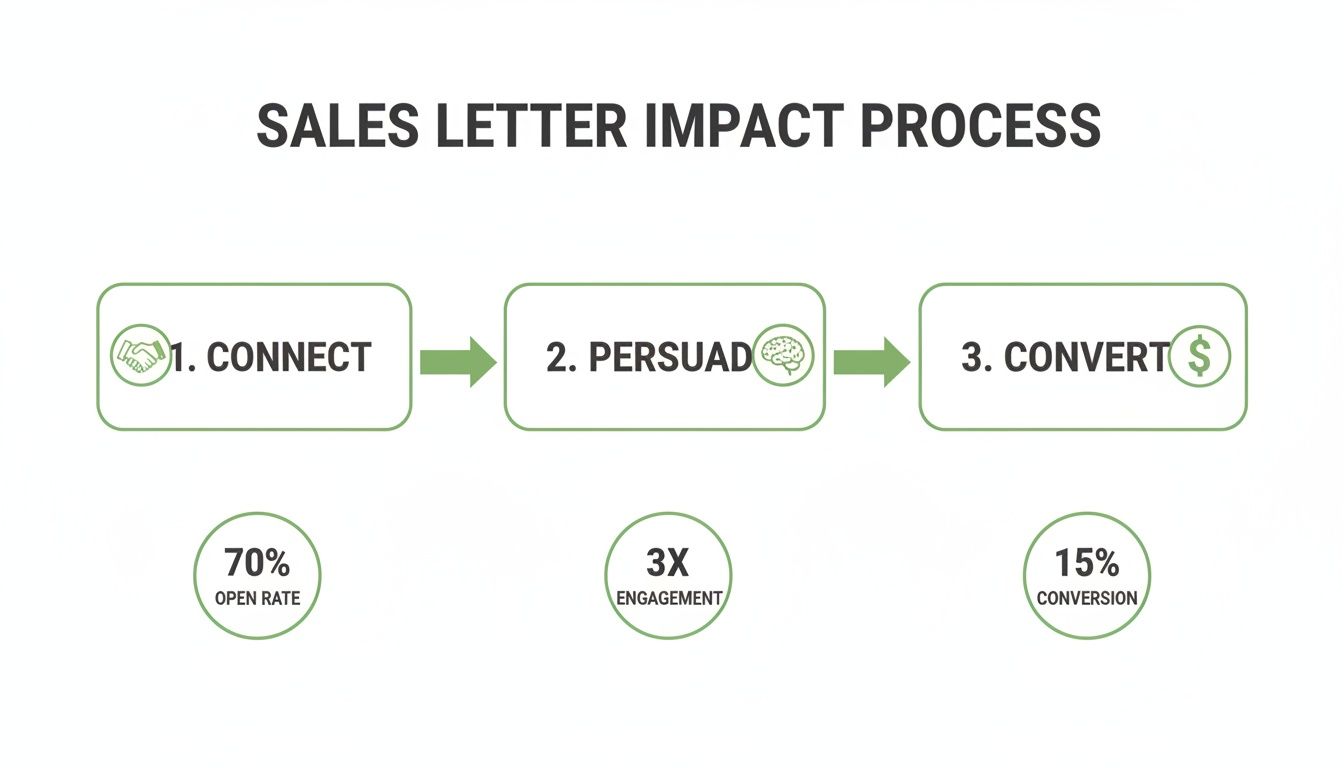
It’s a straight line: you connect with them on a human level, persuade them with a solid argument, and then convert that interest into real action.
The Core Components of a High-Converting Sales Letter
Before we dive into the step-by-step process, let's get a bird's-eye view of the essential building blocks of a sales letter that actually gets results. Think of this as your roadmap for the rest of this guide.
| Component | Purpose |
|---|---|
| The Headline | To grab the reader's attention immediately and make them want to read more. |
| The Hook/Opening | To connect with the reader's pain point or desire and pull them into the story. |
| The Body | To build a persuasive case with storytelling, benefits, and social proof. |
| The Offer | To present an irresistible deal that's clear, valuable, and easy to understand. |
| The Guarantee | To remove risk and build trust, making the "yes" decision much easier. |
| The Call to Action (CTA) | To tell the reader exactly what to do next, creating a sense of urgency. |
| The P.S. | To add a final, compelling punch or summarize the key benefit of the offer. |
Each of these elements plays a critical role. Get them right, and you've got a powerful tool for persuasion.
Key Elements of Persuasion
So, what’s the secret sauce that gives a sales letter its persuasive punch? It really comes down to a few core human elements that are often missing from modern marketing.
- Focused Attention: Unlike a chaotic webpage, a letter has the reader’s undivided attention, even if just for a moment. You have the floor.
- Emotional Storytelling: Great letters don't just list features. They tell a story where the reader is the hero, and your product is the secret weapon they need to win the day.
- Tangible Credibility: Holding a physical letter or reading a dedicated email just feels more substantial than seeing a pop-up ad. That feeling inherently builds more trust.
Mastering these components will turn your sales letter into a cornerstone of your digital marketing content strategy.
Getting to Know Your Audience Inside and Out
Let's be honest. You could write the most brilliant, persuasive sales letter in the world, with an offer so good it feels like a steal, but it will do absolutely nothing if it lands in front of the wrong person.
So, before you even think about a killer headline, you have to answer the single most important question in marketing: Who, exactly, are you talking to? This isn't just about their age or job title. It’s about getting inside their head.
You need to move past the superficial stuff and build a real picture of your ideal reader. What’s keeping them awake at 3 AM? What are the nagging frustrations they deal with every single day? What are their secret hopes and biggest goals? Nail this, and you’ve laid the groundwork for a sales letter that actually connects with a real human being.
Moving Beyond Basic Demographics
Demographics like age, location, and income are just the starting point. They give you a vague outline, but they don’t tell you why someone buys. The real breakthroughs happen when you dig into their psychographics—their attitudes, their values, and the hidden desires that actually drive their decisions.
A crucial first step here is building out a detailed persona profile for sales. Think of this as a composite sketch of your perfect customer, pieced together from real data and actual conversations. It's your guidepost for making sure your message hits home every time.
To build this profile, you have to become a bit of a detective. Your mission is to find out where your people congregate online and just listen.
- Online Forums and Social Media Groups: Places like Reddit, Quora, and niche Facebook groups are absolute gold. This is where people go to vent, ask for advice, and be brutally honest. You'll get unfiltered access to their biggest problems in their own words.
- Customer Reviews: Don't just read your own reviews—read your competitors' too. Look for patterns. What do people constantly complain about? What features make them ecstatic? These are huge clues.
- Surveys and Interviews: Why guess when you can just ask? A simple survey or a quick 15-minute chat with your best customers can uncover a goldmine of information about what problem you really solved for them.
Speaking Their Language
Once you’ve done your homework, you’ll start noticing the specific words and phrases your audience uses over and over again. This is pure gold.
When you use their language in your sales letter, it creates an immediate bond. It subtly tells them, "I'm one of you. I get it."
For example, if you find out your audience of project managers is always complaining about "runaway timelines" and "stakeholder misalignment," weaving those exact phrases into your copy will make them feel instantly understood. Your job is to hold up a mirror to their reality. You can learn more about this process in our guide on what is audience analysis.
And this isn’t just a nice idea—the data backs it up. Research shows that personalized emails can boost open rates by 29% and click-through rates by a staggering 41%. The same principle applies directly to sales letters. It’s no wonder 82% of email marketers say personalization is their top priority. You can dig into more of these powerful email marketing statistics from Porch Group Media to see just how big of a deal this is.
When you truly understand your audience, your sales letter stops being an ad and starts feeling like a one-on-one conversation that solves a genuine problem.
This is the kind of deep empathy that separates a letter that gets tossed immediately from one that gets read, saved, and acted on. You're building a bridge of trust before you even ask for the sale. Every single piece of your letter that follows—from the headline to the P.S.—will be infinitely more powerful because it’s built on this solid foundation.
Crafting Your Message from Headline to Postscript
Okay, you've done the hard work of getting inside your customer's head. Now for the fun part: translating that deep understanding into a sales letter that actually works. This is where we build the engine of your argument, piece by piece, guiding your reader from a casual glance to a confident click.
Every single component matters. The headline, the first sentence, the way you frame your offer—it all has to work together to build unstoppable momentum. Let's break it down.

The All-Important Headline
Your headline has one job: to grab your reader by the collar and make it impossible for them to ignore the next sentence. If the headline bombs, the rest of your letter is dead on arrival. Simple as that.
Think of it as the ultimate gatekeeper. It has to earn the right to your reader's time by promising something they desperately want or need. It must connect directly with a pain point or a deep-seated desire you found during your research.
A few tried-and-true approaches always work well:
- The "How-To" Headline: This is a classic for a reason—it makes a direct promise. "How to Get Your Toddler to Finally Eat Vegetables."
- The "Secret" Headline: This sparks instant curiosity. You're hinting at insider info they're not supposed to have. "The Secret to Decluttering Your Inbox for Good."
- The "Question" Headline: A good question gets the reader to engage immediately. "Are You Making These Common Financial Mistakes?"
Don't just write one headline and call it a day. I always brainstorm at least 10 different versions. Test them. See which one feels like it has the most punch. This is your first—and often best—shot at making a real connection.
Hooking Them with a Compelling Opening
The headline got their attention. Now your opening paragraph has to pull them into your world. This isn't the time to talk about yourself or your product. It's time to talk about them.
The single most powerful way to do this is by telling a story. We're wired for narrative. A relatable story can bypass a reader's natural skepticism and create an immediate emotional bond.
You could start with a personal anecdote, a shocking statistic, or a vivid description of their current frustration—that "before" state they're trying to escape. Your goal is to get them nodding their head and thinking, "Wow, this person gets me."
A great sales letter doesn't start by talking about the product; it starts by talking about the reader's problem. By validating their struggle first, you earn the right to present your solution.
When you show them you understand their pain on a deep level, you build the trust you'll need later when you ask for the sale.
Transforming Features into Irresistible Benefits
I see this mistake all the time. Founders and marketers get so excited about their product's cool features that they forget to explain why any of it matters to the customer.
A feature is what something is. A benefit is what it does for the customer. People don't buy quarter-inch drill bits; they buy quarter-inch holes. It's your job to connect those dots for them.
Here's a simple framework for translating a feature into a benefit-driven statement. Let's imagine we're selling a tool like Natural Write, which helps humanize AI-generated text.
Feature vs. Benefit Transformation for Sales Copy
It’s a subtle but powerful shift. You stop talking about your product's specs and start talking about the customer's future success.
| Product Feature (e.g., Natural Write) | Benefit-Driven Sales Copy |
|---|---|
| Integrated AI Detection Checker | "Stop guessing if your text sounds like a robot. Get instant confidence that your message will pass any AI checker, so you can publish your work without fear." |
| One-Click Humanization Engine | "Transform a bland first draft into natural, engaging prose in a single click. Spend less time wrestling with awkward sentences and more time on your big ideas." |
| Privacy-First Architecture (No Data Stored) | "Edit sensitive client documents or confidential research with complete peace of mind. Your work is processed on the fly and never stored on our servers." |
After you write down a feature, always ask yourself, "So what?" The answer to that question is where you'll find the real, compelling benefit.
Building Unshakable Credibility with Proof
By this point, your reader is intrigued, but they’re also skeptical. "This sounds great," they're thinking, "but can I really trust this?" Now's the time to crush that doubt with cold, hard proof.
Credibility isn't built on claims; it's built on evidence. Weave these elements throughout your letter to make your case undeniable:
- Testimonials: Don't just use generic praise. Use quotes from real customers that highlight specific, tangible results.
- Case Studies: Briefly tell the story of a customer who was struggling with the exact problem your reader has, and show how your product created a transformation.
- Statistics and Data: Numbers cut through the noise. "Our clients see an average 35% increase in productivity within the first month."
- Social Proof: Mentioning the number of happy customers you have or any recognizable brands that trust you can go a long way.
Every piece of proof you provide is another brick in the foundation of trust, making the final decision to buy feel both logical and safe.
The Power of the Postscript (P.S.)
Whatever you do, don't forget the P.S. It's one of the most-read parts of any letter. Many people’s eyes jump straight from the signature to the postscript to get the bottom line. It’s your last chance to make a final, powerful impression.
The P.S. is the perfect spot to:
- Restate your biggest, most compelling benefit.
- Remind them of the offer and any deadlines.
- Toss in an extra bonus to sweeten the pot.
- Address one last objection you know they might have.
A well-crafted P.S. is the final nudge that can push a hesitant prospect over the edge, turning a "maybe later" into a "yes, right now."
Crafting an Offer They Can't Refuse (And a CTA That Seals the Deal)
Everything you’ve written so far—the story, the persuasion, the connection—has been leading up to this exact moment. The offer and the call to action (CTA) are where a reader’s interest finally becomes a decision. Get this part wrong, and all your hard work can fizzle out, leaving a potential customer interested but ultimately doing nothing.
Your offer is the core of the entire deal. It has to be so good, so packed with value, that the reader feels like they’d be foolish to pass it up. This isn't about sleazy hype; it’s about framing your value proposition so it’s overwhelmingly in their favor. A truly powerful offer makes the price feel like a tiny speed bump on the way to a massive win.
Making Your Offer Irresistible
A killer offer is more than just a price tag. It's about how you frame the entire package to dissolve any hesitation and tap into the reader's deepest desires. It's where you stack the deck so heavily in their favor they can’t help but say yes.
From my experience, a few psychological triggers can make a good offer great:
- Value Stacking: Don't just sell the core product. Bundle it with valuable bonuses—guides, checklists, a free consultation, you name it. Then, list out each item and its real-world monetary value to show the mountain of value they're getting for a molehill of a price.
- Ethical Scarcity: People are wired to avoid loss. You can tap into this by introducing genuine scarcity. Maybe you only have a limited number of spots available for a coaching program, or the first 50 buyers get an exclusive bonus.
- Urgency: Deadlines get people off the fence. A simple phrase like, "This special introductory price is only available until Friday at midnight," gives them a concrete reason to act now instead of "later" (which usually means never).
When you combine these elements, you shift the reader’s internal dialogue from, "Hmm, should I buy this?" to "Wow, how can I get my hands on this right now?"
Reverse the Risk with a Powerhouse Guarantee
The final, critical piece of an irresistible offer is the guarantee. Every single purchase, whether it’s for $10 or $10,000, comes with risk for the buyer. What if it doesn't work for me? What if I regret it? Your job is to grab all that risk off their shoulders and place it squarely onto your own.
A strong guarantee isn't just a refund policy; it's a massive statement of confidence. Go beyond the standard "30-day money-back guarantee." Consider something bolder.
A rock-solid guarantee does more than just offer a refund; it sells the product. It tells the customer, "We are so confident that this will solve your problem that we are willing to take all the risk."
Think about a "double your money back" guarantee if they don’t see results, or even a "keep the product and still get a full refund" offer. These kinds of guarantees are incredibly persuasive because they eliminate buyer's remorse before it even has a chance to creep in. Folding this kind of thinking into a broader conversion rate optimization strategy is how you turn good results into great ones.
Write a Clear, Commanding Call to Action
You’ve laid out an incredible offer. Now what? You have to tell the reader exactly what to do next. This is no time to be shy or subtle. Your CTA must be direct, crystal clear, and ridiculously easy to follow.
Confusion is the ultimate conversion killer. If a reader has to pause for even a few seconds to figure out the next step, you've likely lost them. Your instructions need to be so simple a child could follow them.
Use strong, action-oriented verbs that command attention and drive them forward.
- Instead of: "Feel free to get in touch."
- Try: "Call our office now at 555-1234."
- Instead of: "Our website has more info."
- Try: "Go to OurWebsite.com and click the big orange 'Order Now' button."
- Instead of: "Let me know if you're interested."
- Try: "Fill out the enclosed form and drop it in the mail by Friday."
Remember, a physical sales letter has a unique sense of immediacy. Did you know that 84% of consumers read direct mail the same day they receive it? That's a huge window of opportunity. Your CTA needs to capitalize on that moment, pushing for action while the letter is still in their hands.
The goal is a frictionless path from reading to acting. Want to dig deeper into the psychology of a great CTA? Check out our complete guide on what is a call to action. By pairing a value-loaded offer with a clear, urgent CTA, you deliver that final, powerful nudge that turns an interested reader into a happy customer.
Polishing Your Letter for Maximum Impact
Alright, you've got a first draft. The core ideas are there, the arguments are laid out, but let's be honest—it’s not ready for prime time. This is where the real magic happens. The final polishing and formatting phase is what separates a decent draft from a sales letter that actually converts.
It's so tempting to call it done the moment you type that last period. I've been there. But skipping this step is a classic rookie mistake. This last 10% of effort is what turns a letter that gets glanced at and tossed into one that gets read, saved, and acted on.
The Old-School Trick That Works Every Time
Before you change a single comma, do this one thing: read your entire sales letter out loud. It feels a little silly at first, but it's hands-down the most powerful editing technique I know. Your ears will catch what your eyes gloss over, every single time.
When you speak the words, you’ll immediately hear where things go wrong:
- Awkward, clunky sentences that make you stumble.
- Paragraphs that ramble on and never seem to end.
- Robotic, formal language—the tell-tale sign of an unedited AI draft.
- A tone that just doesn't sound human.
If a sentence feels weird to say, it’s going to feel even weirder to read. This is your chance to smooth out the rhythm and make your voice sound genuine and conversational. It’s especially critical if you’re using tools like ChatGPT to get started; this step is where you inject the human soul back into the text.
Make It Easy on the Eyes
Nobody wants to read a giant wall of text. We live in a world of skimming, and your letter needs to be visually welcoming. The whole point is to guide your reader’s eye right to the most important stuff without them even trying.
Good formatting isn't just about aesthetics; it’s about psychology. It breaks down your message into bite-sized, digestible pieces, which keeps your reader moving down the page instead of giving up.
Here’s how to make your letter a breeze to read:
- Short Paragraphs Are Your Friend: Seriously, stick to 1-3 sentences per paragraph. This creates a ton of white space, making the page feel open and approachable.
- Use Subheadings as Signposts: Just like the ones in this guide, subheadings break up the content and let someone who's just skimming get the gist of your argument.
- Make Key Points Pop with Bold Text: Use bolding to highlight critical benefits, surprising statistics, and key phrases. It pulls the reader's eye exactly where you want it to go.
Your formatting should do the heavy lifting for the reader. By making your letter easy to skim, you actually make it more likely they’ll slow down and read the parts that resonate with them.
This way, even if someone only gives your letter a three-second scan, they'll still walk away with your core message.
A Final Sanity Check for Your Draft
Okay, once the flow and formatting feel right, it’s time to get granular. A checklist helps you look at your letter with fresh eyes and ensures you haven't missed anything that could sabotage your sale.
Run through your letter one last time with these questions in mind:
- Does the Headline Demand Attention? Does it grab them by the collar with a powerful benefit or a dose of irresistible curiosity?
- Is the First Paragraph About Them? Did you lead with their problem or desire, or did you make the mistake of talking about yourself right away?
- Are the Benefits Obvious? Have you answered the "so what?" for every feature? Is it crystal clear what's in it for them?
- Does It Sound Like a Real Person? Read it again. Does it sound like you're having a conversation, or does it sound like a corporate brochure?
- Is the Call-to-Action Impossible to Miss? Is it painfully obvious what you want them to do next? Is there zero confusion?
- Did You Prove Your Claims? Where are the testimonials, data points, or stories to back up your biggest promises?
- Is It Jargon-Free? Did you cut out all the industry buzzwords and acronyms that a normal person wouldn't understand?
Running through this list will tighten up your copy and make your arguments hit that much harder. This final polish is what elevates a sales letter from just "words on a page" to a truly persuasive tool.
Frequently Asked Questions About Sales Letters
Even after you’ve got a solid plan, a few questions always seem to surface right when you're ready to write. Let's tackle some of the most common ones I hear so you can get past those final roadblocks and create a letter that actually converts.
What’s the Perfect Length for a Sales Letter?
Forget about a "perfect" word count. The right length is simply however long it takes you to make a compelling argument and get the reader to act. Some of the most legendary sales letters were monsters—we're talking multiple pages long—because they needed that space to build an undeniable case.
Your focus should always be on value. A quick, punchy letter can be incredibly effective for a simple, low-cost product. But if you’re selling something complex or expensive, you'll need more runway to build trust, handle objections, and justify the price.
As long as every word is laser-focused on your reader and their needs, you're on the right track.
How Do I Keep My Letter From Sounding Like Spam?
Authenticity. That’s your best defense. If your letter reads like a genuine conversation instead of a high-pressure sales pitch, you've already won half the battle.
Ditch the over-the-top claims and hype-filled language. Instead, open with empathy. Show you understand your reader's world and the specific problem they're facing.
Then, back up everything you say with real proof.
- Testimonials from actual customers detailing their wins.
- Case studies that paint a clear "before-and-after" picture.
- Hard data and specific numbers that add undeniable credibility.
And if you can, personalize it beyond just slapping their name at the top. Mentioning their industry or a recent challenge they've faced shows you’ve done your homework. A letter that genuinely helps someone never feels like spam.
Can I Really Use AI to Write My Sales Letter?
Absolutely—as long as you’re the one who has the final say. AI writing tools are a massive help for brainstorming ideas, structuring your argument, and churning out a first draft. They can get you from zero to sixty in minutes, which is a lifesaver when you're staring at a blank page.
But here’s the catch: a raw AI draft almost always lacks the soul of a great sales letter. It's often clunky, robotic, and devoid of the emotional connection that truly persuades someone.
Think of AI as your junior copywriter. Let it do the initial heavy lifting. Your real job is to come in as the seasoned editor, rewriting and injecting your brand's unique voice and personality to make the message feel human.
Your expertise is what turns a passable draft into a piece of copy that closes deals.
Ready to turn those robotic AI drafts into authentic, high-converting copy? The Natural Write humanizer is designed for exactly that. It polishes the tone, boosts clarity, and helps your message bypass AI detectors while truly connecting with your readers. Try it for free and feel the difference a human touch makes.