

Think of writing fluency as the ability to get your thoughts onto the page smoothly, without constantly getting tripped up. It’s more than just having perfect grammar; it’s about the effortless flow from your brain to the screen, making the words feel natural for you to write and for someone else to read. It's the critical bridge between knowing what you want to say and actually saying it well.
Unpacking the Meaning of Writing Fluency

Picture a skilled musician playing a complex song. Their fingers dance across the instrument, seemingly on their own. They aren't pausing to think about every single note; their focus is entirely on the music's emotion and expression. That’s the perfect picture of fluency. It’s a kind of automaticity that frees up your brain to focus on the bigger picture.
When you write fluently, you're no longer wrestling with the mechanics—the spelling, the punctuation, the basic sentence construction. Instead, your mental energy shifts from how you're writing to what you're writing. This is where the magic happens. You can finally concentrate on developing stronger ideas, building a convincing argument, and letting your unique voice shine through.
Why Fluency Is More Than Just Speed
It’s a common misconception that writing fluency just means writing fast. While speed is definitely part of the equation, it’s far from the whole story. Real fluency is a blend of several key ingredients working in harmony.
To give you a clearer picture, let's break down the core elements that make up strong writing fluency. The table below gives a quick overview of these pillars, which we'll explore in more detail.
The Pillars of Writing Fluency at a Glance
| Component | What It Means | Why It Matters |
|---|---|---|
| Speed & Ease | Writing at a comfortable, steady pace without agonizing pauses. | It keeps your momentum going and prevents the frustration of "writer's block." |
| Coherence & Clarity | Your sentences and paragraphs connect logically, guiding the reader. | If your ideas are jumbled, your message gets lost, no matter how good they are. |
| Stylistic Naturalness | The writing sounds authentic and human, not awkward or robotic. | This is what engages readers and makes your writing enjoyable and persuasive. |
As you can see, it’s about being quick, clear, and natural. This skill is vital everywhere, whether you're a student trying to write a compelling essay or a marketer crafting an email that people will actually open.
And yet, achieving this seamless flow is a real challenge for many. Recent studies are quite telling; some educational assessments show that only 26% of students are writing at a proficient level. This points to a massive gap in a fundamental skill. If you're curious about the data, this writing statistics report provides some eye-opening context.
True fluency occurs when the act of writing becomes as unconscious as the act of speaking. The writer’s focus shifts from forming letters and words to shaping ideas and arguments.
Ultimately, mastering writing fluency is about closing that frustrating gap between the brilliant ideas in your head and the words that end up on the page. It’s how you create work that is not only correct but also clear, engaging, and genuinely persuasive.
The 5 Core Elements of Writing Fluency
True writing fluency isn't just one thing; it's a blend of five distinct skills working in harmony. When these elements are all in place, your ideas can travel from your brain to the page smoothly, making a real impact. The first step to getting better is understanding what you're actually trying to improve.
Let's pull back the curtain on each of these components.
1. Speed: The Engine That Keeps You Going
Speed is the most straightforward element, but it’s not about typing like a maniac. It’s about finding a consistent, comfortable pace that keeps your thoughts from getting bogged down. A fluent writer doesn't spend ages staring at a blank screen, wrestling with the perfect word during that crucial first draft.
This kind of momentum is what keeps writer's block at bay. Think of it like a long-distance runner holding a steady pace versus someone who sprints, stops, and struggles to get going again. The real goal here is to capture your ideas while they're still fresh and clear.
2. Accuracy: The Bedrock of Your Credibility
While that first draft is all about flow, accuracy is the non-negotiable foundation that everything else rests on. This is all about the technical side of things—grammar, spelling, and punctuation. If your writing is riddled with errors, it constantly pulls the reader out of the experience and chips away at their trust in your message.
Fluent writers have a solid grasp of these rules and can apply them without having to stop and think too much. It doesn't mean they're perfect, but their baseline accuracy is high enough that editing becomes a clean-up job, not a major overhaul.
Writing fluency is what happens when the technical stuff becomes so automatic that you can finally focus all your energy on the art of communication. The mechanics should serve the message, not get in its way.
3. Automaticity: The Secret to Creative Freedom
This might be the most powerful element of them all. Automaticity is the magic that happens when the basic acts of writing—forming letters, spelling words, building sentences—become completely second nature. It’s a lot like learning to drive. At first, you’re consciously thinking about the wheel, the pedals, and the mirrors. Before you know it, you’re just driving, and your mind is free to focus on the road ahead.
For a writer, that mental freedom is a game-changer. When your brain isn't tied up with the mechanics, it can focus on bigger things like developing complex ideas, structuring a persuasive argument, or nailing the perfect tone. In fact, studies show that writers who struggle with the basics can see their output quality drop by 40-50% in timed writing tasks because their cognitive load is just too high. You can read more about these educational findings and their implications.
4. Coherence: The GPS for Your Reader
Coherence is the invisible glue that holds your writing together, making sure it all makes sense from one sentence to the next. It’s the logical thread that guides your reader along a clear, easy-to-follow path. A coherent piece has a solid structure, smooth transitions, and a thought process that unfolds naturally.
Without it, even grammatically perfect writing can feel like a confusing jumble of ideas. This is all about organizing your thoughts so your audience can move effortlessly from your opening line to your final point without ever getting lost. If you want to dig deeper into this, our guide on achieving better sentence fluency is a great place to start.
5. Naturalness: The All-Important Human Touch
Finally, naturalness is what makes your writing sound like it was written by an actual person. It’s the rhythm, voice, and style that separate engaging writing from dry, robotic text. A fluent writer's work reads more like a good conversation than a technical manual.
This quality is absolutely vital for connecting with your audience. It builds trust, makes your message more persuasive, and helps your ideas stick. Natural writing avoids awkward phrasing and stiff, overly formal language, choosing instead a voice that is confident, clear, and easy to relate to.
How Writing Fluency Impacts Your Success
Writing fluency isn't just some abstract skill you hear about in English class; it's a real-world engine for getting things done. When you can get your thoughts onto the page without a struggle, it has a domino effect on nearly every part of your personal and professional life. This isn't about sounding smart—it's about working smarter and connecting with people more effectively.
For students, this means getting past the basic struggle of just putting words down. A fluent writer can build a complex argument in an essay with confidence, which leads directly to stronger analysis and, you guessed it, better grades. They spend less time fighting with sentence structure and more time actually thinking about the topic.
This map shows how the core parts of fluency—speed, coherence, and naturalness—all connect and support each other.
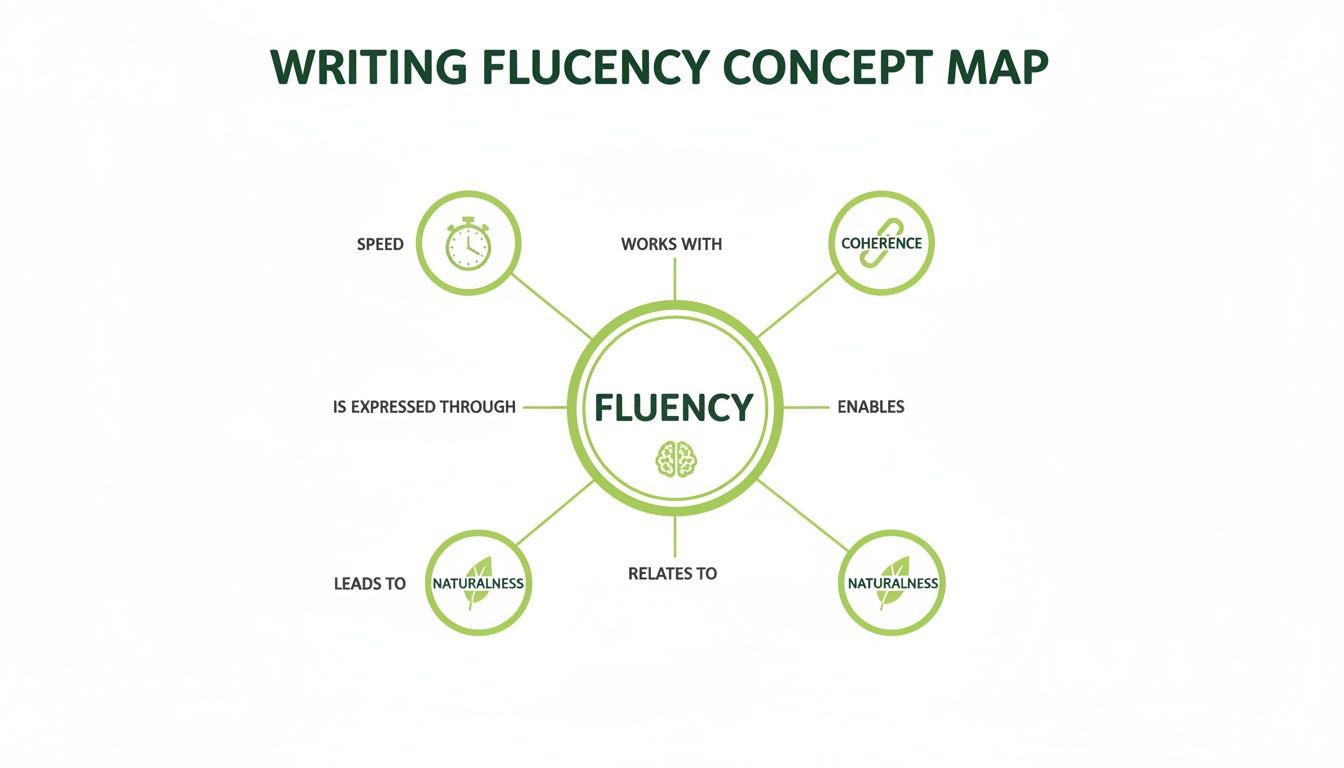
As you can see, each element feeds into the main goal: turning your ideas into clear, effective writing without all the friction.
Success in the Professional World
In the professional world, the impact is even more obvious and easy to measure. Fluent writing is a huge driver of both efficiency and influence, and it’s what often separates the top performers from everyone else.
- For Marketers: Persuasive copy is everything. Fluency helps you whip up compelling ad campaigns, engaging social media updates, and emails that actually get opened and clicked. It's the thin line between a message that gets scrolled past and one that gets people to act.
- For Professionals: Clear, direct communication saves time and stops confusion in its tracks. A well-written report, a persuasive proposal, or an email that leaves no room for doubt can speed up projects and build your reputation as someone who is credible and effective.
Strong writing fluency is also a must-have for building a professional brand. It's how you define and consistently apply your unique what is brand voice.
The Bottom-Line Productivity Boost
At the end of the day, fluent writers simply produce better work in less time. They feel less frustrated and are better prepared to handle complex communication tasks. By getting rid of the mental speed bumps that come with clunky, hesitant writing, you free up your brain to focus on the bigger picture—strategy, creativity, and solving problems.
This boost in efficiency doesn't just improve your work; it builds your confidence and your professional standing. Investing in this skill is a direct investment in your own success. If you want to dig deeper, our guide on what is clarity in writing has some great insights. Honing your writing fluency is one of the most practical steps you can take toward hitting your biggest goals.
Spotting Fluent vs Non-Fluent Writing

The best way to really wrap your head around writing fluency is to see it—and its absence—in the wild. Theory is great, but there’s no substitute for developing an ear for what sounds right. Once you can tell the difference between smooth, natural prose and writing that feels clunky and disconnected, you can start to improve your own work.
Think of non-fluent writing like a car that sputters and stalls. It might eventually get you where you’re going, but the ride is jarring and unpleasant. The sentences might be technically correct, but they lack a natural rhythm, forcing the reader to stop, reread, and piece the ideas together themselves.
H3: Example A: A Professional Email
Let's look at a common scenario: a quick follow-up email after a meeting. Pay attention to how the first draft comes across as hesitant and a bit awkward, while the second feels clear, confident, and professional.
Non-Fluent Version: "Subject: Follow Up I am writing to you for a follow up from the meeting we had. It was about the project. The project plan has some next steps. I wanted to see what you thought. Your ideas are needed for us to proceed. Please reply."
This version feels robotic. The short, choppy sentences are disconnected, making the writer seem unsure of themselves and stripping the message of any professional grace.
Fluent Version: "Subject: Next Steps for the Q3 Project Following up on our meeting this morning, I’ve outlined the next steps for the Q3 project plan. I would appreciate your feedback on the proposed timeline when you have a moment. Your insights will be crucial as we move forward, so please let me know your thoughts by the end of the day."
See the difference? This email flows. It uses transitional phrases ("Following up on..."), clearly states the purpose, and makes the request with confidence. That's fluency in action.
The hallmark of non-fluent writing is that it makes the reader do all the work, forcing them to connect ideas that the writer failed to link. Fluent writing guides the reader effortlessly from one point to the next.
H3: Example B: A Marketing Blurb
Now, let's try a short promotional blurb for a new product. The goal here is to be persuasive and exciting, but a lack of fluency can completely drain its energy.
Non-Fluent Version: "Our new app is here. It helps you organize tasks. It has many features. You can use it for work. You can use it for personal life. Download it. You will be more productive."
This isn't an ad; it's a list of facts. The repetitive sentence structure is monotonous and does absolutely nothing to build excitement or connect with a potential user.
Fluent Version: "Ready to take control of your day? Our new app streamlines your entire life, seamlessly organizing both professional projects and personal tasks in one intuitive space. With a suite of powerful features designed for maximum productivity, you can finally stop juggling and start achieving. Download it today and discover a more organized you."
This version tells a story. It opens with a question, uses stronger verbs ("streamlines," "juggling," "achieving"), and varies the sentence length to create a compelling rhythm. The call to action feels like a natural conclusion, not just another item on a list.
H3: Fluent vs Non-Fluent Writing Checklist
To help you start spotting these issues in your own writing, I've put together a quick checklist. Use it to diagnose where your text might feel clunky and to remind yourself of what smooth, confident writing looks like.
| Writing Trait | Signs of Non-Fluent Writing | Characteristics of Fluent Writing |
|---|---|---|
| Sentence Structure | Repetitive patterns (e.g., all short sentences); lacks variety. | Mix of short, punchy sentences and longer, more complex ones. |
| Flow & Rhythm | Abrupt, choppy, and hard to read aloud. | Smooth and logical transitions between ideas; easy to read aloud. |
| Word Choice | Basic, overly simple, or repetitive vocabulary. | Precise, varied, and engaging language; uses strong verbs. |
| Tone | Robotic, hesitant, or unclear. | Confident, clear, and appropriate for the audience and purpose. |
| Reader Effort | Forces the reader to reread and connect the dots. | Guides the reader effortlessly from one point to the next. |
| Cohesion | Ideas feel like a disconnected list of facts. | Sentences and paragraphs build on each other to form a cohesive whole. |
Keep this checklist handy when you're editing. Learning to recognize these patterns is the first and most important step toward transforming your own writing from disjointed to dynamic.
Actionable Exercises to Build Your Fluency

Knowing what writing fluency is and actually building it are two different things. Just like an athlete doesn't get stronger by just reading about exercise, you need consistent, focused practice to get your ideas flowing onto the page.
Think of these exercises as your personal writing gym. Each one targets a different "muscle"—speed, automaticity, rhythm, and style—to help you quiet that inner critic and write without friction. Make them a regular habit, and you'll see real progress.
Master Freewriting to Build Momentum
Hesitation is the arch-nemesis of fluency. Freewriting is the perfect way to fight back. The concept is brilliantly simple: set a timer for five or ten minutes and just write. Don't stop, don't edit, and don't even worry if it makes sense.
If you hit a wall, just type the last word you wrote over and over until a new idea pops into your head. This exercise trains your brain to stop second-guessing itself and builds the automaticity needed to trust your instincts and just get the words out.
The core principle of freewriting is to separate the act of creating from the act of critiquing. By silencing your inner editor during the drafting phase, you give your ideas the space they need to flow freely.
Use Sentence Combining for Sophistication
One of the tell-tale signs of non-fluent writing is a series of short, choppy sentences that make the text feel disjointed. Sentence combining is a fantastic exercise for smoothing this out and making your writing sound more mature.
Start with a few simple, related thoughts. Your mission is to weave them into a single, more elegant sentence.
- Original: The dog was old. He barked at the mailman. He did this every day.
- Combined: Every day, the old dog barked at the mailman.
Practicing this teaches you to use different sentence structures, conjunctions, and clauses, which ultimately gives your writing a much more natural and engaging rhythm.
Practice Imitation to Learn from the Best
Want to write better? Start by learning from the masters. This isn't about copying their work; it's about absorbing their technique. Imitation is a time-honored exercise where you study writers you admire to see how they make their prose sing.
Here’s a simple way to get started:
- Select a Passage: Find a paragraph from an author whose style feels incredibly fluent to you.
- Analyze It: Look closely at their sentence lengths, their word choices, and the way they transition from one idea to the next. What makes it work so well?
- Rewrite It: Now, write about a completely different topic, but try to mimic the structure and rhythm of the passage you just analyzed.
This is a training exercise, not plagiarism. It helps you internalize the patterns of great writing. After all, fluent writing is all about clarity, and exercises like this are closely related to the skill of writing clear instructions—both require you to get your point across without confusion.
Working these exercises into your routine will genuinely transform your writing process. Once you’ve drafted your ideas, you can take the next step by exploring our detailed writing revision checklist. And remember, smart tools like Natural Write can be a great coach, helping you spot clunky phrasing and turn your drafts into confident, polished prose.
A Few Lingering Questions Answered
Let's clear up a few common questions that pop up when people start focusing on writing fluency. Getting these details straight can make a real difference in how you practice and track your progress.
What’s the Real Difference Between Fluency and Proficiency?
It's easy to mix these two up, but they’re not the same thing. Think of proficiency as your toolbox. It’s all the knowledge you have stored away—your vocabulary, your grasp of grammar, your understanding of how to structure an argument. It’s what you know.
Fluency, on the other hand, is how smoothly you use those tools in the moment. It’s the ease and natural flow with which you can pull the right word, phrase, or sentence structure from your toolbox and put it onto the page without getting stuck.
Here’s an analogy: A proficient guitarist knows all the chords and music theory. A fluent guitarist can improvise a beautiful solo, letting the music flow without having to stop and think about where their fingers should go next. True mastery happens when your proficiency becomes fluent.
How Can I Actually Measure My Progress?
You don't have to guess if you're getting better. You can track your improvement in a few concrete ways.
For speed, try timing yourself during a 10-minute freewriting session each week. Over time, you should see your words-per-minute count start to climb without sacrificing clarity.
But it’s not just about speed. For quality, pull up something you wrote six months ago and compare it to a recent piece. You’ll know you’re on the right track when you see:
- Fewer clunky or awkward phrases.
- A much more natural rhythm when you read it out loud.
- You're spending less time fixing basic sentence flow and more time refining your ideas.
Tools can also give you an outside perspective, flagging fewer and fewer robotic patterns as your writing becomes more natural.
The real win isn’t just writing faster. It’s writing better with less struggle. Progress is when clear, compelling text flows out of you, instead of feeling like something you have to wrestle into existence.
Is It Too Late to Improve My Writing Fluency?
Absolutely not. Writing fluency is a skill, just like learning an instrument or a sport. It's not some fixed talent you're either born with or not. It’s built through deliberate practice, no matter your age or experience level.
Whether you're a high school student staring down a term paper or a 30-year marketing veteran trying to write better emails, the right exercises will strengthen the "muscles" you need for fluid writing. Consistent effort is what builds momentum, and anyone can improve with dedicated practice.
Tired of your AI-generated drafts sounding robotic? Natural Write instantly transforms awkward text into smooth, human-like prose that bypasses AI detectors with a single click. Refine your essays, emails, and articles effortlessly. Try it for free at https://naturalwrite.com.