Clarity in writing is all about getting your point across without making your reader work for it. It’s the art of presenting your ideas so they land exactly as you intended—quickly, easily, and without any confusion.
Think of it as removing all the friction between your message and your audience's mind.
What Does Clarity in Writing Actually Mean?
Imagine looking through a dirty, fogged-up window. You can sort of see what’s outside, but the view is blurry, distorted, and confusing. You have to squint and guess. Now, picture a perfectly clean window. The glass is so clear you barely notice it’s there.
Unclear writing is that foggy window. It forces the reader to struggle, making them guess at your meaning until they eventually give up.
Clear writing is the clean window. It doesn't draw attention to itself. Instead, it offers an unobstructed view of your ideas, letting them shine through perfectly.
This isn't just a "rule" for good writing; it's a sign of respect for your reader. When you take the time to be clear, you’re doing the hard work upfront so they don't have to. That simple act builds instant trust and makes you sound credible, whether you're writing a marketing email, a college paper, or a quick update to your team.
The Foundation of Clear Communication
Every single piece of clear writing stands on a few core pillars: a well-defined purpose, a deep understanding of the audience, and a commitment to simplicity. Get these right, and clarity naturally follows.
This flowchart shows how these elements all work together to support your main goal.
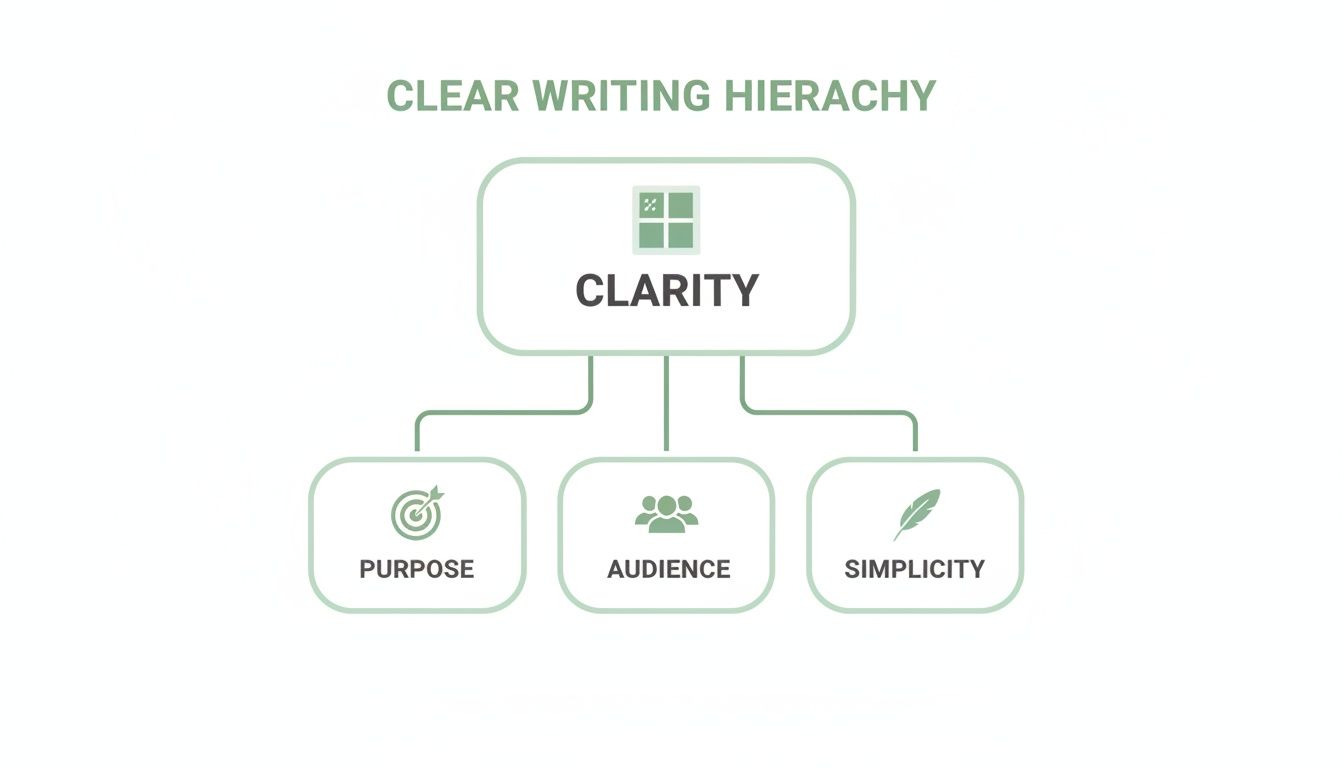
As you can see, you can't achieve true clarity without first knowing why you're writing, who you're writing for, and keeping your language straightforward. As we go through this guide, we'll dive into how each of these components builds on the others to create powerful, effective communication.
The table below gives a quick snapshot of these foundational elements, which we’ll explore in much more detail.
The Four Pillars of Clear Writing
| Pillar | What It Means for Your Reader | Why It Builds Trust |
|---|---|---|
| Clear Purpose | "I know exactly what this is about and why I should care." | It shows you respect their time by getting straight to the point. |
| Audience Awareness | "This feels like it was written specifically for me." | It demonstrates empathy and a genuine desire to connect. |
| Simple Language | "I can understand this easily without a dictionary." | It makes your ideas accessible and proves your confidence. |
| Logical Structure | "I can follow this argument from start to finish without getting lost." | It guides them effortlessly, showing a well-organized mind. |
Think of these four pillars as your checklist. If your writing ever feels weak or confusing, chances are one of these areas needs a little more attention.
Why Clear Writing Is Your Most Valuable Skill

It’s one thing to understand the definition of clear writing. It’s another thing entirely to grasp its power. Clarity isn’t some fuzzy “soft skill”—it’s a hard asset that delivers real results, no matter what you do. Think of it as the invisible engine driving successful marketing campaigns, efficient projects, and real leadership.
When communication gets muddy, the consequences are immediate and expensive. A vague project brief blows past its deadline and wastes resources. An unclear ad campaign fails to connect, leaving money on the table. Every time, that ambiguity chips away at trust and hurts your credibility.
Your brilliant ideas and deep expertise are only as good as your ability to communicate them. If your writing is confusing, it builds a wall around your best work, trapping it behind a barrier of misunderstanding.
"Clear writing serves the needs of the reader. If you’re creating content to build an audience or a business, clarity isn’t optional—it’s essential. Without it, your message gets lost, and your content fails to connect."
The Tangible ROI of Clarity
The cost of poor communication is staggering. It’s not just about frustration—it’s a direct hit to the bottom line. That’s why investing in clarity pays off, big time.
The demand for precision is so high that the writing enhancement software market, valued at USD 320 million in 2023, is expected to nearly double by 2033. This isn't a surprise when you consider the cost of miscommunication, which is estimated at a jaw-dropping $37 billion every year for U.S. businesses alone. Companies that get this right see massive productivity gains—clearer emails and reports can boost efficiency by as much as 25%.
Why Ambiguity Weakens Your Message
When you write clearly, you build trust. Your reader doesn't have to guess what you mean or struggle to find your point. That smooth experience leads to better engagement, higher conversions, and a more loyal audience. In the world of modern search, clarity is also key for artificial intelligence search optimization, because algorithms are designed to favor content that gives users a direct, helpful answer.
On the flip side, ambiguity creates friction. It makes you sound less confident, less authoritative. Every moment a reader spends confused is a moment they could be clicking away.
Mastering clarity isn't just about becoming a better writer. It’s about becoming more effective, persuasive, and influential in everything you do. It might just be the single best investment you can make in your career.
How to Master the Core Elements of Clarity
Getting clear isn't some abstract art form—it's a practical skill you can build, one technique at a time. Mastering these core elements is like learning the fundamentals of a sport. Once they become second nature, your writing just flows, becoming more powerful and effective.
Think of it as creating a well-marked trail for your reader’s mind. Your job is to clear away any obstacles or confusing turns so they can follow you effortlessly. And that journey begins long before you type a single word. It starts with a simple plan.
Plan Your Message Before You Write
Clarity starts with intention. Before you even think about writing, stop and ask yourself: What is the one thing my reader absolutely must take away from this piece?
Once you nail down that core message, outline the key points that back it up. This simple structure becomes your compass, keeping you from wandering off on tangents or repeating yourself. A solid plan ensures your writing stays focused, logical, and easy to follow from the first sentence to the last.
Choose Simple and Precise Words
The best writers don’t use complicated words to sound smart; they use simple words to make complex ideas feel easy. Your goal is to remove every possible barrier between your message and your reader.
- Avoid Jargon: Unless you're writing for a small group of specialists, swap out technical terms for plain language. If you have to use jargon, explain it right away.
- Eliminate Filler Words: Words like "really," "actually," and "just" are often just clutter. Cut them. Your sentences will instantly become more direct and powerful.
- Be Specific: Vague language breeds confusion. Instead of saying, "The product improves efficiency," get concrete: "The product helps teams complete projects 20% faster."
Precision builds trust. It shows you know what you're talking about far more effectively than a big vocabulary ever could.
The goal is to make your reader feel smart and informed, not to show off how many words you know. Clear language is a sign of respect for your audience's time and intelligence.
Structure Sentences for Impact
How you build your sentences is just as important as the words you pick. Long, winding sentences force the reader to do all the heavy lifting, and there’s a good chance they’ll get lost along the way.
Try to mix short, punchy sentences with medium-length ones to create a nice, readable rhythm. A good rule of thumb is to start your sentences with the most important info (the subject) and use an active voice. For example, “The team launched the new feature” is so much clearer than “The new feature was launched by the team.” If you're working in different formats, you can find great tips for creating clear video scripts that also focus on keeping an audience hooked.
Finally, remember that clarity and conciseness go hand in hand. More often than not, making your writing clearer also means making it shorter. You can dig deeper into this relationship by understanding what conciseness in writing is and how it sharpens your message. By trimming the fat, you let your core idea shine.
Real-World Writing: Before and After

It’s one thing to talk about the rules of clear writing. It’s another thing entirely to see them in action. This is where the lightbulb really goes on.
Let's break down a few "before and after" examples to show you how a few small, deliberate tweaks can rescue a piece of writing from the land of confusion.
We’ll look at three common situations where clarity gets lost: a vague project update, a dense academic paragraph, and a marketing email that just doesn't land. Each "before" is tangled up in classic clarity killers like jargon, passive voice, and fuzzy language.
Then we'll untangle them. It's the best way to see how this stuff works in the real world.
Example 1: The Vague Project Update
A project manager needs to give a quick status update. The first draft is stuffed with corporate buzzwords, leaving the team wondering what they’re actually supposed to do.
Before:
"It is imperative that the Q3 project deliverables are actioned in alignment with our strategic imperatives. The recent synergistic activities have resulted in a recalibration of timelines, which necessitates that all stakeholders leverage their core competencies to mitigate potential downstream impacts."
This is pure business-speak. It sounds official, but it's all fluff and no substance. It’s hard to read and even harder to act on.
After:
"We need to adjust our Q3 project timeline. Our recent work together showed we need more time for testing. To stay on track, please focus on your key tasks and let me know of any roadblocks by Friday."
See the difference? The "after" version is direct, honest, and actionable. Here’s how we got there:
- Simple Words: "Actioned" became "adjust," and "synergistic activities" became "our recent work together." Much better.
- Active Voice: Instead of the weak "It is imperative that...," we get the direct "We need to..."
- A Clear Ask: The team knows exactly what to do and when to do it. No guesswork needed.
Example 2: The Dense Academic Paragraph
Academic writing is notorious for getting bogged down in complex sentences and passive voice. This can make a brilliant idea feel completely out of reach for most readers.
Before:
"The epistemological foundations of constructivism are predicated on the notion that knowledge is not a passively received entity but is instead actively constructed by the learner through experiential engagement with their environment."
After:
"Constructivism is based on a simple idea: people learn by doing. Instead of just absorbing facts, learners build knowledge through their own experiences."
The second version keeps the core idea but makes it accessible to anyone. It swaps out abstract jargon for concrete concepts, turning a dense theory into something that feels practical and intuitive.
Example 3: The Uninspiring Marketing Email
This email is trying to sell a new tool, but it's so focused on features instead of benefits that it fails to make a connection. It's all about them, not the customer.
Before:
"Our new software platform offers a suite of integrated tools designed to optimize your workflow."
After:
"Our new software helps you finish your work in half the time by putting all your tools in one place."
The second version works because it answers the only question a reader really cares about: "What’s in it for me?"
It translates a vague feature ("a suite of integrated tools") into a powerful benefit ("finish your work in half the time"). That’s a perfect example of what is clarity in writing—it's all about connecting your message to what your reader actually needs.
Tackling Clarity with Complex and Technical Topics

Writing about dense subjects like data, finance, or technology brings its own set of challenges. The big question is always: How do you simplify the complex without dumbing it down?
The secret isn’t to strip away the nuance. It's to give your reader the right context.
True clarity, especially with technical topics, comes from being transparent. It’s about guiding your reader through your reasoning instead of just dropping a conclusion in their lap. Think of yourself as a tour guide for a complicated idea. You don’t just skip the tricky parts—you explain them step-by-step, so your audience arrives at the same understanding you did.
This approach builds a massive amount of trust. When you show your work, you empower readers to think for themselves.
Context Is the Bridge to Understanding
Handing someone data without context is like giving them a destination without a map. They see the endpoint, but they have no clue how you got there or why it even matters. To achieve real clarity, you need to build a bridge between your expertise and what your audience already knows.
For instance, just stating a formula isn't enough. Not even close. You have to explain what each variable means and why the formula actually works. This is a core idea in great technical writing, where the goal is to enable the user, not just inform them.
The impact here is huge. Research shows that a staggering 79% of users will ditch documentation if the formulas aren’t clear. On the flip side, sites that take the time to explain them see 42% higher comprehension rates. In some fields, this level of clarity cuts down on support tickets by up to 35%. It turns confusing data into something people can actually use and helps them avoid costly mistakes. If you want to dig into the numbers, you can check out the full research on simplifying data-heavy documentation.
The goal is not to prove how smart you are, but to make your reader feel smart. Clarity in complex topics is achieved by illuminating the path to understanding, not just pointing at the answer.
Practical Strategies for Technical Clarity
Ready to turn confusion into comprehension? The key is to demystify your process. Here are a few ways to do it:
- Use Analogies: Compare a complex technical process to something familiar. You could explain a data pipeline by comparing it to an assembly line in a factory. Simple, but effective.
- Define Jargon Immediately: If you absolutely have to use a technical term, define it in simple language the very first time it appears. No exceptions.
- Show the "Why": Don't just present a dataset or a finding. Explain the methodology behind it. How was the data collected? What assumptions did you make? Most importantly, why should the reader care?
By providing this crucial context, you transform your writing from a dry report into a genuinely useful educational tool.
Your Actionable Clarity Checklist and Toolkit
Knowing the theory behind clear writing is one thing, but actually doing it consistently is a whole different ballgame. This is where you bridge that gap. Think of what follows as your pre-flight check before you hit "publish."
This push for systematic clarity isn't just a nice-to-have; it's a huge driver for businesses. As the world gets flooded with more complex data, the need for tools that make sure messages land has exploded. The market for writing enhancement tools is on track to hit $1.37 billion by 2029.
And for good reason. These tools have helped cut down writing errors by a whopping 62% in professional settings. That’s a game-changer when 81% of B2B buyers say clear content is a must-have for them to even consider engaging.
Your Go-To Clarity Editing Checklist
Before you send anything out into the world, run it through this quick checklist. Each point is designed to catch the most common clarity-killers and make your message sharper.
Word and Sentence Level:
- Simple Language: Did I swap out complex words for simpler ones? (Think "use" instead of "utilize.")
- Active Voice: Are my sentences direct? ("The team decided...") Or are they passive? ("...It was decided by the team.")
- No Filler: Have I hunted down and removed empty words like "really," "just," and "actually"?
- Sentence Length: Is there a good mix of short, punchy sentences and longer ones to create a nice rhythm?
Paragraph and Document Level:
- One Idea Per Paragraph: Does each paragraph stick to a single, focused point? Getting this right often comes down to understanding what is paragraph structure.
- Clear Topic Sentences: Does the very first sentence of each paragraph signal what it's about?
- Logical Flow: Do my ideas transition smoothly from one paragraph to the next, or are there awkward jumps?
Must-Have Tools in Your Writing Toolkit
Let’s be honest, technology can be a huge help in our quest for clarity. Here are two standout tools that will spot issues your own eyes might glide right over.
The Hemingway Editor is like that tough but fair coach you had in school. It doesn't just circle grammar mistakes; it brutally highlights confusing sentences, passive voice, and complicated words, forcing you to be more direct.
Grammarly, on the other hand, is more of an everyday writing assistant. Its premium version is especially good at offering specific tweaks to improve clarity, tighten up your phrasing, and adjust your tone for the right audience.
When you pair a manual checklist with smart tools like these, you build a powerful, repeatable system for getting your point across, every single time.
Got Questions About Clear Writing?
Even when you're trying your best to be clear, a few common questions always seem to pop up. Let's tackle the big ones so you can find that sweet spot between simple and smart.
Can Writing Be Too Simple?
There’s a huge difference between simple writing and simplistic writing.
Being clear isn't about dumbing down your ideas. It's about stripping away the fluff so your smart ideas can actually shine. The point is to make complex thoughts accessible, not to water them down until they're meaningless.
Albert Einstein said it best: "Everything should be made as simple as possible, but not simpler." Your job is to use the most direct language that gets your point across without sacrificing precision.
How Do I Keep a Professional Tone Without Sounding Complicated?
This is a classic trap. So many people think that using big words and tangled sentences makes them sound more professional. It’s actually the opposite.
True experts can explain complex things in a simple way. That's real confidence.
You can sound professional and be clear by focusing on:
- Precise Language: Use the right terms for your industry, but don't assume everyone knows what they mean. A quick definition the first time you use a term goes a long way.
- Solid Arguments: Build your case with good evidence and a logical flow. If your thinking is clear, your writing will be too.
- A Confident Voice: Just say it. Use direct, active phrasing instead of hiding behind passive sentences.
Ultimately, clarity is the best sign of professionalism. It shows you know your stuff so well you don’t need to hide behind a wall of jargon.
What's the Single Best Habit for Writing Clearly?
If you only do one thing, do this: read your writing out loud.
It sounds almost too easy, but it works like magic. Your ears will catch all the awkward phrases, clunky sentences, and confusing spots that your eyes just skim over.
When you hear your own words, you become the audience. If you find yourself stumbling, getting tongue-tied, or running out of breath, that’s your cue. That sentence needs a rewrite.
Turning robotic AI drafts into something that actually sounds human is tough. Natural Write instantly refines your text to make it more readable and engaging, so your message always lands the way you want it to. Polish your next piece with a single click.