When you find yourself searching "correct this sentence," you're usually looking for more than a quick grammar fix. You're trying to solve a deeper problem: making your writing sound clear, confident, and, well, human.
This whole challenge has taken on a new dimension with the rise of AI writers. These tools can pump out text that's technically perfect but often feels sterile and robotic. A sentence can be 100% correct according to a grammar checker, yet still feel completely "off."
Going Beyond Basic Grammar Correction
That "off" feeling usually comes from subtle issues that software struggles to spot.
We're talking about things like:
- Awkward phrasing that a native speaker would just never say.
- An unnatural tone that doesn't quite fit the context or audience.
- A lack of genuine voice, which makes it hard for a reader to connect.
The real goal isn't just about fixing mistakes; it's about refining how you communicate. This skill is vital everywhere, from crafting personal emails to learning how to write perfect headlines that grab attention. Every single word should be pulling its weight to connect with your audience.
The Rise of AI and the Need for a Human Touch
AI's impact on writing is impossible to ignore. The AI content detection market alone was valued at an estimated USD 1.79 billion in 2023 and is on track to hit USD 6.96 billion by 2032.
While AI tools can help bloggers spend 30% less time writing, they often produce that robotic prose we mentioned. This can be a huge problem in academic or professional settings where AI detectors are common.
The kicker? Even perfectly good human writing can get falsely flagged. One study found that well-written, grammar-perfect blogs were mislabeled as AI-generated a staggering 60% of the time.
This is where the skill of "humanization" comes in. It’s the art of taking a technically correct sentence and breathing life into it—giving it the rhythm, nuance, and clarity that resonate with a real person.
Ultimately, correcting a sentence is about making it more effective. It's about ensuring your message lands exactly as you intended, with a voice that is unmistakably yours. For a deeper dive, you can explore our guide on what is clarity in writing and how it truly impacts your readers.
Common Sentence Flaws in AI vs Human Writing
To get better at spotting what needs fixing, it helps to know what to look for. Here's a quick look at the typical issues found in both AI-generated and human-written text.
| Error Type | Common in AI Writing | Common in Human Writing |
|---|---|---|
| Robotic Tone | Frequent use of overly formal words and predictable sentence structures. | Less common, but can appear in formal or academic writing. |
| Awkward Phrasing | Phrases that are grammatically correct but sound unnatural to a native speaker. | Typos, grammatical errors, and run-on sentences. |
| Repetitive Language | Overuse of the same words, transition phrases, and sentence starters. | Tendency to overuse personal favorite words or crutch phrases. |
| Lack of Nuance | Difficulty understanding and conveying subtle humor, sarcasm, or emotional depth. | Voice can be inconsistent or not match the intended audience. |
| Over-Explaining | A tendency to state the obvious or be unnecessarily wordy. | Can be too brief, leaving out important context or details. |
Knowing these patterns helps you diagnose your text more accurately, whether you're polishing your own draft or humanizing an AI-generated one.
Spotting Common but Tricky Sentence Errors
Before you can fix a sentence, you have to know what’s actually broken. It's easy to plug something into a tool and ask it to "correct this sentence," but the most damaging mistakes are often the subtle ones—the kind most automated checkers glide right over. These are the issues that suck the life out of your writing, leaving readers feeling lost or disconnected without knowing exactly why.
Learning to see these patterns is a bit like a musician training their ear. At first, everything sounds fine, but soon you start noticing the subtle discord that others miss. This is the skill that will sharpen your editing instincts and help you fix problems at their source.
Unmasking the Passive Voice
One of the biggest culprits behind weak, clunky sentences is the passive voice. This happens when the subject of the sentence is being acted upon, rather than doing the acting. The result often feels indirect, wordy, and a little bureaucratic.
Before: The report was completed by the team on Tuesday.
Why it feels off: Sure, it's grammatically correct. But it’s roundabout. The team—the ones who actually did the work—are tacked on at the end like an afterthought.
After: The team completed the report on Tuesday.
Why it's stronger: This active version is direct, concise, and puts the focus right where it belongs: on the doer. It has more energy and is just plain easier to read.
Catching Dangling Modifiers
A dangling modifier is a classic writing gaffe. It's a descriptive phrase that doesn't logically connect to the thing it's supposed to be describing, often leading to some pretty confusing (and sometimes hilarious) mental images.
Before: Walking through the park, the flowers were beautiful.
Why it’s a problem: This sentence implies the flowers are taking a stroll. Who is actually walking? We don't know.
After: As I was walking through the park, the flowers were beautiful.
Why it works: By simply adding the subject ("I"), the sentence suddenly makes perfect sense. The descriptive phrase now has a clear subject to latch onto.
A great way to check for this is to ask yourself, "Who or what is doing this?" If the sentence doesn't give you a clear answer right away, you might have a dangler on your hands. This simple check can save your writing from a world of confusion.
Clarifying Vague Pronouns
Pronouns like "it," "they," "this," and "that" are incredibly useful. They keep us from sounding repetitive. But when it's not crystal clear what noun a pronoun is referring to, you create ambiguity that forces your reader to stop and puzzle it out.
Think about a typical project update email:
- Before: The marketing team met with the sales department to review their strategy. It wasn't working.
- Why it's vague: What exactly wasn't working? The marketing strategy? The sales strategy? The meeting itself? "It" could be anything, leaving the reader to guess.
To fix this, you just need to be more specific.
- After: The marketing team met with the sales department to review the lead generation strategy. The sales team explained that this approach wasn't converting clients.
- Why it's better: By replacing the vague pronoun with specific details, all the ambiguity disappears. There’s no room for misinterpretation, which means your message gets across loud and clear.
A Practical Workflow for Humanizing Your Text
Knowing the theory is great, but putting it into practice is where you'll see the real difference. Let's walk through a simple, repeatable process for taking a flawed or robotic sentence and turning it into something polished and genuinely engaging.
A tool like Natural Write can be a game-changer here. Think of it as a smart assistant that handles the heavy lifting—like fixing awkward phrasing and clunky sentences—so you can focus on the final, creative touches that make the writing truly yours. It's not about blindly accepting suggestions; it's about using the technology to get a much stronger first draft that you can then refine.
From Draft to Polished Final Text
The core process is simple: paste your text, let the humanizer do its thing, and then make your own intelligent tweaks. This method combines the speed of AI with the irreplaceable nuance of human judgment, which is honestly the most effective way to refine your writing today.
Here’s what you see when you start with Natural Write. Just drop your text into the left panel and get ready for the transformation.
The clean, side-by-side layout makes it incredibly easy to compare your original text with the improved version, making the whole review process fast and intuitive.
Scenario 1: The Dense Academic Sentence
We’ve all seen it. Academic writing that gets so tangled in jargon and complex structures it’s nearly impossible to read.
- Before: "The methodological framework employed for the investigation was predicated on a qualitative analysis of emergent thematic patterns derived from semi-structured interviews."
Technically correct? Sure. But it’s a headache to get through. This is the perfect kind of sentence to run through a humanizer.
- After (Humanized): "We used a qualitative approach to analyze the themes that emerged from our semi-structured interviews."
See the difference? The "after" version is direct, clear, and uses an active voice. It communicates the exact same information without making the reader feel like they need a dictionary to understand it.
Tackling Lifeless Marketing Copy
Marketing content has one job: connect with people. But so much AI-generated content falls completely flat, lacking any real personality. With generative AI use exploding—ChatGPT alone had 800 million weekly active users by mid-2025 and 58% of companies were using it for writing—this has become a massive problem.
Raw AI output often gets flagged by detectors like Originality.ai, which boasts a 92.3% accuracy rate. This creates a real need for effective humanization.
The core issue with AI-generated copy isn’t grammar; it’s the lack of an authentic voice. A humanizer helps bridge that gap by rephrasing robotic text into something that sounds genuine and persuasive, bypassing detectors while preserving your core message.
Scenario 2: The Generic Blog Post Intro
First impressions are everything, and a bland, generic intro is a surefire way to make readers click away.
- Before: "In the world of today, it is very important to consider the various factors that influence digital marketing strategies. This article will delve into these factors."
This is passive, stuffed with filler words, and tells the reader absolutely nothing new. It generates zero excitement. A quick pass through a humanizer can inject some much-needed energy.
- After (Humanized): "What really drives a successful digital marketing strategy? We’re breaking down the key factors that actually move the needle, helping you cut through the noise."
This revised intro is so much more dynamic. It grabs your attention with a question, uses stronger language ("move the needle"), and promises real, tangible value. It sets a completely different, more confident tone for the entire article.
If you want more strategies for refining your sentences, check out our guide on how to grammar check and rephrase your content.
How to Keep Your Writing Sounding Like You
Let's get one thing straight: correcting your sentences isn't about scrubbing your personality from the page. It’s about making your unique voice clearer and more impactful. When you’re constantly looking up how to "correct this sentence," the real goal is to sharpen your style, not trade it for something generic and robotic. The best tools are partners in this process, helping you refine your message so it sounds like a better, more polished version of you.
Your authentic voice is a unique blend of your word choice, sentence structure, and the natural rhythm of your writing. If you over-edit, you risk stripping all that away, leaving behind text that’s technically perfect but has no soul. You want your readers to hear you, not the faint hum of a grammar checker.
Think of it as a simple workflow: you start with your raw text, use a tool to help humanize it, and then apply a final polish.
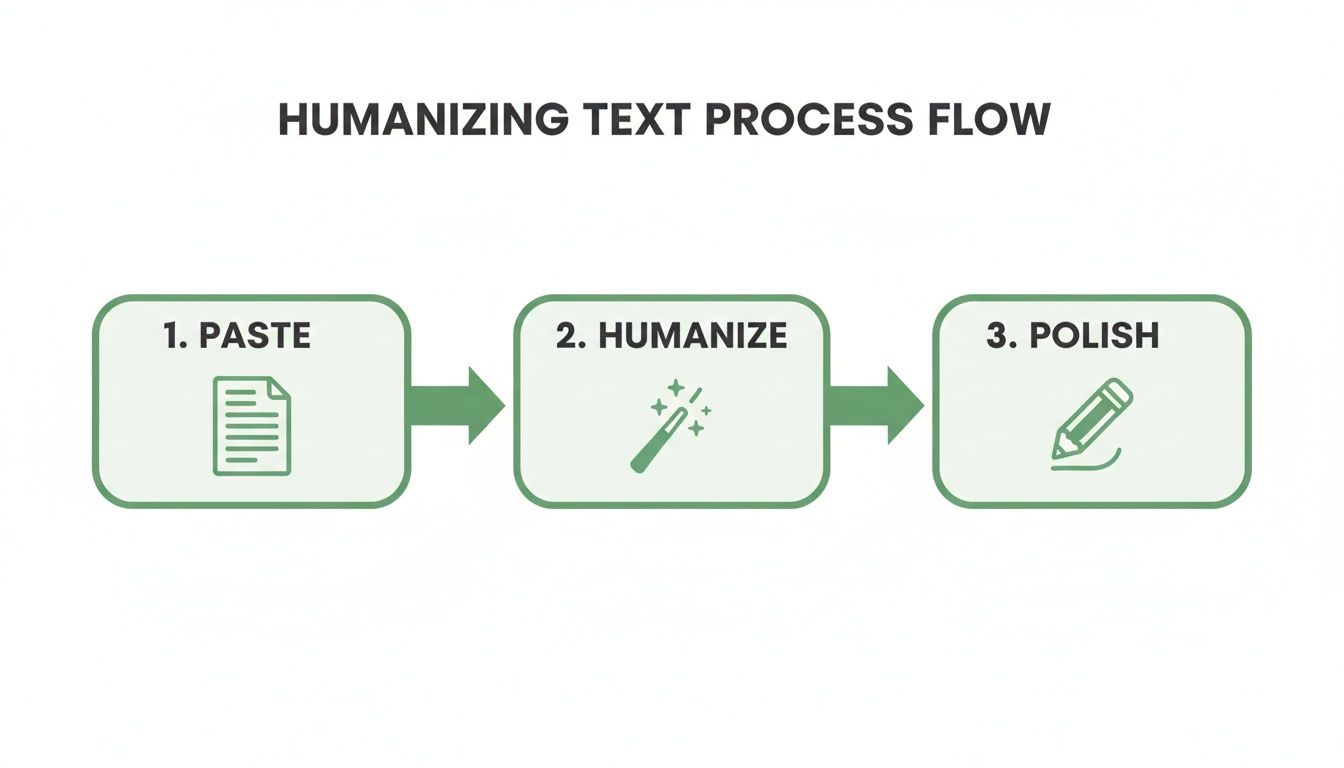
The key is that middle step. "Humanizing" isn't the end of the road. That final polish is where you step back in, reclaim the piece, and make sure your personality shines through.
Read Your Work Aloud
If you only take one piece of advice, make it this one. Reading your writing out loud is the single most effective way to protect your voice. Your eyes will glide right over awkward phrases and clunky sentences, but your mouth won't. If you stumble while reading a sentence, it needs to be fixed.
Ask yourself: Does this sound like a real person talking, or does it sound stiff and overly formal? Your ear is your best editor for catching the things software can't—the cadence and flow that are uniquely yours.
Pro Tip: Try recording yourself reading a paragraph and then playing it back. Listening to your own words as an outsider makes it much easier to hear where your authentic style gets lost in translation.
Simplify and Trust Your Gut
It’s a common trap. Writers, especially in business or academic fields, often try to sound more authoritative by using complicated words and convoluted sentences. They think it makes them sound smarter, but it usually just confuses the reader and hides the writer's true voice behind a wall of jargon.
Here are a few things to keep in mind:
- Always ask: "Is there a simpler way to say this?"
- Ditch the buzzwords: Can you swap that industry jargon for a clearer, more direct word?
- Chop up long sentences: If a sentence feels like it's dragging on forever, break it into two or three shorter, more direct ones.
At the end of the day, your instinct is your most valuable editing tool. If a suggested change just feels wrong, it probably is. The real skill is knowing which edits to accept and when to stand your ground for a choice that feels true to you. Trust your gut; it’s what keeps your writing genuine.
Why Your Final Read-Through Still Matters Most
Automated tools are fantastic assistants, but they're not the author. At the end of the day, your judgment and human intuition are the most critical parts of the writing process, especially when you want to move beyond just correcting a sentence and actually connect with a reader. Technology is a wizard at spotting technical flaws, but it often misses the subtle art of communication—the tone, context, and nuance that make writing feel alive.
Your final read-through is where you bridge that gap. It’s your chance to go from a technically perfect piece of writing to one that’s genuinely compelling. This is where you catch an awkward rhythm the software missed or decide that a slightly unconventional phrase actually captures your voice better than the "standard" fix it suggested.
The Limits of AI Detection and Correction
The fuzzy line between human and AI-generated text is exactly why your oversight is so important. Research shows that people are surprisingly bad at spotting the difference, with only 19% accuracy in detecting AI-generated text—that’s barely better than a coin flip. This really highlights why we need good tools to help flag robotic writing. You can dig into the full findings in this comprehensive NIH study on AI text detection accuracy.
But here’s the catch: even the best detectors aren't perfect. A top-tier tool like Originality.ai might boast 92.3% accuracy on raw AI output, but it can get tripped up once a human starts editing or "humanizing" the text. In one experiment, AI-generated content with just minor paraphrasing sailed right past four out of five leading detectors.
On the flip side, I've seen crisp, well-written human blogs get incorrectly flagged as AI-generated. This proves that complexity, a unique style, or even just very clear writing can sometimes mimic the patterns that detectors are trained to look for.
This is precisely why you have to be the final authority. A tool might flag a sentence you poured your heart into as "likely AI" simply because it's well-structured. Without your review, you could end up "fixing" something that was never broken, stripping your writing of its personality in the process.
Your Intuition Is the Ultimate Editor
At the end of the day, these tools are assistants. They offer great suggestions and catch errors you’d otherwise miss, but they can't grasp your intent, understand your audience, or create the specific emotional impact you’re aiming for.
Think of it like this:
- A tool checks for rules. It’s a stickler for grammar, spelling, and established patterns.
- You check for feeling. You know if a sentence needs to sound more confident, empathetic, or urgent.
Your gut feeling is what transforms a string of correct sentences into a cohesive and persuasive message. That last read-through is your opportunity to infuse the text with your authentic voice, making sure the final product isn’t just accurate, but genuinely effective.
Common Questions About Sentence Correction
Even with the best tools at your fingertips, you're bound to have questions. It’s one thing to fix a typo, but it’s another thing entirely to trust a tool with the nuance and meaning of your work. Let’s walk through some of the most common concerns I hear from writers.
Getting these answers straight will help you move from simply fixing mistakes to confidently crafting writing that truly connects with your audience.
Will a Sentence Corrector Change My Original Meaning?
This is the big one, isn't it? The short answer is: a good tool won't. A quality sentence corrector is designed to preserve your core message by clarifying it, not by changing it. Think of it less as a rewriter and more as a sophisticated editor suggesting ways to make your point land with more impact.
That said, you're always the one in the driver's seat. It's absolutely crucial to review every suggestion. The AI offers a path, but you have the map. Make sure every change sharpens your intent before you accept it.
Can Using These Tools Make My Writing Sound Generic?
It’s a real risk. If you blindly accept every suggestion an automated tool offers, you can definitely sand down the interesting edges of your unique voice. The trick is to use these tools strategically.
I always recommend using humanizers to polish clunky, AI-generated drafts or to catch glaring structural issues. But that’s just the first pass. The real magic happens when you go back through it yourself. Reading your work aloud is a fantastic way to catch awkward phrasing and inject your own rhythm and personality back into the text.
Remember, a sentence can be grammatically perfect and still be clunky, passive, or unclear. Basic grammar checkers are great for technical rules, but they can't judge style, rhythm, or impact. If a sentence doesn't sound natural when you say it, it probably needs a second look for readability, not just correctness.
When you hit a wall with specific rules—like figuring out what tense to use on your resume—it’s often better to consult a detailed guide rather than rely on a tool that might miss the context. Your own judgment, backed by good resources, is always the most powerful editing combo. It’s all about blending the efficiency of technology with your human understanding of tone.
Ready to transform your text from robotic to remarkable? Natural Write offers a free, powerful platform to humanize AI content instantly, ensuring it bypasses detectors while keeping your core ideas intact. Paste your draft and see the difference at https://naturalwrite.com.