When we talk about word choice, we’re talking about the specific words you deliberately pick to get your message across. It’s far more than just stringing together grammatically correct sentences. It’s about finding the perfect word for the moment—the one that carries the right meaning, tone, and feeling for your audience.
Think about the difference between calling someone "thin," "slender," or "gaunt." Each word paints a completely different picture in the reader's mind, and that’s the power of word choice in action.
Unpacking the Art of Word Selection
Imagine you're a painter standing before a canvas with an infinite palette. You could use any number of blues for the sky, but only that one specific shade of cerulean will capture the exact feeling of a crisp autumn morning. Words are your paint.
The art of word choice, often called diction, is all about consciously selecting the right words to match your message, your desired emotional impact, and your ultimate goal. This isn't a license to hunt for the biggest, most obscure words in the dictionary. Often, the best writing is the clearest and most direct. It's about recognizing the subtle power each word holds and using it to your advantage.
The Core Elements of Word Choice
To really get this right, you need to understand the two forces that give words their punch: denotation and connotation.
- Denotation is the straightforward, dictionary definition of a word. For instance, both "house" and "home" denote a physical structure where people live. Simple enough.
- Connotation, on the other hand, is the emotional baggage or cultural vibe a word carries. "House" is neutral, but "home" instantly brings up feelings of warmth, family, and safety.
Skilled writers are masters at balancing these two. They choose words not just for what they literally mean, but for what they suggest. This careful selection is a huge part of what makes a writer's style unique. To dig deeper into how these choices build your authorial identity, check out our guide on what is voice in writing.
To help you keep these concepts straight, here’s a quick breakdown of the key components that make word choice so effective.
The Building Blocks of Effective Word Choice
| Element | What It Means | Why It Matters |
|---|---|---|
| Precision | Using the exact word for a specific meaning. | Eliminates ambiguity and ensures your reader understands your message perfectly. |
| Clarity | Choosing simple, direct language over jargon. | Makes your writing accessible and easy to follow, respecting your reader's time. |
| Tone | The attitude or feeling your words convey. | Shapes the reader's emotional response, building trust, humor, or urgency. |
| Connotation | The implied feelings and ideas a word evokes. | Adds layers of meaning and emotional depth that a literal definition can't capture. |
| Audience | The specific group of people you're writing for. | Helps you select language that resonates with and is appropriate for your readers. |
Ultimately, mastering these elements allows you to move beyond just conveying information and start creating a real experience for your reader.
Good word choice is the foundation of clear communication. It’s the difference between a message that is simply understood and a message that is truly felt and remembered by the reader.
So, what is word choice in writing? It’s your most essential tool for building a connection, establishing your credibility, and making your ideas stick long after someone has finished reading.
Why Your Word Choice Matters More Than You Think
Have you ever read a sentence that just felt off, even if you couldn't quite put your finger on why? Chances are, the issue was word choice. Words are the building blocks of your writing, and they quietly shape how your reader feels, thinks, and acts.
Think about it this way: a single word can pivot an entire sentence's meaning. It's the difference between sounding confident or hesitant, professional or overly casual. Saying you "managed a team" is fine, but saying you "led a team" paints a much more vivid and powerful picture of your leadership.
Building Trust and Credibility
Whether you're writing a business proposal or a simple email, your language is the bedrock of trust. Choosing the right words shows you know your stuff and you've put thought into what you're saying.
When you use language that is clear, specific, and right for your audience, you're not just communicating—you're building credibility. Vague or incorrect words do the opposite; they create confusion and can make you seem uninformed. It's not just about sounding smart; it's about proving you're a trustworthy source.
You can see this in action by looking at the impact of precise language in digital marketing, where a single word can make or break a campaign.
The Hidden Impact on Perception
The words you choose do more than just convey information; they mold how people see you. It's a common trap to think that using complex, fancy words makes you sound more intelligent. Often, it does the exact opposite.
Research consistently shows that writers who use overly complex vocabulary are often seen as less effective and even less sincere. Simpler, more direct language almost always comes across as more confident and persuasive.
The goal of writing is to connect, not to show off your vocabulary. A study in the Journal of Language and Social Psychology found that writers using common words like "sad" were more effective than those using rare synonyms like "forlorn." The real skill isn't knowing big words; it's knowing how to use common words with nuance and precision.
The image below breaks down the key elements that determine how a word lands with your audience.
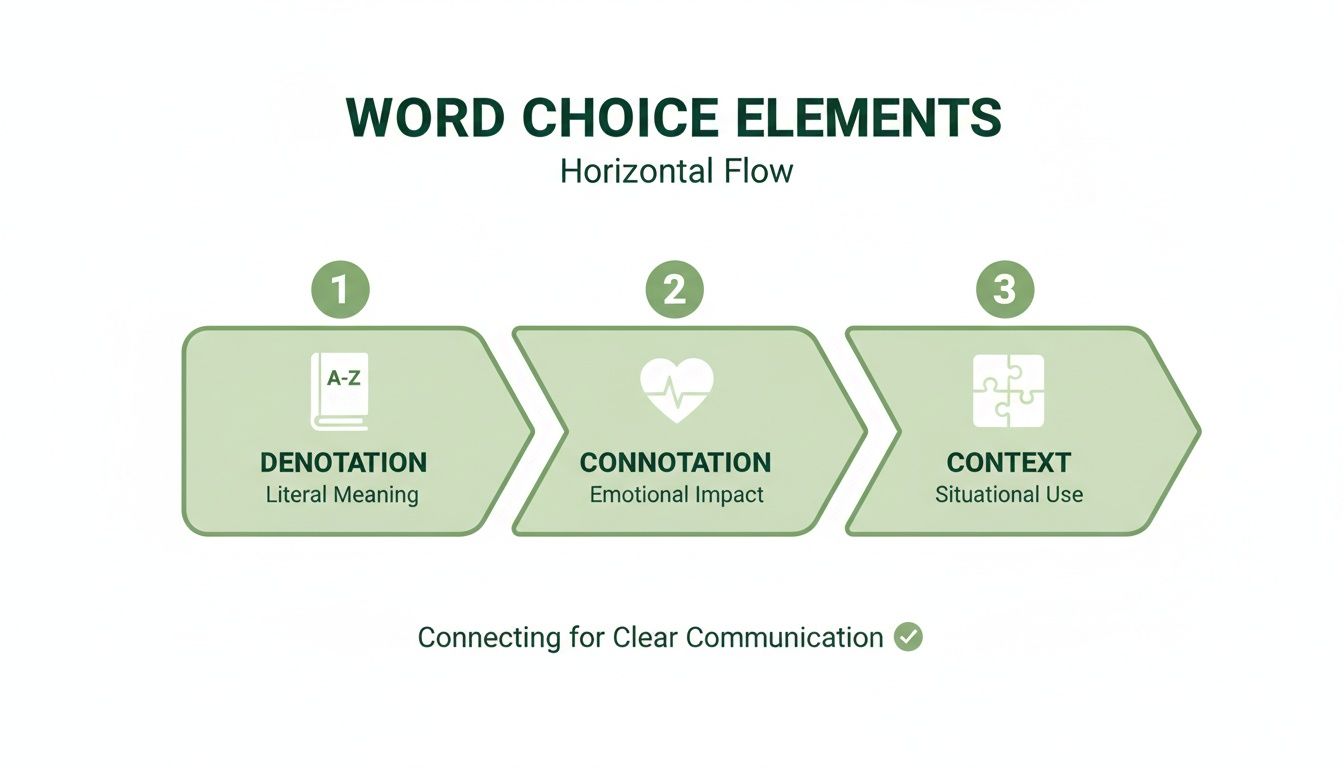
As you can see, a word’s dictionary definition (denotation), its emotional association (connotation), and the context it sits in all have to align for your message to be clear and powerful.
Common Word Choice Mistakes and How to Fix Them

Even the pros get tripped up by a few common word choice traps. We’ve all been there. These little missteps can pile up, leaving your writing feeling clunky, unclear, or just a bit… off. Recognizing these pitfalls is the first step to tightening up your prose and making it land with real impact.
Many of these issues pop up because of simple misunderstandings about how words work together. For instance, awkward word pairings—what experts call collocation errors—are incredibly common. One study on college-level writing revealed that 51% of students used unnatural word pairs, like saying "strong rain" instead of "heavy rain." Even more telling, a whopping 65% reached for synonyms that completely missed the right emotional tone or nuance.
Vague and Generic Language
This is probably the most common mistake of them all: using words that are too broad to paint a clear picture for the reader. Generic language is the enemy of memorable writing.
Take a sentence like this: "The man went to the building." It’s grammatically sound, but it’s a ghost. It has no life and gives the reader absolutely nothing to work with.
Before: The man went to the building.
After: The exhausted firefighter staggered into the smoke-stained firehouse.
See the difference? The "after" version swaps those empty placeholders ("man," "went," "building") for words loaded with meaning ("exhausted firefighter," "staggered," "smoke-stained firehouse"). Suddenly, you have a character, a mood, and a story. The same goes for vague pronouns that leave your reader guessing. Our guide on vague pronoun examples offers more ways to bring that same precision to all your sentences.
Misusing a Thesaurus
A thesaurus feels like a writer's best friend, but it can also be a real saboteur. Too many of us grab a synonym without truly understanding its connotation—the subtle emotional weight a word carries.
For instance, "thin," "slender," and "gaunt" all describe a similar physical state, but they create completely different feelings. "Slender" feels graceful and positive. "Gaunt," on the other hand, suggests illness or hardship. If you swap them without thinking, you could send your message completely off the rails.
- The Fix: Don’t just find a synonym; get to know it. Look up its definition and, more importantly, read a few example sentences. See how it behaves in the wild before you drop it into your own writing.
Using Redundant Phrases
Redundant phrases, or tautologies, are just filler. They use two or more words to say the exact same thing, bogging down your sentences and making your writing feel padded.
Here are a few culprits you can cut from your writing today:
| Redundant Phrase | Concise Alternative |
|---|---|
| Added bonus | Bonus |
| Final outcome | Outcome |
| Past history | History |
| Unexpected surprise | Surprise |
Trimming these is an easy win. It instantly makes your writing more direct and confident. By hunting for these common offenders—from vague descriptions to repetitive phrases—you'll start to sharpen your prose, making sure every single word is doing a specific job. That kind of intentionality is what separates good writing from great writing.
Actionable Strategies to Improve Your Word Choice
Knowing what good word choice is and actually doing it are two different things. Getting better isn't about memorizing the dictionary; it's about building new creative habits and training your brain to see the possibilities in every sentence.
The strategies below are practical, hands-on exercises. They’re designed to shift you from being a passive writer—one who grabs the first word that pops into their head—to an active one who consciously builds sentences for the greatest possible impact. Think of this as your gym routine for developing stronger, more precise writing muscles.
Become a Word Collector
You can't use words you don't have. The best way to expand your mental toolkit is to start paying attention to the words you encounter every day. In short, become a more curious and mindful reader.
Read Widely and Actively: Step outside your comfort zone. Don't just read articles in your niche. Dive into fiction to see how great authors paint pictures with language. Read poetry to feel the rhythm and emotional punch of each word. Study top-tier journalism to learn how to be clear and powerful with fewer, more active verbs.
Keep a Word Journal: When a word jumps out at you—maybe because it sounds beautiful, feels incredibly precise, or is just new to you—capture it. Jot it down in a notebook or a digital doc. Crucially, write down its definition and the sentence where you found it. Context is everything; it shows you how the word actually works in the wild.
This isn't just about building a bigger vocabulary. It’s about re-tuning your brain to appreciate language on a deeper level.
Master the Thesaurus
A thesaurus can be your best friend or your worst enemy. Used carelessly, it leads to clunky, unnatural sentences. But used thoughtfully, it's a tool for discovery.
Never just swap a word for the first synonym you see. Instead, use it like an investigator:
- Start with Your Word: Look up the word you're second-guessing, like "walk."
- Explore the Alternatives: You'll see options like stroll, trudge, march, amble, and stagger.
- Analyze the Nuance: Now, dig in. What does each word really mean? Stroll feels relaxed. Trudge sounds heavy and exhausted. March is all about purpose and rhythm, while stagger suggests a loss of balance.
- Choose with Precision: Pick the one word that perfectly captures the specific action, tone, and feeling you need for that exact moment in your writing.
This simple process turns the thesaurus from a crutch into a powerful creative tool, helping you find the most evocative word for any context.
Practice Sentence Reframing
One of the best ways to sharpen your skills is to take weak sentences and actively make them better. This is where the real work happens. You’ll train your editor's eye to spot limp verbs, generic adjectives, and missed opportunities.
Take a bland sentence and rewrite it several times, aiming for a different vibe with each version.
- Original Sentence: The big dog ran across the yard.
- Reframed for Speed: The massive wolfhound bolted across the lawn.
- Reframed for Playfulness: The fluffy sheepdog bounded across the grass.
- Reframed for Laziness: The old retriever ambled across the patch of green.
Notice how this exercise pushes you to replace weak verb-adverb combos (like "ran quickly") with a single, powerful verb ("bolted"). It’s a direct, practical way to make your writing tighter, more vivid, and far more engaging.
Humanizing AI-Generated Text with Better Word Choice

This image nails the most important part of working with AI: the human touch. That’s where you, the writer, step in to turn a robotic draft into something that actually sounds like it was written for people.
AI writing tools are amazing for speed, but their output often feels a bit... sterile. It’s because AI hasn't quite mastered the art of word choice, the very thing that makes our communication feel genuine. You get text that's grammatically flawless but emotionally empty.
You can usually spot AI-generated text a mile away. It’s the repetitive sentence structures, the slightly strange word pairings, and a general lack of personality that gives it away. The content might be informative, but it doesn't connect. This is exactly why a human editor is still the most valuable part of the process.
From Robotic to Relatable
Interestingly, the challenge of polishing AI text isn't new. It’s a lot like the issues seen in academic research. One study found that 38.29% of writing errors from English language learners stemmed from literal translations—word choices that just felt off, much like AI’s clunky phrasing. It's the same core problem: a missing intuitive feel for the language.
Your job is to catch these robotic habits and inject a real voice into the text. Think of it as swapping out generic verbs for more vivid ones, varying the rhythm of your sentences, and picking words that carry the right emotional tone.
Here’s a quick checklist for your edits:
- Spot the Repetition: Is the AI leaning on the same transition words or sentence starters? Mix it up.
- Listen for Awkward Phrasing: Read your sentences out loud. If something sounds unnatural or clunky, it probably is.
- Add Emotional Depth: Replace bland, neutral words with ones that have more specific connotations to better guide how your reader feels.
The goal isn't to start from scratch. It's about strategic polishing. You keep the efficiency of the AI-generated draft but add the warmth, precision, and unique voice that only a human can bring to the table.
Using Tools to Restore Authenticity
Luckily, you don't have to do all this polishing by hand. Turning sterile AI drafts into something lively and engaging is a common hurdle for writers today. If you want to get a broader sense of the tools available, checking out a guide on the best AI content writers can offer some helpful context.
Specialized platforms are now designed to automatically spot and fix robotic writing patterns. They’re trained to recognize the subtle giveaways of AI content and suggest more natural-sounding alternatives. This lets you refine your message without losing your core ideas, making the whole editing process faster.
Learning how to expertly convert AI to human text allows you to maintain the authenticity and quality that builds a real connection with your audience.
Got Questions About Word Choice? We've Got Answers.
Even after you've got a handle on the basics, a few common questions always seem to pop up. Let's tackle them head-on to clear up any lingering doubts and make sure these concepts really stick.
Does Good Word Choice Mean Using Big, Complicated Words?
Absolutely not. This is probably the single biggest myth about writing, and it’s a trap that’s easy to fall into. The goal of great word choice is precision and clarity, not showing off your vocabulary. The best word is simply the one that gets your exact meaning across to your reader.
More often than not, a simple, punchy word is way more effective than a clunky, obscure one that makes your reader pause and open a new tab to search for a definition. Using overly complex words can make your writing feel stuffy, break the reader's flow, and honestly, it can even make you sound less confident in what you're saying.
The goal is connection, not confusion. Always choose words that are precise and easy to grasp over words that are just trying to sound impressive. Clear communication wins every time.
How Is Word Choice Different from Grammar?
Think of it like this: grammar is the blueprint for a house. It’s the set of rules that ensures the foundation is solid, the walls are straight, and the whole structure is sound. Grammar is the essential framework.
Word choice, on the other hand, is the interior design. It's the paint colors, the furniture, the textures—everything that gives the house its unique personality and makes it feel like a home. It's all about style, tone, and feeling.
A sentence can be grammatically flawless but still fall completely flat because of weak word choice. For instance, "The man ambulated sluggishly" is technically correct. But "The man trudged" is just better. The single verb "trudged" paints a vivid, evocative picture all on its own.
Can I Just Use a Thesaurus to Improve My Word Choice?
A thesaurus is a fantastic tool, but you have to handle it with care. It's more like a starting point for ideas than a vending machine for synonyms. Just swapping one word for another without understanding its specific flavor can lead to some really awkward sentences.
Synonyms often carry slightly different emotional weight (connotations) or are typically used in very different situations.
- Example: "Slender," "thin," and "gaunt" might all show up as synonyms for a person's build.
- Analysis: "Slender" sounds graceful and positive. "Thin" is more neutral, a simple description. "Gaunt" implies sickness or extreme hardship.
You can see how using them interchangeably would create wildly different impressions. Before you plug in a new word, always take a second to check its definition and look at a few examples of how it's used in a sentence. Make sure it truly fits.
How Do I Choose the Right Words for a Specific Audience?
The secret here is empathy. You have to step into your reader's shoes for a moment. What do they already know? What's their relationship to your topic? What kind of language will they find familiar and comfortable?
For a highly technical audience, for example, using precise jargon is a good thing—it shows you speak their language and builds credibility. But for a general audience, that same jargon would be a brick wall, shutting them out completely.
The best way to get a feel for this is through immersion.
- Read what your audience reads. If you're writing for software developers, hang out in the blogs and forums they do.
- Listen to the tone. Is it formal and serious? Or is it casual, conversational, and full of inside jokes?
- Absorb the vocabulary. Pay attention to the specific words and phrases that pop up again and again in that community.
Doing this helps you internalize the voice that will actually connect with them. Your writing will feel like it belongs, which is the fastest way to build trust and keep them reading.
Ready to stop guessing and start humanizing your text with confidence? Natural Write instantly refines robotic AI drafts, corrects awkward phrasing, and enhances readability with a single click. Ensure your writing sounds authentic and bypasses AI detection effortlessly. Try Natural Write for free and transform your content today!