Conciseness in writing is about one thing: making every single word count. It’s the art of communicating your message with the fewest words possible, but without gutting its clarity, tone, or meaning. When you write concisely, your message is powerful, direct, and incredibly easy for your reader to digest.
Understanding Conciseness in Writing

A lot of writers think being concise just means writing less. And while that's part of it, true conciseness is more of a strategic weapon. Think of it like the difference between a scenic, winding country road and a direct highway. Both get you to the same place, but one is a heck of a lot more efficient.
Concise writing is a sign of respect for your reader's time. We’re all drowning in information, so an audience is far more likely to stick with a message that gets straight to the point. It’s about cutting through the noise and delivering your idea with precision.
"Conciseness is not the enemy of detail; it is the enemy of waste. It prunes the weak branches so the strong ones can grow."
This means you have to be ruthless in hunting down and eliminating filler words, redundant phrases, and tangled sentences that just get in the way of what you’re trying to say.
The Core Principles of Concise Writing
Getting to this level of clarity isn't just about mashing the backspace key. It's a whole mindset built on efficiency. Here are the foundational ideas:
- Clarity Over Complexity: The goal is to be understood instantly. If a simple word works just as well as a complex one, use the simple one. Always.
- Purpose in Every Word: Put every word and phrase on trial. If it doesn’t add value, clarify your point, or strengthen the tone, it has to go.
- Active Voice is Key: The active voice is your best friend. “The team completed the project” is shorter and punchier than “The project was completed by the team.” It’s a simple switch that makes a huge difference.
While conciseness makes your writing sharp and to the point, it’s not the whole story. You also need your sentences to flow together logically. You can learn more about that in our guide on what is cohesion in writing.
Wordy vs Concise Phrases Quick Guide
To get a real feel for this, let’s look at some common culprits. So many wordy phrases can be trimmed down to a single, powerful word.
Here's a quick reference table to help you spot them in your own writing.
| Wordy Phrase | Concise Alternative |
|---|---|
| In the event that | If |
| Due to the fact that | Because |
| At this point in time | Now |
| Has the ability to | Can |
| In order to | To |
| A large number of | Many |
| Despite the fact that | Although |
| Make a decision | Decide |
Keep this little guide handy. The more you practice spotting these, the more naturally you’ll start choosing the stronger, more concise alternative from the get-go.
Why Concise Writing Is a Business Superpower
In business, clarity isn't just a nice-to-have. It's a genuine competitive advantage. Rambling emails, fuzzy project briefs, and bloated reports don't just annoy people; they create friction, waste hours, and lead to expensive mistakes.
Think of it like this: clear, direct communication is the lubricant that keeps the gears of your business turning smoothly.
Imagine a project going completely off the rails because the key instructions were buried in five paragraphs of fluff. Now, picture that same project succeeding because the goal was spelled out in one punchy, impossible-to-misunderstand sentence. That’s the difference we’re talking about. It’s not just about words; it’s the gap between burning resources and hitting your targets.
Concise writing is a direct investment in productivity. When your message is understood instantly, you eliminate the back-and-forth emails, clarification meetings, and rework that grinds progress to a halt.
This isn't just theory—it has a real financial impact. A classic case study found that rewriting bureaucratic documents for clarity saved the U.S. Navy between $25 million and $37 million every single year. All they did was cut the jargon and reduce miscommunication. As you can see in these insights on the ROI of clear business writing, mastering conciseness gives you a measurable edge.
The Tangible Benefits of Brevity
Beyond preventing disasters, building a culture of conciseness unlocks some powerful advantages that add up over time. This isn’t just about writing less; it’s about achieving more with every word you choose.
These benefits hit both your team’s performance and the company’s bottom line:
- Increased Productivity: When instructions are crystal clear, teams get things done faster and more accurately. Less time is wasted trying to figure out what a message really means, and more time is spent on actual work.
- Fewer Costly Errors: Misinterpretation is the root of so many business screw-ups. A direct message slams the door on ambiguity, slashing the odds of mistakes that blow up budgets and timelines.
- Stronger Professional Brand: Let’s be honest, we all judge. People and companies known for clear, confident communication are seen as more competent and trustworthy. Your writing style is a direct reflection of your professional credibility.
Building a Reputation for Clarity
At the end of the day, writing concisely is about respecting people’s time—your reader's, your team's, and even your own. It sends a powerful signal that you know your stuff inside and out and can boil down complex ideas to what really matters.
Think about a speaker. The one who rambles sounds unsure, while the one who gets straight to the point commands the room and builds trust. The exact same thing is true for your writing.
When you trim the fat from your emails, proposals, and reports, you're doing more than just saving words. You’re building a reputation for efficiency and authority, one clear message at a time.
How to Spot and Eliminate Wordiness
Learning to write concisely is a bit like becoming your own editor. The first step is training your eye to spot the fluff—the common culprits that add clutter and weaken your message. Once you develop this "wordiness radar," you can hunt down and kill the unnecessary words standing between your ideas and your reader.
It's really about recognizing a few common patterns. The worst offenders are usually sneaky filler words, redundant phrases that say the same thing twice, and the passive voice, which has a nasty habit of making sentences long and clunky.
This isn't just about sounding better. Clear communication has real-world business benefits, from boosting productivity to building a stronger professional brand.
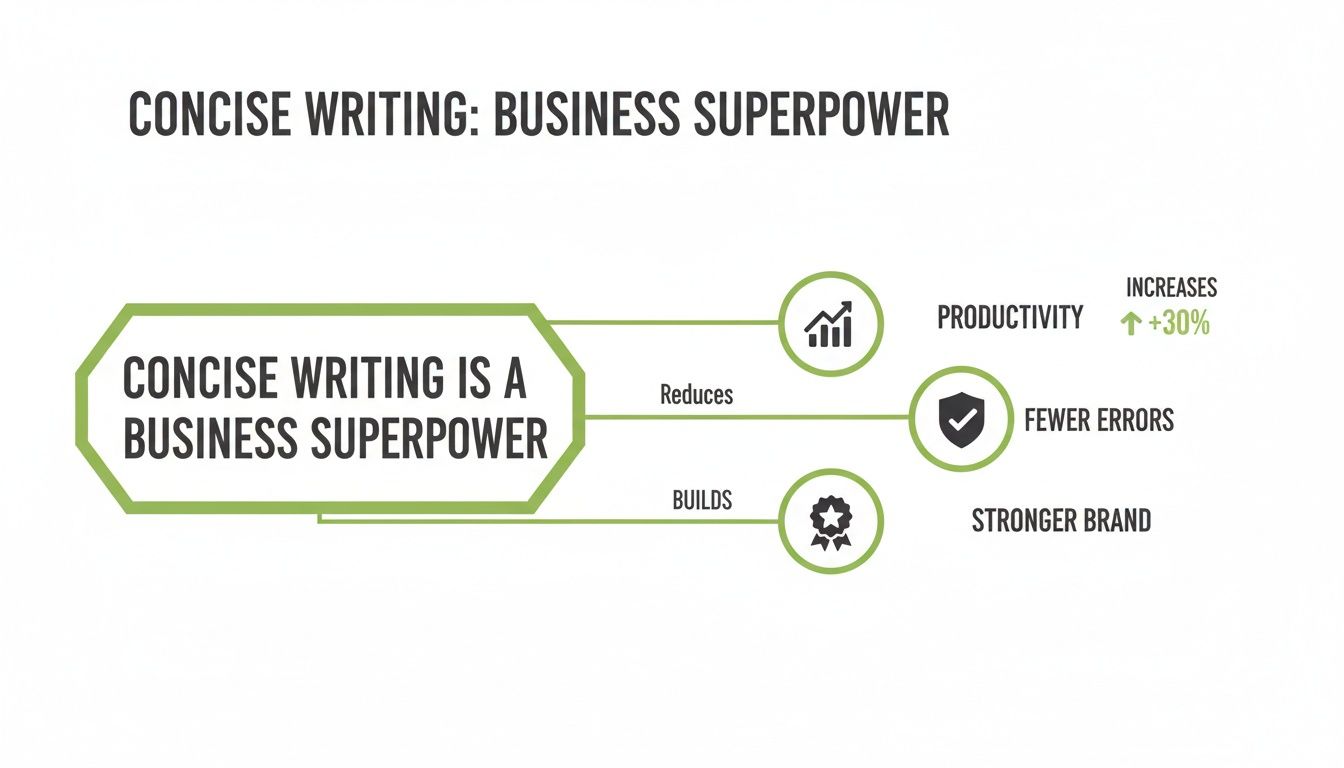
As you can see, cutting the clutter pays off in a big way.
Target and Remove Filler Words
Filler words are the "ums" and "ahs" of writing. They slip into our sentences but add almost zero meaning. Words like just, really, actually, basically, and very often make your statements sound weaker, not stronger.
- Before: I just wanted to basically say that the report is really good.
- After: The report is excellent.
See how much more confident and direct that is? Removing them is an instant upgrade. For a deeper look at strengthening your sentences, check out our guide on how to rewrite a sentence for more impact.
The rule is simple: if a word doesn’t serve a purpose, cut it. Challenge every single word to justify its place in the sentence.
This is especially true for professional documents. For instance, when it comes to your resume, knowing what to leave out is just as important as what you put in. Many people struggle with cutting your resume for conciseness, but it’s a non-negotiable skill in a world drowning in information.
Eliminate Redundant Pairs
Redundant pairs—also known as tautologies—are phrases where two words mean the exact same thing. We use them all the time when we talk, but in writing, they just create noise. Think of phrases like "final outcome," "past history," or "unexpected surprise."
You can almost always chop one of the words without losing a single drop of meaning.
- Before: The final outcome of the project was an unexpected surprise.
- After: The project's outcome was a surprise.
It’s about saying what you mean, and only what you mean. The Plain English Campaign has been championing this idea for decades, pushing for straightforward language that everyone can understand. The core of their philosophy? Kill the redundancy.
Switch from Passive to Active Voice
The passive voice is a classic conciseness killer. It often makes sentences longer and more convoluted by flipping the natural order of who did what. Switching to the active voice is one of the quickest and most effective ways to make your writing sharp and clear.
- Passive: The report was written by the marketing team. (8 words)
- Active: The marketing team wrote the report. (6 words)
The active version isn't just shorter—it's more direct and has more energy. It puts the person or thing doing the action right up front, which makes your writing easier to follow. A good habit is to scan your drafts for words like "was" and "by" to quickly spot and fix passive constructions.
Actionable Techniques for Writing Concisely
Knowing your writing is wordy is one thing. Actually fixing it is another. The best way to write concisely isn't just about deleting words during the editing phase; it's about building stronger habits from the first draft.
Think of it as choosing the right tool for the job. You could use a dozen clunky phrases to get your point across, or you could use one sharp, precise sentence. This isn't just a stylistic preference—it's a professional necessity. In fact, while two-thirds of employees write for their jobs, only about 37% feel they get useful feedback to improve. That's a huge gap where sharp, concise writing can give you an edge.
Here are a few techniques to get you started.
Swap Weak Adverbs for Strong Verbs
This is one of the fastest ways to add punch to your sentences. Adverbs like very, really, and extremely are often just propping up a weak verb. Instead of adding a modifier, find a single, powerful verb that does all the work.
Before: The CEO spoke very angrily about the quarterly losses.
After: The CEO railed against the quarterly losses.
Before: She walked quickly across the stage.
After: She strode across the stage.
See the difference? The "after" versions are shorter, more vivid, and carry more weight. It's a key skill, especially when you need to learn how to write a summary and every word counts.
Turn Stuffy Nouns Back into Verbs
Have you ever read a sentence that feels like it’s wading through mud? It’s probably full of nominalizations—verbs that got turned into clunky nouns, usually ending in -ion, -ment, or -ance. These "zombie nouns" suck the life out of your writing.
The fix is simple: find the action hidden inside the noun and turn it back into a verb.
Before: The team will conduct an investigation into the issue.
After: The team will investigate the issue.
Before: We need to make a determination about the budget.
After: We need to determine the budget.
This one change instantly makes your writing more direct and energetic. It's a secret weapon for crafting impactful marketing copy, where clarity is everything.
Common Writing Flaws and Their Concise Solutions
Spotting these common issues in your own writing is half the battle. This table breaks down a few frequent offenders and gives you a clear strategy for fixing them.
| Writing Problem | Example of the Problem | Concise Solution Technique |
|---|---|---|
| Nominalizations | "We need to have a discussion about the report." | Turn the noun back into a verb: "We need to discuss the report." |
| Passive Voice | "The decision was made by the committee." | Make the subject perform the action: "The committee made the decision." |
| Redundant Phrases | "The final outcome was unexpected." | Remove the repetitive word: "The outcome was unexpected." |
| Weak Verb + Adverb | "He ran very quickly to the store." | Use a single, stronger verb: "He sprinted to the store." |
| Filler Words | "Basically, I think we should probably reconsider." | Cut unnecessary words: "I think we should reconsider." |
Keep these solutions in mind as you edit, and you’ll start to see your writing become much sharper.
Lead with the Main Point
Don't bury the lede. Your readers are busy and want the important information upfront. Get right to the point in your first sentence, then use the rest of the paragraph to add context or supporting details.
This "front-loading" approach forces you to be clear about your core message from the very beginning. Instead of building up to a big reveal, state your conclusion plainly and then explain how you got there. It respects your reader’s time and makes sure your message lands, even if they’re just skimming.
Conciseness in Digital Content and Marketing
In the digital world, attention is the only currency that matters. Every scroll, click, and share is a tiny transaction, and your audience has a very limited budget. This is where the old-school rule of conciseness becomes a non-negotiable tool for anyone creating content online.
Clarity and brevity are everything. When someone is scrolling through their social media feed, they make a split-second decision: stop or keep moving. A bloated, rambling post never stood a chance.
Think of concise writing as the engine behind all effective digital communication. It’s what powers the email subject lines that actually get opened, the social media captions that stop the scroll, and the web copy that turns visitors into customers.
Driving Performance with Fewer Words
Every piece of digital content you create has a job to do—generate a lead, make a sale, build brand awareness. Unnecessary words just create friction. They slow the reader down and give them a reason to click away.
Getting straight to the point removes those roadblocks.
This direct approach has a real, measurable impact on performance. Shorter, clearer calls-to-action almost always get higher click-through rates. Web pages with scannable, punchy copy tend to have lower bounce rates and keep people around longer.
When your message is delivered with precision, its value becomes immediately apparent. You're not just saving the reader time; you're making it easier for them to understand why they should care and what action they should take next.
This is exactly why the demand for sharp, effective writing keeps climbing. The global copywriting services market was valued at around $25.29 billion in 2023, largely driven by the need for powerful short-form content.
With projections showing it could grow to over $42.22 billion by 2030, the financial incentive for mastering conciseness is crystal clear. You can dig into more data on the value of professional copywriting to see how this trend is shaping the entire industry.
Practical Applications in Digital Marketing
So, what does this look like in the real world? Concise writing isn't just some abstract theory; it's a daily discipline for successful marketers.
- Email Marketing: Subject lines have to be punchy, often under 50 characters, to avoid getting cut off on phones. The email itself should lead with the most important information right away.
- Social Media: Captions need to grab attention in the first line or two. Using short sentences, bullet points, and obvious calls-to-action makes a post far more digestible and shareable.
- Website Copy: Headlines and subheadings must communicate value instantly. Product descriptions should skip the jargon and focus on benefits, using active language to persuade people quickly.
In every case, the goal is the same: deliver maximum impact with minimum words. Learning what conciseness is in writing isn’t just about tweaking your style—it’s about boosting your campaign’s ROI and getting real results.
A Few Common Questions About Writing Concisely
Once you start trying to write more concisely, a few questions pop up right away. It's totally normal to worry that cutting words will strip the personality out of your writing or, worse, make you sound like a jerk.
Let's clear up some of the most common concerns so you can edit with confidence. The goal is to be both efficient and effective, not just blunt.
How Can I Be Concise Without Sounding Rude?
This is probably the #1 concern people have, especially in professional settings. You need to send a quick email or a Slack message, but you don't want to come across as abrupt or dismissive.
The trick is to separate being concise from being curt.
Conciseness is about ditching unnecessary words, not essential courtesies. You can still be friendly and polite.
- Curt: "Report is late. Send it now."
- Concise but polite: "Hi team, just a reminder that the Q3 report is now past due. Please send it over as soon as you can. Thanks!"
The second one gets straight to the point but keeps a respectful, professional tone. You're cutting the fluff, not the warmth.
Is Conciseness Always the Right Goal?
Honestly? No.
While it’s a powerhouse for most business, technical, and web writing, some situations need a different touch. Context is everything.
A legal contract, for example, needs exhaustive language to close every possible loophole, even if it makes the document a bear to read. And a novelist uses rich, descriptive language to build a world and make you feel something—slashing all those "extra" words would gut the story.
As a rule of thumb, match your style to what your audience needs and what the document is for. When it comes to reports, emails, and web copy, conciseness is almost always king. For creative writing or emotional storytelling, you have more room to breathe.
What's the Best Way to Maintain My Tone?
Your writing voice is so much more than word count. It’s in your word choices, your sentence rhythms, and the overall feel of the text.
To keep your tone intact while you trim, focus on a couple of things.
First, lean on strong verbs and specific nouns. They inject personality and clarity at the same time. Second, mix up your sentence lengths. A few short, punchy sentences paired with slightly longer (but still clear) ones feels much more natural and human.
And here’s a simple trick: read your work out loud. You’ll immediately hear where things sound robotic, or where your editing made the tone a little too harsh. Then you can go back and tweak a word or two to sound more like yourself while keeping the message sharp.
Ready to make every word count? Natural Write is a free tool that helps you refine AI-generated text into clear, humanized writing. It polishes your drafts for conciseness and clarity without losing your unique voice. Try it now at naturalwrite.com.