

Think about the brands you love to follow online. What makes you stop scrolling and actually read their posts? It’s probably not just what they’re selling—it’s how they talk. That unique personality they bring to every caption, tweet, and reply? That’s their social media tone of voice.
It’s the special sauce that makes a brand feel less like a faceless company and more like someone you genuinely want to connect with.
What Is Social Media Tone of Voice and Why It Matters

Imagine your brand walked into a room. How would it speak? Would it be the witty friend cracking jokes, the thoughtful mentor offering sage advice, or the industry expert speaking with calm authority? That personality is the core of your social media voice.
Without a consistent voice, your posts can feel jarring and disconnected, leaving your audience confused. One day you’re serious and professional, the next you’re dropping memes and slang. This inconsistency erodes trust. But when your voice is clear and steady, you turn a simple feed into a real community.
It’s All About Human Connection
In a sea of endless content, a distinct personality is what helps you stand out. It’s what builds an emotional connection that algorithms can't manufacture, making your brand instantly recognizable in a crowded feed. If you want a deeper dive into the basics, this guide on what is brand voice and how to define your brand tone is a fantastic starting point.
This human touch isn’t just a "nice to have" anymore—it's what people expect. Consumers are tired of corporate jargon and polished, robotic messaging. In fact, a whopping 78% of people prefer brands that sound human. They want to interact with brands that feel authentic, empathetic, and real. That’s how you build lasting trust.
A consistent brand voice isn’t about being perfect; it’s about being predictable in a good way. Your audience learns what to expect, which builds trust and makes them feel like they truly know you.
When you get your social media tone right, you unlock some powerful benefits:
- Builds Trust and Recognition: Consistency makes you feel familiar and reliable. When people know what to expect from you, they’re far more likely to trust what you have to say.
- Fosters a Real Community: A relatable voice doesn't just talk at people; it invites them into a conversation. Your feed becomes a place where followers feel comfortable sharing their own thoughts and ideas.
- Sets You Apart from the Crowd: In a market full of look-alikes, your unique voice is often your strongest differentiator. It’s what makes you memorable long after someone has scrolled past your post.
The Building Blocks of a Memorable Brand Voice

Nailing your social media voice isn't as simple as picking one adjective like "friendly" and calling it a day. Think of it more like a recipe. A truly unforgettable voice is a careful blend of specific ingredients that, when combined, create a personality your audience instantly recognizes and loves.
To get that recipe right, you need to understand the four core components that give your voice its unique character and flavor.
Word Choice: The Language You Use
The words you pick are the most direct signal of your brand's personality. This is about more than just vocabulary; it’s about the specific flavor of your language. Are you buttoned-up and professional, or do you lean into casual slang and abbreviations?
Your word choice immediately sets the vibe. A brand trying to connect with Gen Z on TikTok might drop an "iykyk" (if you know, you know) into a caption. On the other hand, a financial services firm on LinkedIn will use more formal language to project authority and build trust. Every word has a job to do, so make them count.
Personality Traits: Who Your Brand Is
If your brand walked into a room, how would people describe it? Pinpointing a few core personality traits is the secret to staying consistent. These traits become your brand’s north star, guiding how you react, what you share, and the way you talk to people.
Get specific. Instead of a bland word like "nice," dig deeper. Are you:
- Witty and Sarcastic? Think of Wendy's legendary roasts on X.
- Nurturing and Supportive? Like a wellness brand offering a gentle, encouraging word.
- Passionate and Mission-Driven? Patagonia’s voice is inseparable from its fierce environmental activism.
- Authoritative and Educational? A B2B software company that makes complex topics feel simple.
These traits are the difference between sending a funny GIF and a formal, empathetic message in a customer service exchange.
A brand's personality isn't just about being funny or serious. It's about being consistently yourself. Authenticity in your chosen traits is what builds a loyal following that feels a genuine connection to your brand.
Sentence Structure and Cadence: The Rhythm of Your Voice
The way you build your sentences has a huge impact on how your message lands. This is your cadence—the rhythm and flow of your writing. Short, punchy sentences feel energetic and urgent, making them perfect for a platform like X.
In contrast, longer, more descriptive sentences can communicate thoughtfulness and depth, which works wonders for an educational Instagram carousel or a LinkedIn article. Mixing up your sentence lengths keeps your content from feeling flat and helps you emphasize key points, making your writing far more dynamic and engaging.
Emotional Intent: What You Want People to Feel
Finally, always ask yourself: what emotion do I want to leave my audience with? Your intent is what shapes the entire mood of your content. You’re not just posting; you’re trying to evoke a specific feeling.
For example, you might want to:
- Inspire: By sharing a powerful success story or a motivational quote.
- Entertain: With a perfectly timed meme or a hilarious, relatable anecdote.
- Educate: By breaking down a complex idea into simple, actionable steps.
- Reassure: With a calm, clear, and supportive response to a customer concern.
By being deliberate about your emotional goal, you ensure your social media tone of voice not only reflects your brand but also meets your audience where they are. Checking out different brand voice examples can provide excellent inspiration for how to pull all of these elements together.
How to Define Your Unique Social Media Voice
Finding a memorable social media voice isn't something that just happens. It’s a deliberate process, a bit like an archaeological dig into your own brand. Let's walk through a framework that will take you from fuzzy ideas to a real, functional voice your whole team can use to create consistently great content.
Think of it as building your brand’s personality from the ground up. You want to make sure it’s true to your mission and genuinely connects with the people you’re trying to reach. The goal is to get past generic adjectives and create a practical guide for how you talk to the world.
Start with Your Core Brand Values
Before you even think about writing a tweet, you have to look inward. Your social media voice has to be a genuine extension of your brand's mission and what you stand for. If your brand were a person, what would they believe in? What principles would guide them?
Jot down three to five core values that are the absolute foundation of your brand. Are you innovative? Community-focused? Playful? These values are your anchor. They stop you from chasing every fleeting trend and keep your voice authentic. Every post, comment, and caption will be built on this foundation.
Audit Your Existing Content
Alright, time for a little honest self-reflection. Gather up a bunch of your recent social media posts, blog articles, and even customer service emails. Read them out loud. Seriously. Then ask yourself a few questions:
- Does this sound like one consistent person? Or does it feel like a different writer took the wheel every day?
- How did people respond? Zero in on the posts with the best engagement. What was the tone and language you used there? What did you do right?
- Where are the disconnects? Find the content that just felt flat, off-brand, or didn't land with your audience. This audit isn't about judgment; it's about figuring out your starting point.
This kind of forward-thinking is more important than ever. By 2026, success on social media will hinge more on building a real community than just chasing viral hits. Brands that establish trust with a human tone will be the ones that thrive as these platforms become the go-to spots for search and decision-making. You can find more insights on these upcoming social media trends at Slate Teams.
Listen to Your Audience
You can’t figure out your voice in a vacuum. You absolutely have to understand the language your target audience actually uses day-to-day. Spend some time in the comments section of your own posts, read customer reviews, and lurk in the forums or subreddits where your ideal customers are already hanging out.
Pay attention to their slang, their sense of humor, the questions they ask, and what they complain about. The point isn't to copy them, but to understand their world so you can speak to them in a way that feels familiar and shows you get it. This is especially useful for things like crafting effective holiday captions for Instagram, where getting the tone just right can make a huge difference.
The "This, Not That" Framework
One of the most effective ways to sharpen your tone is by using the "We are ___, but we are never ___" framework. It's brilliant because it adds nuance and draws clear lines in the sand.
- We are witty, but never snarky.
- We are confident, but never arrogant.
- We are helpful, but never patronizing.
- We are casual, but never sloppy.
This simple exercise takes vague ideas and turns them into crystal-clear guidelines. It creates a solid foundation for your entire social media tone of voice and gives your team the guardrails they need to be creative without straying from the brand's core personality.
Adapting Your Tone Across Different Platforms
A strong social media tone of voice isn't a rigid script you read from; it’s more like a core personality that knows how to read the room. Think of it this way: you speak differently to your boss than you do to your best friend, even though you’re still the same person.
Adapting your brand’s tone for different platforms works the same way. You’re not changing who you are, just how you show up to the conversation.
This is a critical step because each social platform has its own unwritten rules, etiquette, and audience expectations. A professional, data-heavy post that works wonders on LinkedIn will likely fall flat on the fast-paced, entertainment-driven feed of TikTok.
Failing to adapt makes your content feel out of place and can signal to users that you just don’t “get” the platform’s culture. The goal is to maintain your core brand voice while adjusting your tone to feel native to each environment.
Fine-Tuning Your Voice for Each Channel
So, how does a brand show up authentically on the major platforms without losing its identity? Let's break it down.
LinkedIn: The audience here is in a professional, career-oriented mindset. Your tone should be more polished, authoritative, and insightful. Focus on industry trends, company milestones, and educational content that provides real value.
Instagram: This is a highly visual platform where storytelling and aesthetics rule. Your tone can be more aspirational, creative, and personal. Use longer, descriptive captions for carousels and a friendly, engaging tone in your Stories to build community.
X (formerly Twitter): Speed and brevity are everything here. The tone is often witty, timely, and conversational. Your brand can be more reactive, joining real-time conversations with short, punchy statements, questions, or a bit of humor.
TikTok: This platform is all about entertainment, authenticity, and trends. The tone should be casual, fun, and often self-aware. Overly polished or corporate content gets ignored, so lean into a more human, unscripted feel.
This handy cheat sheet sums up the different approaches.
Platform Tone of Voice Cheat Sheet
| Platform | Primary Audience Mindset | Recommended Tone | Content Focus |
|---|---|---|---|
| "How can I grow my career/business?" | Authoritative, Polished, Insightful | Industry analysis, company news, professional advice, case studies | |
| "Show me something beautiful, interesting, or inspiring." | Creative, Aspirational, Personal | High-quality visuals, behind-the-scenes stories, community features | |
| X (Twitter) | "What's happening right now?" | Witty, Reactive, Conversational | Real-time commentary, quick takes, polls, breaking news, customer service |
| TikTok | "Entertain me, make me laugh, or teach me something new." | Casual, Authentic, Playful | Trends, user-generated content, humor, quick tutorials, relatable skits |
Remember, this isn't about creating four different personalities. It's about letting different facets of your one core personality shine, depending on the context.
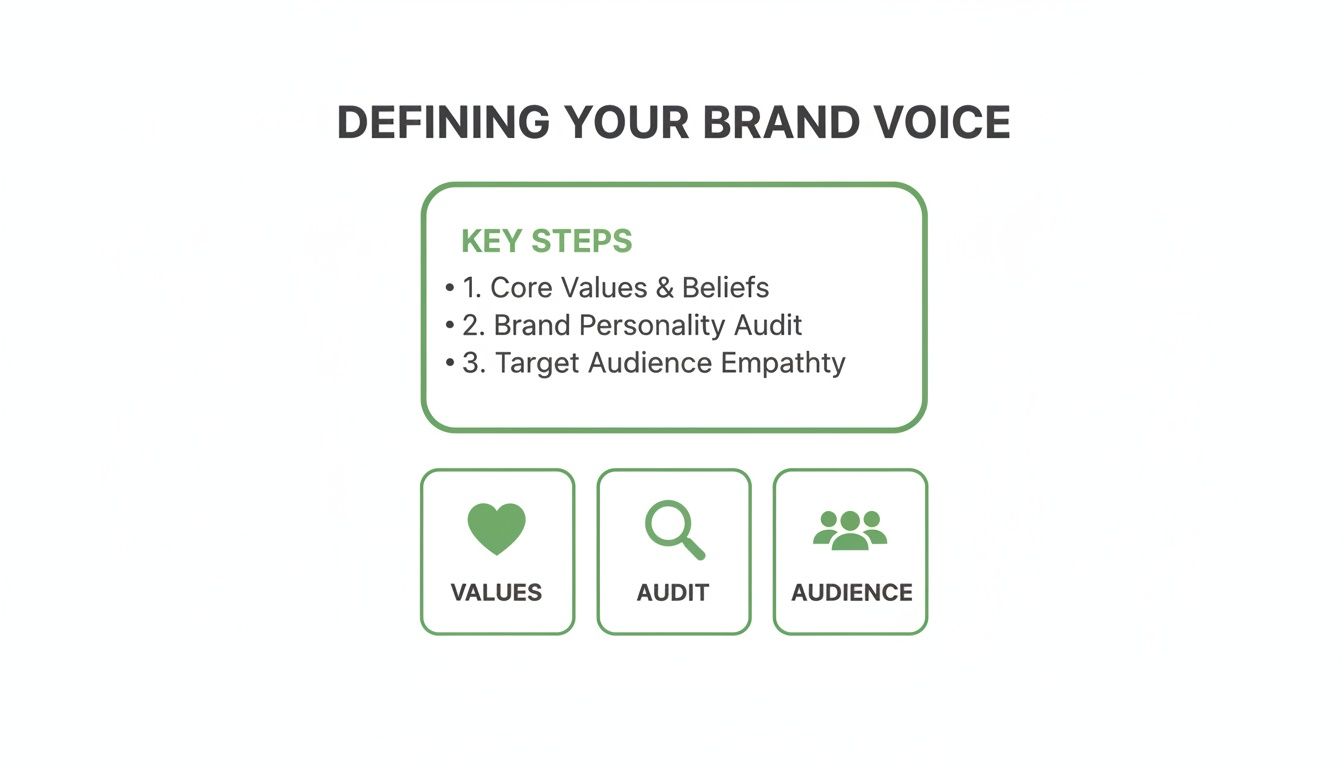
This process—grounding your voice in your values, personality, and audience understanding—ensures your core identity remains consistent. It gives you a solid foundation for all those platform-specific tweaks.
Why This All Matters
Ultimately, adapting your social media tone of voice boosts engagement because it respects the user’s context. People are on LinkedIn to network, not to watch dance challenges. They're on TikTok for a laugh, not to read a whitepaper.
The data backs this up. According to research from Hootsuite, simply tailoring your content format on LinkedIn can make a huge difference, with multi-image posts hitting a 6.6% engagement rate and videos reaching 5.6%.
By fine-tuning your tone, you ensure your message not only reaches people but truly resonates, no matter where they happen to be scrolling. For more ways to keep your audience hooked, check out our guide packed with effective social media content ideas.
How to Maintain Consistency and Measure Impact
Defining your social media tone of voice is like writing the first draft of a script. The real magic, though, happens when your team performs it consistently every single day. Without a clear plan, your brand’s personality can easily fracture, especially as your team grows and more people get their hands on the keyboard.
The cornerstone of consistency is a living, breathing style guide. This isn't just a document with a few buzzwords; it's a practical manual filled with concrete "dos and don'ts," sample posts, and clear guidance on everything from emoji use to navigating tricky customer complaints. Think of it as your brand's playbook—a central source of truth for every person who posts.
To get everyone on the same page, you need to bake this playbook into your team's habits.
Keeping Everyone in Sync
- Simple Training Rituals: Don't just email the guide to new hires. Walk them through it. Hold quick, regular check-ins to review recent posts and make sure everyone is still aligned.
- Smart Workflows: A simple peer review can work wonders. Before a post goes live, have a second set of eyes give it a quick once-over. They can easily spot when the tone feels a little off-brand.
This internal work is what ensures your brand presents a unified front to the world, building the recognition and trust you've worked so hard for.
Measuring What Truly Matters
So, how do you know if your voice is actually connecting with people? Likes and follower counts are fine, but they don't tell the whole story. To measure the true impact of your tone, you have to dig into the qualitative data—the stuff that reveals how people feel about your brand.
Start by really reading the language in your comments, DMs, and mentions. Are people using positive, enthusiastic words? Are they sharing your content with captions that reflect your brand’s personality? This kind of sentiment analysis is a powerful clue that you're building a real emotional connection.
Look beyond vanity metrics. The goal isn’t just to be seen; it’s to be felt. A high engagement rate is good, but a comment section filled with genuine, positive conversation is even better.
Next, pay attention to engagement ratios, not just raw numbers. A post with fewer likes but a high number of thoughtful comments and shares often signals a much deeper connection. This is the feedback loop that matters. By listening closely to these qualitative signals, you can fine-tune your social media tone of voice over time, ensuring it continues to hit the right notes with your community.
For more guidance on creating these essential documents, explore our detailed post on building effective brand voice guidelines.
Got Questions About Social Media Tone of Voice?
Figuring out the finer points of a social media tone of voice can feel tricky, especially when you're aiming for perfection. Let's dive into some of the most common questions and sticking points that pop up for marketers and brand builders.
These are the practical hurdles that usually appear after the big-picture strategy is done. Nailing these details is what will make your brand voice truly effective.
How Can I Find My Tone of Voice If My Brand Is New?
Start by picturing your ideal customer. Seriously, who are they? What do they talk about, what do they care about, and what's their communication style? A great way to do this is to see which other brands they already follow and love—and don't just stick to your direct competitors. This isn't about mimicking them, but about understanding the world they live in and the conversations they’re already enjoying.
Then, turn the focus inward. What are your brand's core values? Are you a trailblazer, or are you the reassuring expert? Your tone of voice needs to connect your brand’s reason for being with your audience's daily life. Try to lock in three to five personality words that capture your brand's essence (like "Witty, insightful, and encouraging") and use them as your North Star. Don't worry about getting it perfect on day one; your voice will sharpen as you start posting and getting real feedback.
What Is the Biggest Mistake Brands Make with Tone of Voice?
The number one mistake, hands down, is inconsistency. One day a brand is buttoned-up and professional, and the next it's dropping memes and slang like a teenager. This kind of personality whiplash doesn't just confuse people; it chips away at the trust you're working so hard to build. This usually happens when there's no central style guide for the team to rally around.
Another classic blunder is chasing trends that have nothing to do with the brand's actual identity. Just imagine a sophisticated, high-end fashion label suddenly adopting a sarcastic, snarky persona. It would feel completely fake and would almost certainly turn off the very people they want to attract.
Authenticity and consistency are the twin pillars of a powerful brand voice. Without them, even the most creative content strategy will fail to connect on a human level.
Can I Use AI for Social Media and Still Sound Human?
Absolutely, but with a major catch: you need a strong human editor in the driver's seat. AI tools are fantastic for kickstarting ideas, churning out first drafts, and smashing through writer's block. They can be a massive time-saver.
The problem is, raw AI output almost always lacks the quirks, the specific nuances, and the genuine emotion that make a voice feel real. The best way to work is to let AI handle the heavy lifting, then have a human come in to edit heavily, injecting the brand’s unique personality using your style guide. Think of AI as your prep cook—it gets all the ingredients ready, but the chef is the one who adds the secret sauce that makes the dish memorable.
If you're using AI to draft your social media content, ensuring it sounds genuinely human is the final, crucial step. Natural Write transforms robotic-sounding text into clear, engaging language that connects with your audience and bypasses AI detection. Try Natural Write for free and give your content an authentic voice.