

Writing a case study analysis is about more than just summarizing the facts. Think of yourself as a detective and a strategist. Your job is to apply theoretical knowledge to a real-world scenario, pinpoint the core problem, and then build a rock-solid case for your proposed solution.
It all comes down to building a logical argument, backed by the evidence you find within the case itself.
Understanding What Your Professor Actually Wants
Before you even think about writing, you need to decode the assignment. A case study isn't a book report. It’s a critical thinking workout designed to see if you can diagnose complex problems, weigh the evidence, and make smart judgments.
Your professor doesn’t want a play-by-play of what happened. They want you to dig into the why—why did this happen, and what should be done about it now?
This kind of assignment is a staple in so many programs for a reason. In fact, over 65% of graduate-level business and social science courses use them, and that number climbs to over 80% in top business schools. The analyses that earn the best grades always do one thing well: they connect the dots between theory and reality.
Differentiating Description from Analysis
This is the number one trap students fall into: they describe instead of analyze. A descriptive paper just retells the story, listing events as they occurred. An analytical paper uses those same events as evidence to support a larger argument.
It’s the difference between these two approaches:
- Description says: "The company's sales fell by 15% in the third quarter."
- Analysis asks: "What specific decisions and market shifts caused that 15% drop? And what does this tell us about the company’s competitive weakness?"
To get a better feel for the kind of thinking required, it helps to understand what a case study interview entails. The mindset is nearly identical. You’re acting as a consultant. The company already knows the facts; they hired you for your expert diagnosis and a clear plan of action.
This simple framework illustrates the first crucial steps in your thinking process.
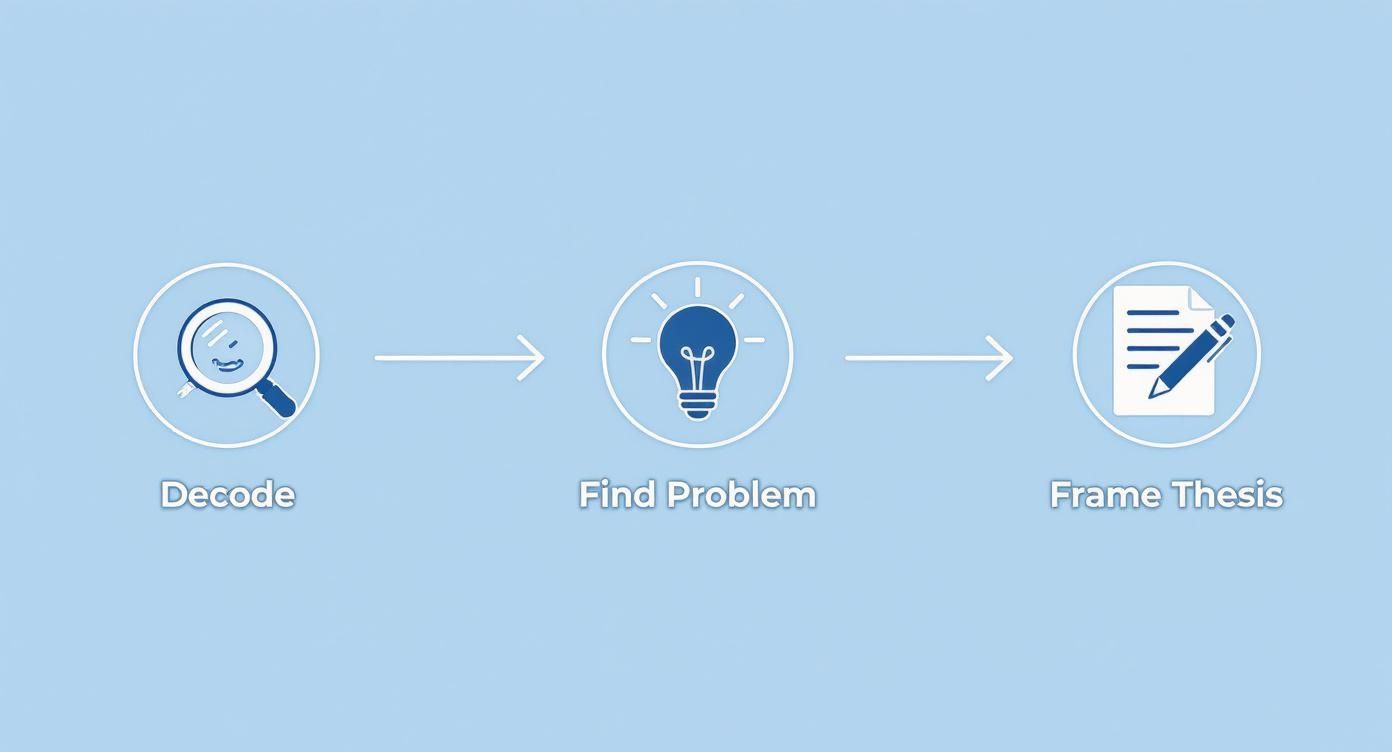
Starting this way forces you to move from just reading the case to actively solving its central puzzle.
To really nail this, it helps to see the difference between an average paper and a top-scoring one. I've broken down the key components below based on common grading rubrics.
Anatomy of a High-Scoring Case Study Analysis
| Component | Average Analysis (C-Grade) | Excellent Analysis (A-Grade) |
|---|---|---|
| Problem Framing | States the obvious problem mentioned in the case. | Identifies a deeper, underlying strategic problem the company might not even see. |
| Use of Evidence | Lists facts and figures directly from the case text. | Synthesizes data from multiple parts of the case to support a specific argument. |
| Application of Theory | Mentions a relevant framework (e.g., SWOT) but doesn't fully apply it. | Uses a framework to generate genuine insights that drive the final recommendations. |
| Argument Structure | The paper reads like a summary with recommendations at the end. | The entire paper is a cohesive argument, with each section building on the last. |
| Recommendations | Suggests generic solutions like "improve marketing." | Proposes specific, actionable, and justified recommendations with potential risks noted. |
Thinking about these distinctions from the very beginning will help you stay on the right track and focus your efforts on what truly matters.
Key Takeaway: Your goal isn't to prove you've read the case. It's to prove you understand it. Frame your entire analysis around one central problem, and make every single section work to build your argument toward a powerful, defensible conclusion.
Gathering Evidence Like an Investigator
Once you've nailed down the core problem, it's time to put on your detective hat. A killer case study analysis isn't built on gut feelings or vague assumptions—it's built on a bedrock of hard evidence pulled straight from the case. This is where you shift from being a passive reader to an active investigator.
Think of the case document as your crime scene. Every scrap of information—a line from a financial statement, a manager's quote, a product launch timeline—is a potential clue. Your job is to sift through it all, organize what you find, and get ready to build a rock-solid argument. This means you need to read with a purpose.

Adopt Active Reading Techniques
Just skimming the text won't cut it. You have to really get in there—question the material, challenge it, and pull out the key facts as you go. Your first read-through is just to get the lay of the land. It's the second and third passes where the real investigation happens.
Here are a few practical ways to do this:
- Highlight with a system: Don't just paint paragraphs yellow. Use different colors for different things. Maybe one for financial data, another for quotes from key players, and a third for major events or decisions.
- Talk back in the margins: Scribble questions and initial thoughts as they pop into your head. If a CEO's statement on page two seems to clash with a data table in the appendix, make a note of it.
- Start a "fact sheet": Keep a running list of the most critical pieces of evidence on a separate document. Jot down dates, revenue figures, market share numbers, and powerful direct quotes.
Doing this forces you to internalize the details and helps you start connecting the dots. The case transforms from a flat story into a dynamic set of evidence you can actually work with.
Triangulate Your Data for Stronger Claims
One piece of data is a hint. Multiple pieces of data all pointing to the same conclusion? Now that’s an argument. This is the idea behind triangulation—you cross-reference information from different parts of the case to see if your insights hold up.
For example, if the intro mentions sagging customer satisfaction, go hunt for proof. Can you find it in the sales figures? In interview notes? In market research data buried in an appendix?
This is how you build credibility. In fact, a major review of academic methods found that over 75% of top-tier case studies used at least three different data sources to make their case. The very best ones averaged 3.7 sources per case. It's a clear signal: don't hang your entire argument on a single piece of evidence. You can dig deeper into this by exploring research on data triangulation in case studies.
When you can back up your claims with multiple pieces of evidence, you shift from saying "I think..." to "The evidence shows..." It’s a game-changer.
Pro Tip: Don’t just look at what's in the case—pay attention to what isn't. Sometimes the biggest clue is a piece of missing information. If a company is supposedly struggling with morale but there are zero details from HR or any employee surveys, that absence is a powerful piece of evidence in itself.
Filter Out the Noise
Heads up: not every detail in the case is going to be useful. Many cases are intentionally stuffed with "noise"—irrelevant facts and distracting details designed to test your focus. Your job is to separate the signal from the static.
Keep asking yourself one simple question: "Does this piece of information directly help me understand the main problem?"
If the answer is no, set it aside. A company’s founding date is nice trivia, but it probably doesn't explain why their latest product is tanking. Zeroing in on the core evidence—like product development timelines, marketing spend, and what competitors are doing—is what keeps your analysis sharp and persuasive. This is a critical skill for learning how to write a case study analysis that actually makes an impact.
Choosing Your Analytical Framework
Alright, you've gathered all your evidence and have it neatly organized. This is where the real analysis begins. Raw facts don't tell a story on their own; you need a lens—an analytical framework—to interpret them, uncover what's really going on, and build a powerful argument.
Think of your framework as the engine of your analysis. It provides the structure and logic that turn a pile of observations into sharp, compelling insights. Without one, you're just listing facts. With one, you're building a case.

Connecting Case Facts to Course Concepts
The first place you should look for a framework is right in your course materials. Seriously. The theories, models, and concepts you've been studying weren't just for the midterm. Your professor wants to see you apply them. This is how you show you can bridge the gap between academic theory and a messy, real-world problem.
Flick back through your syllabus and recent lecture notes. Did you just cover a specific model for market entry? A theory on organizational change? If your case touches on those topics, using that specific lens is a straight shot to a top grade.
Applying a course concept shows you're actually engaging with the material, not just grabbing a generic business model off the shelf. It proves you're synthesizing what you've learned.
Selecting a Standard Business Framework
Sometimes, a classic business framework is the most direct way to slice into a case. These models are popular for a reason—they offer a clear, systematic way to organize complex information. The trick is to pick one that actually fits the problem at hand.
Here are a few workhorses and when to pull them out:
- SWOT Analysis (Strengths, Weaknesses, Opportunities, Threats): This is your go-to for a high-level strategic overview. It’s perfect when a case asks for an assessment of a company's internal health and its external environment. Deciding whether to launch a new product? SWOT gives you a balanced picture.
- PESTLE Analysis (Political, Economic, Social, Technological, Legal, Environmental): Pull this one out when the case is getting hammered by big, external forces. A company looking to expand internationally, for example, absolutely needs to analyze the political stability and economic climate of a new market. PESTLE is built for exactly that.
- Porter's Five Forces: This framework is all about industry analysis. If the case requires you to figure out how competitive a market is and why, Porter's Five Forces is your tool. It guides you through the power of suppliers, buyers, and the threat of new competition.
Choosing the right tool is half the battle. You wouldn't use a hammer to saw a board, and you shouldn't force Porter's Five Forces onto a problem about internal company culture.
Justify Your Choice: Don't just dive in. Early on, explicitly state which framework you've chosen and briefly explain why it’s the best fit for this specific case. It’s a simple move that shows you're being thoughtful and deliberate in your analysis.
The Art of Consistent Application
Once you pick a framework, commit to it. Apply it thoroughly and consistently. It’s not a checklist you rush through; it’s the guiding logic for your entire argument. Every point you make should tie back to the components of your chosen model.
For instance, if you're using SWOT, don't just list a few strengths and call it a day. The real work is in analyzing how those strengths can be used to seize the opportunities you've identified. This is how you move beyond simple observation and learn how to write a critical analysis that has real depth.
A well-applied framework keeps your writing structured, logical, and focused. It prevents your paper from becoming a random collection of thoughts and transforms it into a cohesive argument that systematically breaks down the problem and points toward a well-supported solution.
Structuring Your Analysis for Readability and Impact
A brilliant analysis can get completely lost in a messy, disorganized paper. Your structure isn't just a box you stuff your ideas into; it’s what guides your reader through your argument, making your logic crystal clear and your conclusions impossible to ignore.
Think of it this way: the structure is your roadmap. A good one makes the journey from problem to solution feel intuitive and compelling. It also signals to your professor that you know the conventions of academic writing, which instantly adds a layer of credibility to your work. More importantly, it forces you to connect the dots logically, ensuring every piece of your analysis serves a purpose.
The Five Essential Components of Your Paper
A powerful case study analysis almost always follows the same path. This isn't about being boring or formulaic—it's about using a proven blueprint that readers immediately understand. Each section builds on the last, creating momentum that carries your reader right to your final recommendation.
Here’s the standard anatomy of a paper that works:
- The Introduction: This is your hook. Get straight to the point. State the central problem clearly, then deliver your thesis statement—the specific argument or solution you're going to prove.
- Background Summary: Give just enough context to set the scene. Assume your reader is generally familiar with the case but needs a quick refresher on the key facts, people, and events that matter for your specific analysis. Keep it brief and focused.
- Core Analysis: This is the heart of your paper, where you do the heavy lifting. Apply your chosen framework (like a SWOT or Porter's Five Forces) to break down the problem, using hard evidence from the case to back up every single claim.
- Discussion of Alternatives: Show you've thought this through from all angles. Briefly explore one or two other realistic solutions. What are their potential upsides and downsides? This demonstrates critical thinking and makes your final choice seem more robust.
- Final Recommendation: End with a strong, decisive, and actionable recommendation. Circle back to your core analysis to remind the reader why this is the best path forward. It's also smart to acknowledge any potential risks and sketch out a brief implementation plan.
This flow is what turns a collection of interesting thoughts into a persuasive, knockout argument.
Creating a Logical Flow with Headings and Topic Sentences
Your paper's structure should be obvious at a glance. Clear, descriptive headings and subheadings are your best friend here. They act like signposts, telling the reader exactly what's in each section and how it fits into the bigger picture.
Inside each section, it all comes down to the paragraphs. Every paragraph should kick off with a strong topic sentence that states its main idea and connects back to the section's overall point. This simple trick is the glue that holds your argument together. For a deeper look, checking out examples of well-crafted topic sentences for body paragraphs can really sharpen this skill.
Key Takeaway: Structure isn't something you add at the end; it's part of the argument itself. A logical flow guided by sharp headings and clear topic sentences makes your analysis easier to follow and far more convincing.
Looking Beyond Business for Structural Inspiration
The art of building a strong, evidence-based argument isn't unique to business. While case studies have their own specific conventions, the core logic is universal.
For example, learning about the principles of literary analysis can teach you a lot about constructing a narrative around evidence and building a thesis from the ground up. Thinking about structure from a different perspective can make you a much stronger analytical writer, no matter the subject.
Ultimately, your goal is to make it impossible for the reader to get lost. If you outline these key components before you start writing, your hard work will be presented with the force and clarity it deserves.
From Analysis to Actionable Recommendations

This is the moment of truth. You’ve dissected the case, applied your frameworks, and you finally get the problem. Now comes the hard part: turning all that groundwork into recommendations that are practical, persuasive, and actually solve something.
It's tempting to just tack on your solution at the end of the paper, but that's a classic mistake. A truly great case study treats the recommendation section like the climax of a good story. Every piece of analysis you’ve done so far should build toward this final, logical conclusion.
Your goal here isn't just to be smart—it's to offer a plan that feels believable and achievable within the world of the case. This is where your academic exercise transforms into a real-world strategic plan.
Weaving Evidence into Your Narrative
Your recommendations are just opinions until you back them up with hard evidence. You have to seamlessly weave the data, quotes, and facts you gathered earlier into your argument, justifying every single move you propose.
But don't just dump raw data onto the page. That’s lazy. Your job is to interpret it for the reader. Tell them what the numbers mean and why they directly support the path you’re laying out.
For example, don't just state a fact. Frame it with purpose:
- Weak: "The company's market share is 15%."
- Strong: "With a market share of only 15%, the company is dangerously exposed. This makes it urgent to launch a new marketing strategy and claw back ground from key competitors."
See the difference? The second one connects the dots, making your argument feel urgent and powerful. You’re building a case, not just listing facts.
Crafting Recommendations That Are SMART
Nothing sinks a good analysis faster than vague, fluffy suggestions. To keep your plan grounded, use the SMART framework for every recommendation you make. They need to be Specific, Measurable, Achievable, Relevant, and Time-bound.
This simple structure forces you to move beyond generic advice like "improve marketing" and into concrete steps anyone could follow.
Here’s a look at how to turn a weak suggestion into a rock-solid, actionable strategy.
From Weak Recommendation to Actionable Strategy
| Characteristic | Weak Recommendation Example | Strong Recommendation Example |
|---|---|---|
| Specificity | The company should improve its social media presence. | Launch a targeted Instagram campaign focused on video content for the under-25 demographic. |
| Measurability | The campaign should increase engagement. | Aim to increase follower count by 20% and achieve an average engagement rate of 5% per post. |
| Timeframe | This should be done soon. | The campaign will launch in Q3 and run for six months, with bi-weekly performance reviews. |
Putting your ideas into a clear, structured format like this makes them immediately more credible and professional.
Pro Tip: Your recommendations should directly solve the core problem you identified in your intro. If they don't, something's wrong. Either your analysis went off track or your solution doesn't fit. Always double-check that alignment before you finish.
Anticipate and Address Counterarguments
A masterful analysis doesn't pretend it's the only path forward. It acknowledges other options and then explains, with evidence, why they're not as good.
Briefly touch on one or two alternative solutions and use data to expose their weaknesses. This shows you've thought the problem through from multiple angles, which makes your own argument much stronger. It proves your recommendation isn't just some random idea, but the most logical choice after a thorough evaluation.
This kind of critical thinking often starts with how the case itself was selected. A study found that most-similar case designs were used in about 38% of comparative studies, while diverse-case selection was used in 29%. The way you frame the study directly shapes the kind of recommendations that are even possible. You can discover more insights about case selection strategies to get a better handle on these methods.
Justifying Your Final Choice
Okay, this is your closing argument. It's time to build an airtight case for why your solution is the best one on the table. Summarize the key benefits and tie them right back to the data and analysis you've been building all along.
It's also crucial to be realistic about potential hurdles. Acknowledge the risks or challenges of implementing your plan and suggest ways to mitigate them. This adds a layer of practical credibility that professors and bosses love. Think of it like a business proposal; it needs to be as compelling as an executive summary. In fact, knowing how to write an executive summary can give you a huge advantage in presenting your ideas with punch and clarity.
Common Questions About Writing a Case Study Analysis
Even with a perfect outline, you're going to hit a few snags when you're deep in the weeds of an analysis. It’s completely normal. Nailing these little details can be the difference between a good paper and a great one. Let’s walk through some of the most common hurdles I see students run into.
One of the biggest anxieties is always about length. While every assignment is different, most academic case studies are surprisingly concise. We're usually talking about 800 to 1,500 words. The goal isn’t to write a novel; it's to deliver a sharp, focused argument.
Trust me, your professor is looking for quality over quantity. A tight, well-reasoned paper that gets straight to the point will always be more impressive than a long one that waffles on.
How Should I Cite My Sources?
Citation is completely non-negotiable, even if the case packet is your only source. Your professor will almost certainly tell you which style to use—usually APA, MLA, or Chicago. If they don’t, APA is a safe bet for most business and social science courses.
Here’s the stuff you absolutely have to cite:
- Direct quotes you pull from the case text.
- Specific data points, like financial numbers or survey results.
- Paraphrased ideas or key concepts you’re basing your analysis on.
- Any external academic sources you bring in to bolster your argument.
Forgetting to cite properly can look like academic dishonesty, even when it's just an accident. It's a small detail that has a massive impact on your credibility.
What If the Case Has Missing Information?
This is a fantastic question because, a lot of the time, it’s intentional. Instructors use cases with gaps or ambiguity to see how you make decisions with incomplete data—just like you have to in the real world.
So don't panic. Instead, use it to make your analysis even stronger.
Pro Tip: Explicitly point out the missing information and explain how it could affect the situation. For example, you might write, "While the case doesn't provide specific data on employee turnover, the frequent mention of low morale suggests this could be a significant, unmeasured factor in the company's declining productivity."
This move shows you’re not just passively reading the material. It proves you can think critically, identify the limits of the evidence, and consider the implications. That's a key skill when you're learning how to write a case study analysis that really stands out.
Can I Use First Person in My Writing?
This is a style question, and the answer often comes down to your professor's preference. For decades, academic writing stuck to the third person ("the analysis shows...") to sound objective. But these days, using the first person ("I argue that...") is becoming more and more common, and it can make your argument feel more direct and confident.
- Third Person ("the report suggests"): This creates a formal, objective distance from the work. It’s always a safe and professional choice.
- First Person ("I recommend"): This can add a real sense of ownership and conviction to your analysis. It's more direct but can feel less formal to some readers.
If the assignment guidelines are vague, take a look at other readings from the course. If the professor’s own writing is more direct, using "I" is probably fine. When in doubt, though, the formal third person is the safest route.
Ultimately, working through these questions is part of what makes you a better analyst. It shows you're not just trying to finish an assignment—you're genuinely engaging with the material like a pro.
Crafting an analysis that sounds both professional and natural is tough. If your final draft comes out sounding a bit robotic, Natural Write can help. Our platform refines AI-generated or stiff academic text into clear, humanized language that flows smoothly, making sure your great ideas are presented with the clarity and impact they deserve. Transform your writing in one click at https://naturalwrite.com.