So, what’s the real difference between revising and editing? It all boils down to one simple idea: revision is about the big picture, while editing is about the fine details.
Think of it like building a house. Revision is the architect's job. Editing is what the interior decorator does. One builds the foundation, the other perfects the finish. You’d never hire the decorator before the walls are up, right?
Revising vs Editing At a Glance
This table breaks down the core differences, showing how each stage tackles a completely different set of problems in the writing process.
| Aspect | Revising (The Architect) | Editing (The Interior Decorator) |
|---|---|---|
| Primary Focus | Ideas, argument, structure, and clarity | Grammar, style, word choice, and punctuation |
| Goal | To make the writing work on a conceptual level | To make the writing polished and professional |
| Timing | Early stages, after the first draft is complete | Late stages, after the structure is finalized |
Think of revising as shaping the clay, and editing as glazing the finished pot. Both are essential, but they happen in a specific order.
The Architect vs. The Interior Decorator
Let's stick with that house-building analogy for a minute because it’s a powerful way to see the distinction.
When you’re just starting, you hire an architect. Their job is revision. They’re looking at the whole structure and asking the big, important questions:
- Is the foundation solid? (Does my argument actually hold up?)
- Do the rooms flow logically? (Is the paragraph order effective?)
- Does this house do what the owner needs it to do? (Does my writing achieve its main goal?)
At this stage, you might make massive changes. You could knock down a wall, add a new wing, or move the staircase entirely. These are huge, structural shifts that reshape the entire project.
Once the blueprint is solid and the walls are in place, then you bring in the interior decorator. Their job is editing. They aren't worried about moving walls; they accept the structure and focus on making it look and feel perfect. To dive deeper into this part of the process, you can check out our guide on what is content editing.
The diagram below really brings this idea to life, showing the structural focus of revision versus the surface-level polish of editing.
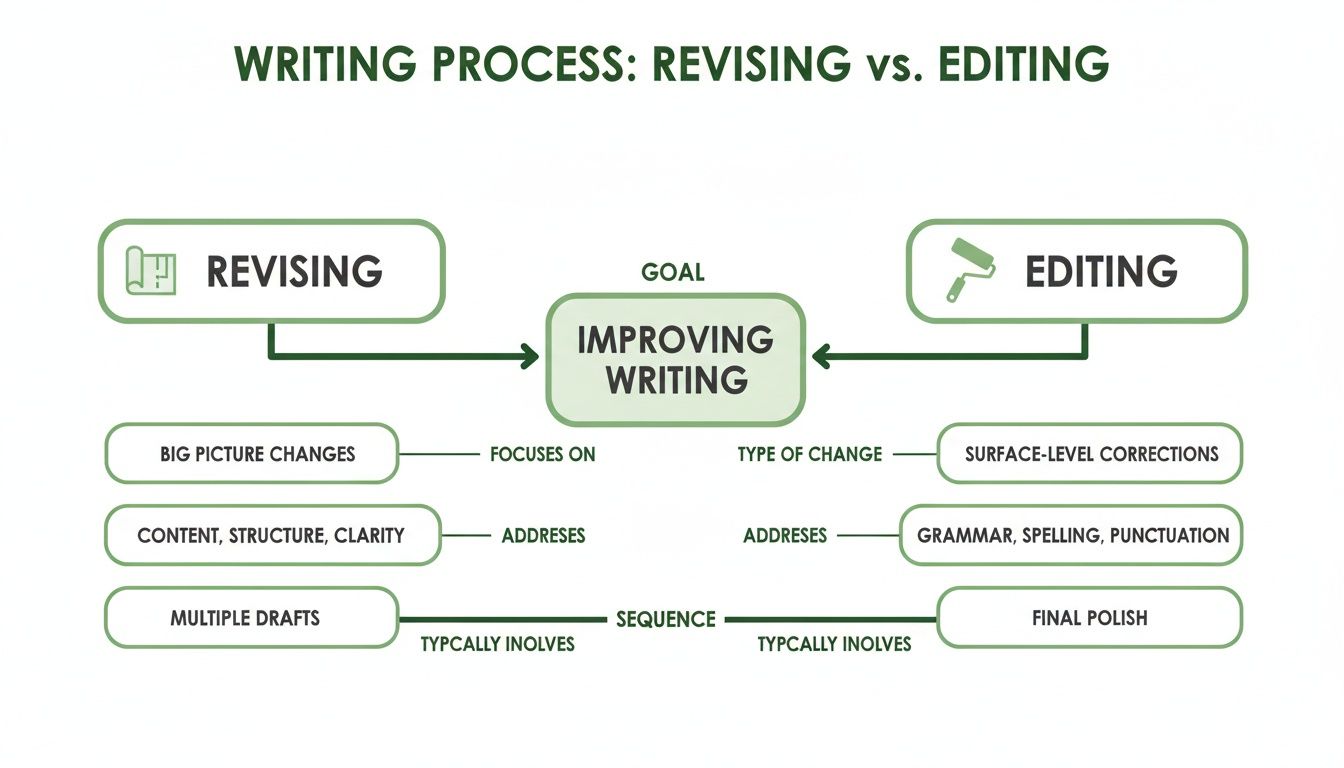
As you can see, revision tackles the heavy-lifting—ideas, organization, and flow. Editing comes later to handle the polish—grammar, style, and word choice. Keeping these two stages separate is the secret to an efficient and much less frustrating writing process.
How to Revise Your Work Like a Pro

Pro writers know a secret: revision isn't about cleaning up typos. It's the creative step where a messy draft actually finds its power. The whole point is to "re-see" your work—to step back and check the architectural plans before you start picking out paint colors.
Forget hunting for grammar mistakes for a minute. Instead, you're asking the big questions. Does my argument actually hold up? Is the structure sound? Will this tone connect with the person I'm trying to reach? This is where good writing becomes great writing.
Start with High-Order Concerns
To revise well, you have to tackle the big-picture stuff first, what academics call "higher-order concerns." It’s a waste of time to polish a perfect sentence in a paragraph that you might end up deleting anyway. Focus your energy where it'll make the biggest difference.
Here’s where to start:
- Thesis and Purpose: Is your main point obvious from the get-go? Does every single paragraph support it?
- Organization and Flow: Do your ideas connect in a way that makes sense? Could you shuffle the paragraphs for a bigger punch?
- Audience and Tone: Are you using the right language for your reader? Does your tone fit the message?
- Supporting Evidence: Are your claims backed up with solid examples, data, or stories?
Revision is the art of seeing the whole forest, not just inspecting individual trees. It's about ensuring the path through the woods is clear, logical, and leads your reader exactly where you want them to go.
Practical Revision Techniques
For a fresh perspective, try reading your draft out loud. Your ears will catch the awkward phrasing and clunky sentences that your eyes might miss. Another killer technique is the reverse outline: jot down the main point of each paragraph on a separate document. This quickly shows you if your logic flows or if you’re repeating yourself.
This focus on the big picture is what separates experienced writers from beginners. In fact, research dating back to the 1980s found that while 75% of student revisions were just simple word changes, professional writers were known to slash up to 25% of their drafts to tighten the structure. You can read more about this on the Texas A&M University writing center blog.
For more hands-on strategies, check out our guide on how to revise an essay like a pro. When you adopt this mindset, revision stops being a chore and becomes one of the most critical parts of creating something worthwhile.
Mastering the Art of Editing Your Prose
So, you’ve revised the big picture. Now it’s time to trade your architect’s hat for an interior decorator’s. Editing is where you pull out the magnifying glass and shift your focus from the overall structure to the nitty-gritty, sentence-level details. This is the final polish that makes your writing shine.
This detailed work has to come after you revise. It’s a classic writing mistake to waste time perfecting the grammar on a sentence you’re just going to delete later. Only when you’re sure the walls are in the right place should you start hanging the pictures.
The real difference between revising and editing is this shift in scale—from the macro view down to the micro. Your job now is to make every single word count.
The Layers of Professional Editing
Editing isn’t just a single pass-through. It’s a layered process, and professional editors usually tackle it in two distinct phases, each with its own goal.
- Line Editing: This is all about the creative quality of your writing. You're looking at rhythm, flow, and impact to make sure every sentence lands with power. It’s what makes your writing not just correct, but truly compelling.
- Copyediting: This part is more technical. Here, you're the detective hunting for errors in grammar, spelling, punctuation, and consistency. This is your last line of defense against mistakes that can tank your credibility.
Editing is what turns a functional draft into a professional piece of work. It’s the stage where you ensure your ideas are not only understood but also felt by the reader.
Actionable Editing Strategies
To edit well, you need to trick your brain into seeing your text with fresh eyes. A classic method is reading your work backward, starting from the last sentence and moving to the first. This completely disrupts the natural flow and forces you to focus on each sentence in isolation, making typos and awkward phrases jump right out.
Using a comprehensive self-editing checklist (https://naturalwrite.com/blog/self-editing-checklist) can give you a structured way to approach this meticulous phase. Ultimately, the goal of both revising and editing is to create something people actually want to read. You can explore more strategies to write engaging content to see how that final polish captivates an audience. By mastering this last step, you make sure your great ideas are delivered with the clarity they deserve.
Building an Effective Writing Workflow

Knowing the difference between revising and editing is one thing. Actually putting that knowledge to work is another. To really save yourself time and headaches, you need a workflow that keeps these two very different jobs in their own lanes.
The single biggest mistake writers make is trying to edit while they draft. It’s a classic trap. You end up stifling your creativity and wasting time perfecting sentences that might get cut entirely during the revision stage.
A structured process lets you focus on the right problems at the right time. By sorting out the big-picture issues first, you build a solid foundation. That makes every step that follows way more efficient.
The Five-Stage Writing Process
Think of this as your roadmap from a messy first draft to a polished final piece. Each stage has just one goal, which keeps you from getting bogged down in the wrong details too soon.
- Drafting: Just get the ideas down. Don't worry about grammar, spelling, or finding the perfect word. The only goal here is to create the raw material you'll shape later.
- Structural Revision: This is where you put on your architect hat. You're looking at the big picture—the core argument, the order of your paragraphs, and the overall flow of your ideas.
- Clarity Revision: Once the structure feels right, read through it again, but this time for clarity. Is your message easy to follow? Is every point backed up with clear evidence?
- Editing: Now you can zoom in. This is the time to polish your sentences, upgrade your word choice, and fix the rhythm of your prose to make it punchy and engaging.
- Proofreading: The final pass. Hunt down every last typo, grammar goof, and punctuation error.
The sequence is everything. Research consistently shows that prioritizing revision over editing leads to dramatically better outcomes. A 2023 study found writers who dedicated significant time to revision scored 27% higher on holistic writing assessments.
Your Writing Workflow Checklist
This checklist breaks the process down into simple, actionable steps. It gives you a clear focus for each stage so you know exactly what you should be working on and when. If you're looking to apply this to a broader content strategy, check out this ultimate guide to a content creation workflow.
Here’s a simple table to keep you on track:
| Stage | Key Tasks |
|---|---|
| Drafting | Write freely, focusing on content, not correctness. |
| Revision | Check thesis, argument strength, and paragraph order. |
| Editing | Improve sentence clarity, word choice, and style. |
| Proofreading | Correct typos, grammar, and punctuation errors. |
Sticking to this deliberate order pays off. A 2021 analysis of widely shared articles found that a staggering 62% of errors came from poor structure, not simple grammar mistakes. It’s a powerful reminder to fix the architecture of your writing before you start decorating the rooms.
How Different Writers Approach This Process
While the core principles of revising and editing are universal, you really see the difference when you watch how various writers put them into practice. The process isn't one-size-fits-all; it changes based on a writer’s goals, their audience, and what they’re trying to create.
Think about a student working on a research paper. Their revision is all about the big picture—the architecture of their argument. They’re asking: Is my thesis strong? Does every paragraph support it? Does this actually meet the requirements of the assignment? Editing comes later, and it’s about polishing the details, like making sure citations are perfect and the language sounds academic.
Now, picture a novelist. Their revision process looks completely different. They’re hunting for plot holes, fixing character arcs, and adjusting the story's pacing. Once the structure is solid, they’ll edit for word choice and dialogue to make their world feel real.
The Impact on Professional Writers
For professional writers, this sequence isn't just a good habit—it’s what drives results. A content marketer’s revision is all about performance. They’re focused on things like hitting target keywords, speaking to a customer’s pain points, and making sure there’s a clear call-to-action.
Once that strategic foundation is in place, they edit for brand voice, clarity, and readability. For them, getting the order right has real financial stakes.
A 2022 report on U.S. self-publishing, for instance, showed that books with multiple rounds of deep revision averaged 41% higher sales than those that only got a simple copyedit. It's not just books, either. Revision-focused blog posts get 37% more shares, proving that a strong structure directly boosts your reach. You can find more on this in the impact of revision at Luminous World Stories.
When you look at these real-world examples, it becomes clear how the same workflow—revise first, edit second—is adapted for any writing task. Whether you’re writing a term paper, a blog post, or a novel, the secret is always the same: nail the big picture before you sweat the small stuff.
Common Questions About Revising vs. Editing
Even after you know the difference, a few practical questions always seem to pop up. Getting these sorted out can save you a ton of frustration and make the whole writing process feel a lot less like a slog. Let's dig into some of the most common hurdles.
At the end of the day, it all comes back to scope. Are you working on the big picture, or are you polishing the fine details? That's the core distinction.
Can I Edit and Revise at the Same Time?
I know it’s tempting, but trying to do both at once is one of the biggest time-wasters in writing. Seriously. Revision is about making huge changes—you might cut entire paragraphs, shuffle the order of your sections, or decide your intro needs a complete do-over.
Imagine spending twenty minutes perfecting the grammar on a single sentence (editing) only to realize you need to delete that whole section later (revision). All that effort just went down the drain. Always, always do the heavy lifting of revising first. Save the sentence-level polish for when you're sure the core content is locked in.
Think of it like this: You wouldn't start hanging pictures and arranging furniture before you’re sure the walls are in the right place. Build the house first, then decorate.
What Is the Difference Between Editing and Proofreading?
This is another classic point of confusion. Editing is all about making your writing better—clearer, stronger, and more persuasive. It’s where you refine your style, nail down the tone, and make sure everything flows smoothly from one idea to the next.
Proofreading is the final, final check. Its only job is to catch the surface-level mistakes that slipped through, like typos, spelling errors, or a weird formatting glitch. Editing is what makes the engine run beautifully; proofreading is the final wash and wax before the car leaves the lot.
How Do I Know When I Am Done Revising?
You're ready to move from revising to editing when you stop making big, structural changes. The key signal is when you feel confident in the draft's foundation and your tweaks become much smaller.
Ask yourself a few quick questions:
- Is my main point impossible to miss?
- Is the flow logical? Can a reader follow my train of thought without getting lost?
- Does every single part of this piece have a clear and necessary job to do?
Once you can answer "yes" to all of these and you find yourself fiddling with words instead of moving paragraphs, you've earned the green light to start editing.
Ready to make your editing process faster and smarter? Natural Write transforms robotic-sounding AI text into clear, humanized prose that bypasses AI detectors with a single click. Refine your drafts and ensure your writing is polished and authentic. Try it free at https://naturalwrite.com.