
So, what exactly is SEO copywriting?
Think of it as the sweet spot where the art of persuasion meets the science of search engine optimization. It’s all about creating content that not only gets a human reader to take action but also gets a search engine to pay attention in the first place.
This dual purpose is key: attract organic traffic from places like Google, and then convert that traffic into actual customers.
Understanding SEO Copywriting: The Art and Science of Ranking

Here’s a simple analogy. Imagine you’re a brilliant chef who makes the best food in town, but you open your restaurant on a deserted backstreet. No matter how incredible your dishes are, almost no one will find you. That's what happens when you have amazing copy without SEO—it's powerful, but it's invisible.
Now, flip that around. Picture a restaurant on a bustling main street, but the menu is bland and forgettable. People will walk in, but they won't stay, and they certainly won't come back. That's SEO without compelling copywriting.
SEO copywriting is about building that amazing restaurant right on main street and making sure the menu is absolutely irresistible. It’s a hybrid skill that has to please two very different audiences at the same time: Google's algorithms and your human readers. If you're new to this, getting a handle on the fundamentals is the best place to start. This guide on What is SEO is a fantastic primer.
The Dual Focus of SEO Copywriting
At its core, SEO copywriting is a balancing act between two goals. Get one wrong, and the whole effort falls flat.
- Attracting Search Engines: This is the technical side of things. It involves weaving in the right keywords, using a clean structure with proper headings (like H1s and H2s), and writing meta titles and descriptions that make people want to click.
- Converting Human Readers: This is classic persuasion. It’s about writing clear, engaging content that solves a reader’s problem, earns their trust, and gently nudges them toward a specific action—whether that's buying a product or signing up for a newsletter.
The core principle is simple: use SEO to draw an audience in, and use compelling copy to convince them to stay and act.
The demand for this skill has absolutely skyrocketed. The global copywriting services market, which includes SEO copywriting as a huge piece of the pie, swelled to $25.29 billion in 2023. It’s not slowing down, either—projections show it hitting $42.22 billion by 2030. This explosive growth just underscores how vital this kind of smart, persuasive, and search-friendly content has become for any business trying to win online.
Traditional Copywriting vs SEO Copywriting At a Glance
To really nail down the difference, it helps to see the two approaches side-by-side. While they share the same DNA—the art of persuasion—their playing fields and tactics are quite different.
| Aspect | Traditional Copywriting | SEO Copywriting |
|---|---|---|
| Primary Audience | Humans (customers, readers) | Humans and search engine algorithms |
| Main Goal | Immediate conversion (sale, signup) | Attract organic traffic, then convert |
| Distribution | Paid ads, print, direct mail, email | Organic search results (SERPs) |
| Key Elements | Headlines, emotional appeal, clear CTA | Keywords, search intent, on-page SEO |
| Measurement | Conversion rates, sales figures | Rankings, organic traffic, conversions |
This table makes it clear: SEO copywriting doesn't replace traditional skills; it adds a crucial new layer of strategy on top. You still need that killer headline and persuasive call to action, but you also need to speak Google's language to get your message heard.
Why SEO Copywriting Is Your Best Marketing Investment
Let’s get one thing straight: SEO copywriting isn't just about getting your website to show up on Google. It's about building a powerful, self-sustaining marketing machine for your business.
Think of it like owning prime real estate on the internet's busiest streets. Instead of constantly renting ad space (like with paid search), you're building a permanent storefront that pulls in your ideal customers 24/7, for free.
A great blog post or landing page doesn't have a shelf life. It won't just bring you visitors the day you hit "publish"—it can keep attracting relevant traffic for months, even years. This creates a steady stream of leads and customers, which dramatically lowers how much you have to spend to find new business over the long haul.
It Pulls in High-Quality Traffic and Leads, Not Just Clicks
Good SEO copywriting isn’t about chasing just any traffic; it’s about attracting the right traffic. You do this by targeting the exact phrases people are typing into Google when they have a problem you can solve.
For example, imagine an e-commerce brand that sells running shoes. They could write a detailed guide on the "best running shoes for flat feet." This article doesn't just rank—it pulls in a very specific audience with a clear need, making them way more likely to buy than some random person who just stumbled onto the site.
Or a SaaS company could create a blog post like "how to improve team productivity with project management software." That's not just content; it's a lead-generation magnet for people who are actively looking to buy a tool just like theirs.
The real goal here is to build a direct bridge from your customer's problem straight to your solution. SEO copywriting is how you build that bridge, making sure your brand is the first answer they find.
This approach works so well because it taps into a huge, active audience. Google handles over 8.5 billion searches every single day. SEO copywriting is the dominant force in the copywriting services market for one simple reason: it helps businesses grab a piece of that massive pie.
And the stakes are high. As of late 2023, the top-ranking pages on Google captured a whopping 91.56% of all traffic. That number falls off a cliff for lower positions. You can dig into more stats on the copywriting services market from Credence Research.
It Builds Authority That Naturally Drives Conversions
Beyond just getting people to your site, fantastic SEO copy builds trust. When you consistently show up with valuable, well-researched answers to your audience’s biggest questions, you start to look like the go-to expert in your space.
This isn't just good for your ego. That authority actually helps improve your search rankings over time and, more importantly, makes it much easier to turn a casual visitor into a paying customer.
Every piece of content you create should do two jobs at once: solve an immediate problem for the reader and show off your expertise while doing it. It’s this powerful mix of visibility, trust, and persuasive writing that makes SEO copywriting one of the smartest, highest-ROI marketing moves you can make.
The Four Pillars of Effective SEO Copywriting
So, what does great SEO copywriting actually look like in practice? It's easy to get overwhelmed, but I find it helps to think of it as a structure built on four core pillars. If you master each one, you'll have a repeatable process that works.
Get these four elements right, and you're not just writing content; you're building an asset that ranks, engages your audience, and ultimately drives business. Let's break down how they all fit together.
1. Keyword Research and User Intent
Everything starts here. Before you even think about writing, you have to get inside your audience's head. What are they typing into that search bar? And more importantly, why are they typing it?
That "why" is what we call user intent, and it’s the single most important piece of the puzzle. Are they looking to learn something new? Are they ready to buy? Or are they just comparing their options? The answer completely changes the kind of article you need to write.
For instance, someone searching for "best running shoes" is in buying mode and needs a comparison guide. Someone searching "what is pronation" just wants information. Nail the intent, and you’re creating content that genuinely helps people—which is exactly what Google rewards.
2. On-Page SEO Elements
Once you've figured out your target keyword and the searcher's intent, it's time to build the technical foundation. This pillar is all about structuring your page so that search engines can instantly understand what it's about. It might sound technical, but it’s actually pretty straightforward.
Here are the main on-page signals you need to get right:
- Title Tag: This is your big headline in the Google search results. It has to grab attention and include your main keyword to have any chance of earning that click.
- Meta Description: Think of this as the ad copy for your article. It’s the short snippet under the title, and while it's not a direct ranking factor, a compelling one can dramatically increase your click-through rate. We've got a whole guide on how to write meta descriptions that really work.
- Headers (H1, H2, H3): These are your signposts. Your H1 is the main title on the page, while H2s and H3s break your content into logical, scannable sections for both human readers and search engine crawlers.
3. Content Structure and Readability
This part is all about the reader experience. You could have the most perfectly optimized page in the world, but if it’s a giant, intimidating wall of text, people will hit the back button in seconds. That high bounce rate is a huge red flag for Google, telling it your page isn't solving the searcher's problem.
Your main goal should be to make your content feel effortless to read. Clarity and scannability are everything.
This means writing for the web. Use short, punchy paragraphs—no more than two or three sentences. Break up ideas with bullet points and use bold text to make key points pop. Plenty of white space isn't just a design choice; it's a readability tool that keeps people engaged and scrolling.
4. Persuasive Writing and CTAs
This is the pillar that closes the deal. You've used SEO to bring people in and great formatting to keep them reading. Now what? You have to guide them to the next step. This is where your classic copywriting chops come into play.
Your writing can't just be informative; it has to be persuasive. It needs to build trust, show empathy, and clearly demonstrate the value you're offering.
This all leads up to a strong Call-to-Action (CTA). Whether you want them to sign up for a newsletter, download a resource, or buy a product, your CTA needs to be crystal clear and feel like the natural next step. It’s the final push that turns a reader into a customer.
A Step-by-Step SEO Copywriting Workflow
Great results don't happen by accident. If you want to turn theory into traffic and conversions, you need a repeatable process—a system that ensures you’re creating high-impact content every single time. It’s about being methodical, not just creative.
Following a structured workflow takes the guesswork out of the equation. It breaks the whole project down into clear, manageable stages that logically build on one another. This is how you consistently produce content that’s not only well-written but also strategically and technically dialed in for search engines.
You can think of the process as having four core pillars that all work together.
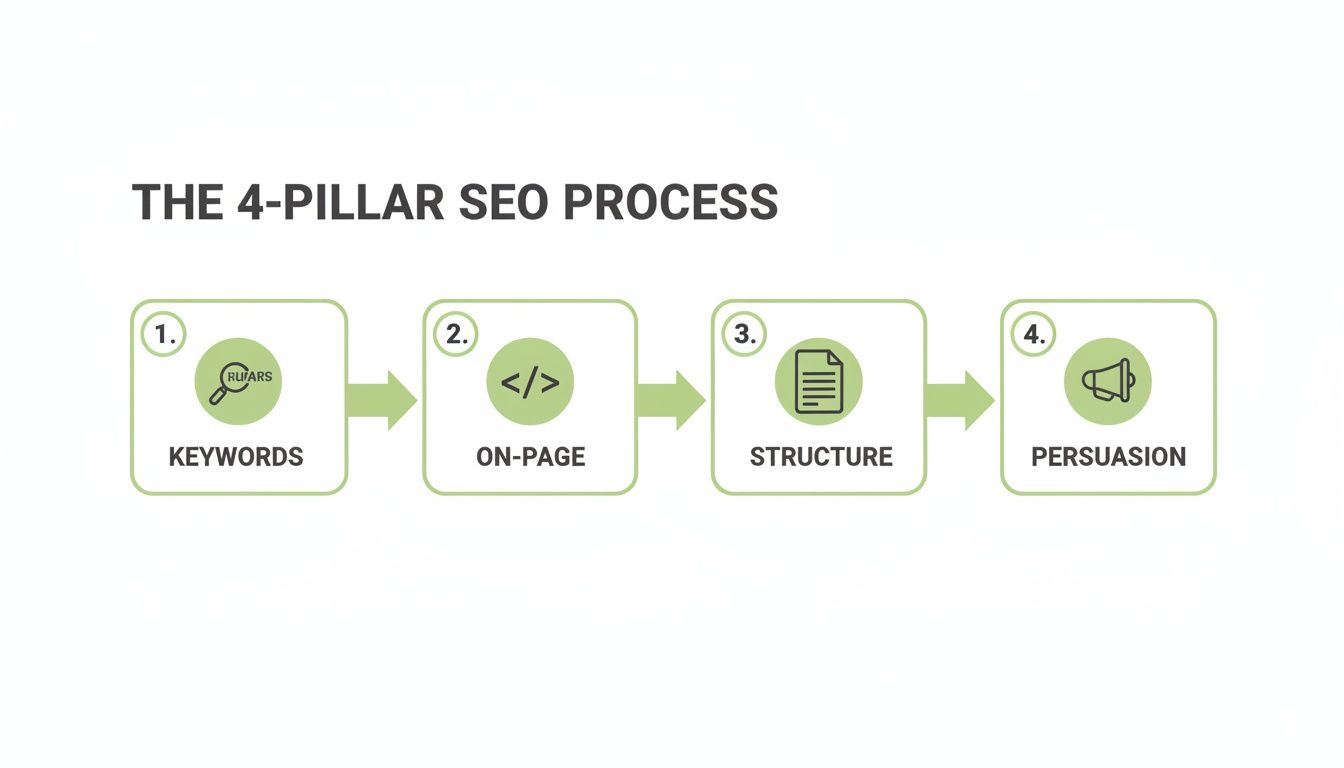
From figuring out what people are searching for to persuading them to act, each step is what turns a simple idea into a high-ranking business asset.
Phase 1: The Planning and Research Stage
This is where the magic really starts. Before you even think about writing, you have to lay the groundwork. Skipping this stage is like trying to build a house without a blueprint—it’s just not going to work.
Your main goals here are to get crystal clear on three things:
- Audience Research: Who are you actually talking to? You need to dig into their pain points, questions, and goals so your content truly connects.
- Keyword Selection: Pinpoint the exact words and phrases your audience is typing into Google. If you need a hand with this, our guide on how to conduct keyword research breaks it all down.
- Competitor Analysis: Look at the pages that are already ranking at the top. What are they doing right? More importantly, where are the gaps you can fill to create something even better?
Phase 2: Drafting and AI-Assisted Creation
Once your plan is solid, it's time to start putting words on the page. This is where you translate all that research into a coherent structure and start writing. A solid outline is your best friend here—it keeps your content flowing logically and prevents you from going off on tangents.
This is also a great time to bring in AI tools like ChatGPT. They can be fantastic for brainstorming ideas, generating a few starter paragraphs, or just getting a rough draft down quickly. But here’s the catch: you can’t just copy and paste.
AI should be your assistant, not your author. Use it to get a head start, but always plan on adding your own expertise and human touch to make it authentic.
The demand for skilled copywriting is booming. The copywriting services market, where SEO is a massive component, is valued at $29.28 billion in 2025 and is projected to hit $48.89 billion by 2032. Since the big AI boom post-2020, the market has shifted—it's no longer just about getting words on a page. The real value is in personalization and a genuine human tone that raw AI simply can’t deliver. You can read more about this market growth on coherentmarketinsights.com.
Phase 3: Humanization and Final Optimization
This is the final, crucial step that separates good content from great content. The goal here is to take your draft—whether you wrote it from scratch or with AI's help—and polish it into a persuasive piece that truly connects with readers and satisfies search engines.
This is where a tool like Natural Write becomes indispensable. It helps you smooth out that robotic, AI-generated feel and turn it into natural, engaging language that can easily pass AI detectors.
Here’s your final pre-publish checklist:
- Refine Tone and Style: Read it out loud. Does it sound like your brand? Is it speaking directly to your audience?
- On-Page SEO Checks: Go back and double-check your title tags, meta descriptions, and headers to make sure they're fully optimized.
- Internal Linking: Weave in links to other relevant pages on your website. This helps both users and search engines navigate your site.
- Proofreading: One last pass to catch any pesky typos or grammar mistakes before you hit publish.
Common SEO Copywriting Mistakes to Avoid
Even the best writers can watch their hard work go nowhere if they fall into a few common SEO copywriting traps. Honestly, knowing what not to do is just as crucial as learning all the best practices. When you learn to sidestep these pitfalls, you give your content a real fighting chance to deliver results.
The good news? These mistakes are usually pretty easy to fix once you know what to look for. They almost always come from getting the balance wrong—that delicate dance between writing for a search engine and writing for a real person.
Mistake 1: Writing for Robots, Not Humans
This is the big one. It's the most common and damaging mistake I see: prioritizing search engines so much that the actual human reader is completely forgotten. The result is robotic, clunky text that’s just plain painful to read.
You’ve probably seen it before. It often looks like keyword stuffing, where a target phrase gets jammed into sentences where it just doesn’t fit naturally. The writer thinks they’re ticking a box for an algorithm, but they’re really just pushing away their audience. Let’s be clear: Google's algorithms are smarter than ever. They reward content that people actually enjoy reading, not just pages that repeat a keyword over and over.
Key Takeaway: Read your copy out loud. If it sounds unnatural or awkward, it needs a rewrite. Always put your human audience first; then, you can gently weave in your SEO.
Before: "Our premium running shoes for flat feet are the best running shoes for flat feet on the market. If you need running shoes for flat feet, look no further."
After: "Finding the right support is crucial when you have flat feet. Our premium running shoes are engineered to provide maximum stability and comfort, making them an ideal choice for your daily runs."
See the difference? We shifted from clumsy repetition to communicating actual value. That’s the core of great SEO copywriting today.
Mistake 2: Creating Thin Content
Another classic misstep is creating "thin" content. These are the articles that feel shallow, offer zero new insight, and don't truly answer the question someone typed into Google. Think of a short blog post that only scratches the surface or a product page that just lists specs without explaining why they matter.
Google’s entire mission is to satisfy a searcher’s intent. If someone lands on your page, doesn't find what they need, and immediately hits the "back" button to try another link, that's a huge red flag for the search engine. It tells Google your page isn't a quality result, and your rankings will suffer for it.
The goal should always be to create the most thorough, helpful, and genuinely useful resource on the web for your topic.
Mistake 3: Ignoring the Call to Action
You can write the most beautiful, perfectly optimized article in the world, but if it doesn't tell the reader what to do next, it’s a massive missed opportunity. You’ve done all this work to get someone to your site and earn their trust, but without a clear Call-to-Action (CTA), all that effort just evaporates.
A weak or missing CTA leaves your reader at a dead end, thinking, "Okay... now what?" Every single piece of content you publish needs a purpose. It should guide the user toward a specific, logical next step—whether that's signing up for a newsletter, downloading an ebook, or buying your product.
How to Measure Your SEO Copywriting Success

Hitting "publish" isn't the finish line. It's the starting gun. The real test of your SEO copy is whether it actually moves the needle for your business, and the only way to know for sure is to look at the data.
This is where you shift from writer to analyst. By tracking a few key performance indicators (KPIs), you get a clear picture of what’s working and what’s falling flat. Tools like Google Analytics and Google Search Console are your best friends here, offering a goldmine of insights into how people find and interact with your content.
Key Metrics to Monitor
So, what should you be looking at? Think of these as the vital signs of your content's health.
- Organic Traffic: This is the big one. Are more people finding you through search engines month over month? A steady climb here means your optimization efforts are paying off.
- Keyword Rankings: Where do you stand? Tracking your position for your main keywords shows you how visible you are to your target audience. The goal is simple: get to the top and stay there.
- Time on Page & Bounce Rate: These two metrics tell you a lot about reader engagement. If people are sticking around for a while (high time on page) and not immediately clicking away (low bounce rate), it’s a great sign your copy is hitting the mark.
Ultimately, though, the most important measure of success is your conversion rate. This is the percentage of visitors who take the action you want them to, whether it's buying a product or signing up for your newsletter.
Connecting all these dots is what separates good SEO copy from great SEO copy. For a more detailed breakdown, our guide on measuring content effectiveness dives into more advanced strategies.
Frequently Asked Questions
Alright, we've covered a lot of ground on what SEO copywriting is and how it works. But when the rubber meets the road, a few questions always pop up. Let's tackle some of the most common ones.
How Long Does It Take to See SEO Results?
This is probably the number one question I get asked, and the honest answer is: it's a long game. SEO copywriting isn't a switch you can flip for instant traffic. While you might see some small upticks within a few weeks, you're really looking at a 3 to 6-month window to see significant, lasting growth in your rankings and organic traffic.
Think of it like planting a tree, not flipping a light switch. The final timeline really depends on where you're starting from—your site's current authority, how tough the competition is for your keywords, and how consistently you're publishing great stuff. Patience is your best friend here.
Can I Use AI for All My SEO Copywriting?
AI writing tools can be a fantastic co-pilot. I use them myself for brainstorming ideas, whipping up a quick outline, or getting a rough first draft on the page. They can definitely speed things up. But letting AI fly the plane solo? That's a mistake.
Raw AI-generated text often has a certain "sameness" to it. It can feel a bit hollow and usually misses the personal stories, unique insights, and genuine voice that actually connect with a reader. The best workflow is a partnership: let the AI do the heavy lifting, then step in with your human expertise to polish the tone, add your own perspective, and make sure the final piece is something people will actually want to read.
What Is the Ideal Keyword Density?
Let's clear this one up: the idea of a perfect "keyword density" is a fossil from an older era of SEO. Search engines have gotten much, much smarter. They're not just counting keywords anymore; they're looking to understand the overall topic and context.
Instead of obsessing over a specific percentage, shift your focus to semantic richness. What does that mean? It means using your main keyword in the most important places (your title, main heading, the first paragraph), and then weaving in related concepts, synonyms, and long-tail variations naturally throughout the rest of the content. Your goal isn't to stuff a keyword in—it's to create the most thorough, helpful resource on that topic.
Ready to turn your AI drafts into polished, human-like content that connects with readers and passes AI detectors? Natural Write makes it easy. Transform your text with a single click and ensure your SEO copy is authentic and effective. Try it for free at https://naturalwrite.com.