
Ever read something that felt… flat? Like a speaker droning on in a monotone voice? That's what happens when writing lacks sentence variety. It’s the secret ingredient that turns a dull, robotic block of text into something with rhythm and life.
So, What Is Sentence Variety, Really?

Think of your writing like a piece of music. It needs a beat. A tempo that speeds up to build excitement and slows down to let an important point land. Sentence variety is how you compose that rhythm.
Without it, every sentence sounds the same, and your reader’s brain checks out. They start skimming. They lose focus. They click away.
This isn’t just about changing things for the sake of it. It's about being intentional. A short, punchy sentence can land a powerful point. A longer, more descriptive one can paint a vivid picture or weave together complex ideas. Mixing them up is what makes your writing persuasive and easy to follow.
The Three Pillars of Variety
At its core, sentence variety stands on three pillars. Getting a handle on these gives you direct control over the flow and feel of your writing. It's the difference between just listing facts and telling a compelling story.
And just like sentences work together to form a paragraph, understanding what is paragraph structure is the next step to organizing these varied thoughts into a cohesive whole.
Here’s a quick overview of the three pillars that give writing its rhythm.
The Three Pillars of Sentence Variety
A quick overview of the core components that create an engaging and readable rhythm in any piece of writing.
| Pillar | What It Means | Why It Matters |
|---|---|---|
| Sentence Length | Alternating between short, medium, and long sentences. | Controls the pacing and keeps the reader engaged. Short sentences add punch; long ones add detail. |
| Sentence Structure | Using a mix of simple, compound, complex, and compound-complex sentences. | Creates a more sophisticated and dynamic texture, preventing grammatical monotony. |
| Sentence Beginnings | Intentionally starting sentences with different words or phrases. | Avoids the repetitive drone of starting every sentence with "The," "It," or the subject. |
By consciously mixing these three elements, you pull your reader in. Your writing becomes more than just words on a page—it becomes an experience that’s easier to read, understand, and remember.
We’ll dig into each of these pillars throughout this guide, with practical techniques you can start using right away.
Why Sentence Variety Boosts Reader Engagement
Have you ever started reading an article, only to find your eyes glazing over a few paragraphs in? Chances are, the culprit was a lack of sentence variety. Our brains are hardwired to spot patterns. When every sentence has the same structure and rhythm, it creates a monotonous drone that tells our minds to check out.
Think of it as cognitive autopilot. When the rhythm is predictable, our brains don't have to work as hard to process the words. That sounds good in theory, but it actually kills focus and retention. Your reader starts skimming instead of really absorbing what you're saying. By shaking up your sentence structure, you break that pattern and force their brain to re-engage.
This isn't just about avoiding boredom—it's about deliberately guiding your reader's experience. A short, punchy sentence lands with force. It creates emphasis, maybe even a little drama. A longer, more complex sentence, on the other hand, lets you build out a detailed picture, connecting several ideas into one flowing thought.
Tailoring Variety to Your Audience
The right mix of sentence lengths isn't one-size-fits-all. It changes depending on who you're writing for and where you're publishing. This is where you have to understand the expectations of your format.
For instance, academic writing and a casual blog post have completely different rhythms. Research shows that online articles do best with an average of 12–20 words per sentence, with only about 8–12% of sentences being long. Academic papers? They often average 20–30 words per sentence. The data is clear: reader attention drops off a cliff when sentences get too long, which is why a direct, clean style wins online.
This idea of matching your style to the medium is crucial everywhere. While sentence variety keeps long-form content flowing, simple formatting can make all the difference in shorter formats. For example, learning how to improve caption readability on social media is a similar skill, just adapted for a different context.
Creating Rhythm and Flow
Ultimately, sentence variety is how you create a comfortable reading rhythm that keeps your audience hooked. It’s the invisible hand that makes writing feel smooth and effortless. When sentences flow together naturally, your readers can focus on your ideas instead of stumbling over clunky prose.
By mastering the rhythm of your writing, you transform static words into a dynamic conversation. This builds trust and authority, making your message not only easier to understand but also far more persuasive.
This seamless flow is directly tied to how effective your writing is. Poor readability can hide even the most brilliant ideas. Building a strong foundation in sentence variety is a huge step toward real writing excellence. For a deeper dive into making your writing easy to follow, check out our guide on what is clarity in writing.
The Four Sentence Structures Every Writer Should Know
To really get a handle on sentence variety, you have to understand the four basic building blocks of writing. Think of them as different types of tools in a workshop. Each one has a specific job, and knowing when to use which allows you to build anything from a simple, sturdy frame to an intricate, detailed masterpiece.
These four structures are the simple sentence, the compound sentence, the complex sentence, and the compound-complex sentence. Getting comfortable with all four gives you incredible control over the rhythm, clarity, and overall feel of your writing.
This diagram shows how mixing these structures keeps a reader hooked by creating emphasis, adding rich detail, and making the whole piece flow smoothly.
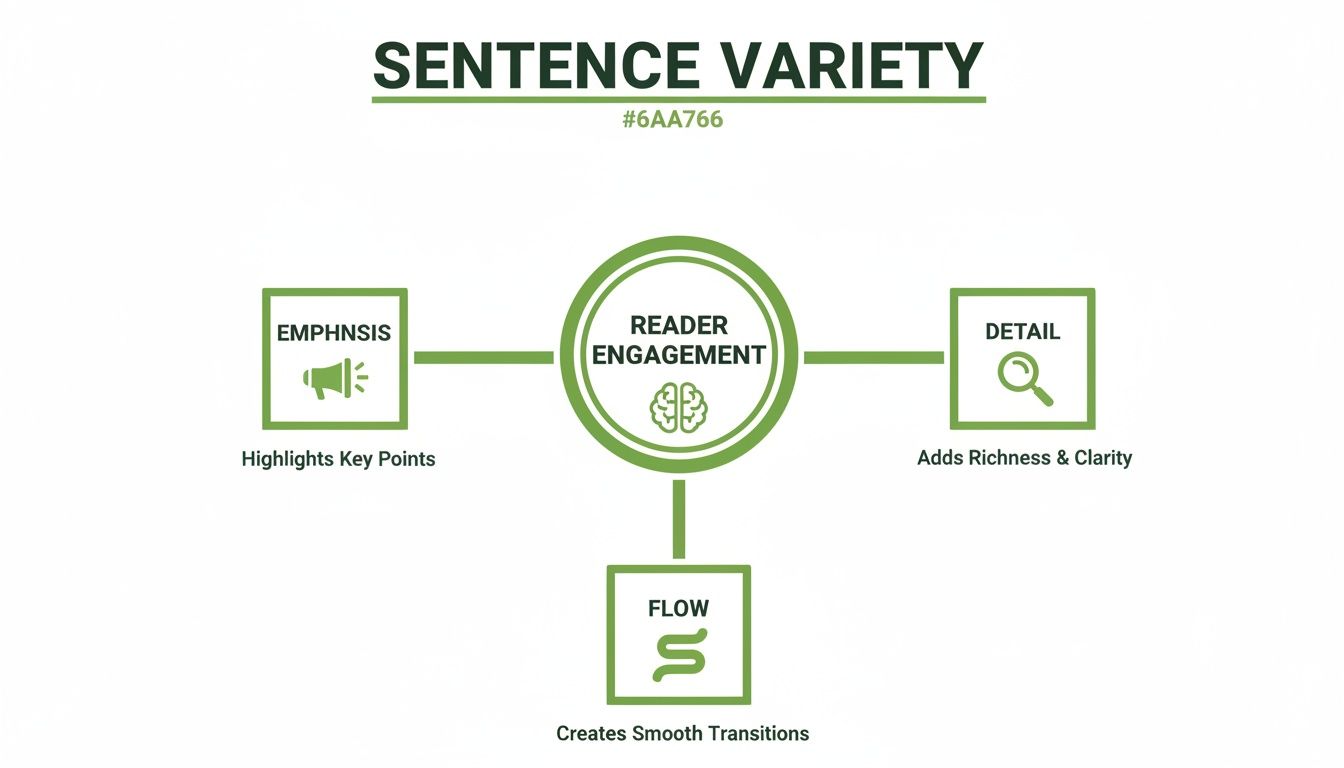
As you can see, variety isn't just a grammar rule—it's a strategic tool you can use to hold your reader's attention and guide them through your ideas.
To make this crystal clear, let's break down each of the four structures. The table below gives you a quick overview of what each one does.
Comparing the Four Sentence Structures
| Structure Type | Clause Combination | Primary Function |
|---|---|---|
| Simple | One independent clause | Makes a direct, clear point. |
| Compound | Two or more independent clauses | Connects two equally important, related ideas. |
| Complex | One independent + one or more dependent clauses | Shows a relationship (like cause-and-effect) and adds context. |
| Compound-Complex | Two or more independent + one or more dependent clauses | Expresses multiple, layered ideas in one sophisticated thought. |
Now, let's dig into how you can put each of these to work in your own writing.
Simple Sentences: The Foundation
A simple sentence has just one independent clause—a single, complete thought with a subject and a verb. It’s direct. It's clear. And it’s powerful. Use it when you need to state a crucial fact or make a bold declaration that lands with a punch.
- Example: The company launched a new product.
This sentence is short and gets right to the point. While stringing too many simple sentences together can sound choppy, using them strategically is a great way to create impact.
Compound Sentences: Connecting Equal Ideas
A compound sentence links two independent clauses (think of it as two simple sentences) with a coordinating conjunction like for, and, nor, but, or, yet, or so. This structure is perfect for connecting two closely related ideas that carry equal weight.
- Example: The company launched a new product, and the initial sales were strong.
Here, you're presenting two main points side-by-side. You're showing they're related without suggesting one is more important than the other.
Complex Sentences: Adding Depth and Detail
A complex sentence combines one independent clause with at least one dependent clause. That dependent clause adds extra information but can't stand on its own as a sentence. These often start with words like because, while, although, when, or since.
- Example: Because the marketing campaign was successful, the new product sold out quickly.
This structure lets you show a cause-and-effect relationship or add essential context, making your writing much more nuanced. The main point lives in the independent clause, while the dependent clause provides the "why" or "how."
Key Takeaway: The magic of sentence variety isn’t in finding one "best" structure. It's in the mix. The real art is in orchestrating these four types to create a rhythm that feels right for the message you’re trying to send.
Compound-Complex Sentences: Weaving It All Together
Finally, we have the compound-complex sentence. This is the most intricate of the four, containing at least two independent clauses and at least one dependent clause. These sentences are fantastic for expressing multiple, layered ideas inside a single, sophisticated thought.
- Example: Although the team faced challenges, they launched the product on time, and it quickly became a bestseller.
This one has it all: a dependent clause ("Although the team faced challenges"), a main idea ("they launched the product on time"), and a second main idea ("it quickly became a bestseller"). It’s a powerful way to connect multiple ideas into one cohesive statement.
Actionable Techniques to Diversify Your Writing

Knowing the different sentence structures is one thing. Actually using them is another. Let's move from theory to practice with a few techniques you can start using right now to bring more variety into your work.
Think of these as your core toolkit for crafting a better rhythm. By focusing on just a few key areas, you can turn repetitive, flat prose into something that feels alive and engaging. It all starts with the first word of each sentence.
Vary Your Sentence Openings
One of the fastest ways to spot monotonous writing is to look at the first word of every sentence. Do you see a long string of sentences all starting with the subject? "The company did this. The company did that. The company did another thing." If so, you’ve found the perfect place to start making improvements.
Breaking this habit is simple. Just be intentional about starting your sentences in different ways to create a more natural flow.
- Start with a prepositional phrase: Instead of "The team met its goals despite the setbacks," try "Despite the setbacks, the team met its goals."
- Start with an adverb: Instead of "The market changed suddenly," try "Suddenly, the market changed."
- Start with a dependent clause: Instead of "The project succeeded because everyone collaborated," try "Because everyone collaborated, the project succeeded."
These small shifts make a huge difference in how your writing feels. If you're looking for more advanced ideas, our full guide on how to vary sentence structure is packed with even more examples and strategies.
Use Punctuation for Rhythmic Effect
Good punctuation does more than just follow grammar rules—it controls the pace and rhythm of your writing. Semicolons and em-dashes, in particular, are powerful tools for creating sophisticated variety without having to rewrite entire sentences.
A semicolon (;) connects two closely related independent clauses. It creates a pause that’s stronger than a comma but softer than a full stop, showing your reader that two ideas are intimately linked.
- Example: The data was clear; the campaign had been a success.
An em-dash (—) adds emphasis or inserts an explanatory thought. It creates an abrupt break that grabs the reader’s attention, which is perfect for dramatic effect or adding a quick, clarifying aside.
- Example: The results were positive—far better than anyone had anticipated.
Pro Tip: Reading your work aloud is the ultimate test for rhythm. Your ears will catch the repetitive patterns and awkward phrasing that your eyes might miss. If it sounds clunky when you say it, it will feel clunky when they read it.
Mix in Questions and Commands
Most writing is made up of declarative sentences—statements that present facts. These are the workhorses of communication, but peppering in other sentence types can dramatically boost engagement.
An occasional question pulls the reader in, prompting them to think instead of just passively consuming your words.
- Example: But what does this mean for the future?
Similarly, a command (an imperative sentence) can serve as a powerful call to action or a direct piece of advice. It tells the reader exactly what to do.
- Example: Focus on the key takeaway.
By consciously using these techniques, you move beyond just relaying information. You start to shape the reader’s experience, making your writing more memorable, persuasive, and honestly, a lot more enjoyable to read.
How to Spot and Fix Common Sentence Variety Mistakes
Even the most seasoned writers fall into comfortable habits. You know your writing needs something more, but putting your finger on it is the hard part. Learning what is sentence variety is one thing, but spotting the lack of it in your own work? That's the real challenge.
The good news is that most monotonous writing stems from a few common mistakes, and they're surprisingly easy to fix once you know what to look for.
The biggest culprit is relying too heavily on the basic Subject-Verb-Object pattern. It's direct, sure. But overuse it, and you get a robotic, choppy rhythm that can lull your reader to sleep. It sounds like this: "The team held a meeting. The manager presented the data. The employees asked questions." Correct, yes. Engaging? Not so much.
Another common pitfall is an imbalance in sentence length. Some writers lean on long, complex sentences, which can overwhelm the reader with a wall of information. On the other hand, a string of short, simple sentences can make your writing feel disconnected and elementary.
Identifying Repetitive Patterns
So, how do you diagnose these issues in your own work? It starts with asking a few simple questions. Grab a paragraph you've written recently and look for these red flags:
- Do most sentences start the same way? Scan the first word of every sentence. If you see the same subject or phrase popping up over and over, you need to switch up your openings.
- Is every sentence a statement? A constant stream of declarative sentences feels flat. Weaving in questions or commands creates a more engaging rhythm.
- Are all sentences roughly the same length? You don't have to literally count the words, but get a feel for the rhythm. If there’s little difference between short, medium, and long sentences, your pacing is likely off.
These simple checks help you go from a vague feeling that something is "off" to knowing exactly what needs fixing. It's a common hurdle, especially for those learning a new language. One study found that while most sentences from L2 students were grammatically correct, they relied heavily on a narrow range of familiar structures. The research noted that nearly 15% of sentences had structural errors, which highlights just how tough it can be to master varied and correct sentence construction. You can read the full research about L2 sentence patterns for more details.
Quick Fixes for Monotonous Writing
Once you spot a problem, the fix is usually pretty simple. You don't need to rewrite the whole thing—just make small, targeted adjustments.
The Fix: Don't just delete and restart. Instead, look for opportunities to combine, rearrange, or rephrase. This approach is faster and helps you train your brain to spot these patterns in the future.
Let’s go back to that choppy "Subject-Verb-Object" paragraph. We can fix it by combining ideas and varying the sentence opening.
- Before: The team held a meeting. The manager presented the data. The employees asked questions.
- After: During the team meeting, the manager presented the data, which prompted several questions from the employees.
By using these simple diagnostic and editing techniques, you can turn flat, monotonous prose into writing that feels dynamic and keeps your readers hooked.
Common Questions About Sentence Variety
Even after you get the hang of the techniques, a few practical questions always pop up when you start applying them to your own writing. This section tackles the most common ones I hear from other writers.
Think of it as a quick-reference guide to help you build confidence and master the art of making your sentences flow.
How Do I Know If My Writing Has Enough Sentence Variety?
The fastest way is to read your work aloud. Seriously. Your ears will catch what your eyes skim over. Does it have a natural rhythm, or does it sound like a robot reading a script? If you can hear the monotony, your reader will definitely feel it.
Another dead giveaway is scanning the first word of each sentence in a paragraph. If you see a bunch of sentences starting the same way (“The team found…”, “The team decided…”, “The team implemented…”), you’ve found a major red flag.
For a more data-driven check, writing tools can visualize your sentence lengths. This helps you spot sections that are too uniform or, just as bad, full of long, winding sentences that make readers' eyes glaze over.
Is It Possible to Have Too Much Sentence Variety?
Absolutely. The goal is always clarity and flow, not just variety for the sake of it. If every single sentence is a different, complex structure, your writing will feel jerky, confusing, and just plain hard to follow.
It's a classic case of trying too hard. The structure should always serve the message, not distract from it.
- Too many long sentences back-to-back will exhaust your reader.
- Too many short, choppy sentences can make your writing feel childish or disconnected.
Great writing finds a comfortable rhythm. The sentence structure becomes almost invisible, guiding the reader through your ideas instead of making them stumble over chaotic or overly clever prose.
What’s the Easiest Way to Start Improving My Sentence Variety?
Start with your sentence openings. This one change delivers the biggest bang for your buck and is the perfect place to begin.
Go back to a paragraph you just wrote and look only at the first word of each sentence. If you see a pattern, just rewrite one or two of them to begin differently. It’s that simple.
For example: Instead of, "He walked to the store. He bought some milk. He went home," you could write: "After walking to the store, he bought some milk and headed home." It’s a small fix that makes a huge difference.
What Tools Can Help Me Analyze My Sentence Structure?
Modern writing assistants are great for getting an objective look at your work. Tools like Grammarly, ProWritingAid, and the Hemingway App are all designed to analyze readability and sentence structure.
They often give you detailed reports on sentence length, flagging sentences that run on too long and highlighting passages that are tough to get through. Some even identify repetitive sentence patterns, giving you specific, data-backed suggestions to help you bring more variety into your writing.
Ready to turn your AI-generated drafts into prose that flows? Natural Write instantly humanizes your text, refining tone, clarity, and sentence variety to bypass AI detectors while keeping your original ideas intact. Try it for free and see the difference.