
Let's cut right to it. The main difference between active and passive voice is all about who—or what—is in the driver's seat of your sentence.
Active voice is direct and punchy. It puts the person or thing doing the action (the subject) right at the beginning, front and center.
Passive voice, on the other hand, is indirect. It shifts the focus to the person or thing receiving the action.
Active vs. Passive Voice: The Core Difference Explained
Think of it like a scene in a movie. The active voice is a clear action shot: The hero (subject) saves the day (object). It’s dynamic, easy to follow, and puts the spotlight exactly where it belongs—on the one making things happen.
For example, "The writer finished the article" is active. Simple. We know who did what.
The passive voice flips the camera around. Now, we’re watching a scene where we see the result of an action, but the hero is either out of frame or mentioned as an afterthought. "The article was finished by the writer" is passive. See the difference? The article is suddenly the star of the sentence, and the writer who did all the work gets pushed to the end.
The Anatomy of Each Voice
At its heart, this is all about sentence construction and where you want to place the emphasis.
- Active Voice Structure: Subject + Verb + Object (e.g., The team won the game.)
- Passive Voice Structure: Object + Verb (a form of "to be" + past participle) + "by" + Subject (e.g., The game was won by the team.)
Generally, the active voice is shorter, more forceful, and just feels more confident. That's why it's the go-to choice for most web content, marketing copy, and anytime you need to be crystal clear.
The passive voice isn't wrong, it's just a different tool. It can be useful when the actor is unknown ("My car was stolen") or when the action is more important than who did it ("The new policy was implemented last week"). Getting a feel for this distinction is a huge step in improving what is voice in writing.
For a quick reference, here’s a simple table that breaks it down.
Quick Guide: Active vs. Passive Voice at a Glance
| Characteristic | Active Voice | Passive Voice |
|---|---|---|
| Focus | On the doer of the action (the subject). | On the receiver of the action (the object). |
| Clarity | Direct, clear, and easy to follow. | Can be vague or indirect. |
| Length | Typically shorter and more concise. | Often wordier and more complex. |
| Tone | Energetic, confident, and authoritative. | Formal, detached, or evasive. |
| Example | The marketing team launched the campaign. | The campaign was launched by the marketing team. |
This quick comparison highlights how a simple change in sentence structure can completely alter the tone and impact of your writing.
This infographic breaks down the essential characteristics of each voice side-by-side, giving you a great visual feel for the difference.
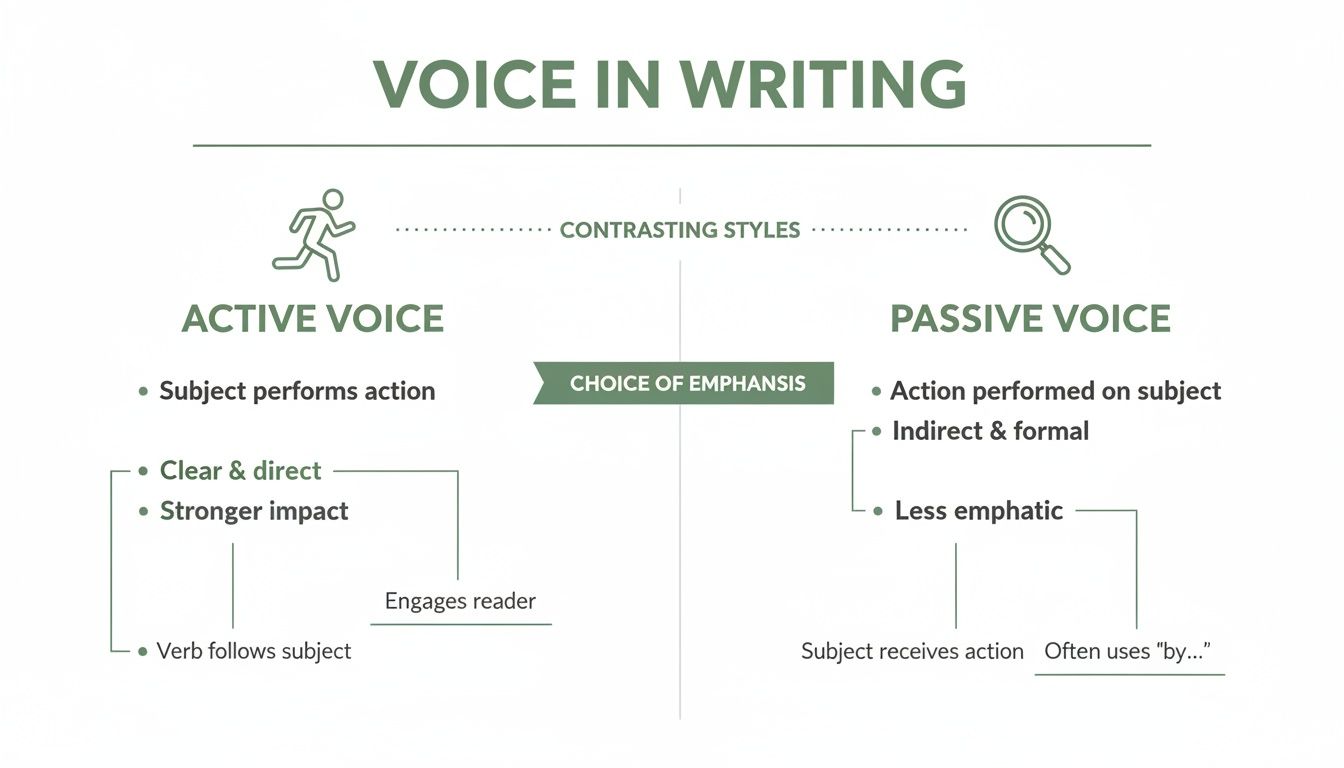
As the visual shows, it’s all about a choice: do you want to highlight the action and who's doing it, or do you want to emphasize the result?
How Active Voice Creates Powerful and Direct Writing

Think of the active voice as talking directly to your reader. It puts the doer—the person or thing taking action—right in the spotlight. This makes your sentences feel energetic, clear, and confident, building a momentum that makes your message stick.
Active sentences just get straight to the point. They don’t beat around the bush, which is a huge plus for your reader's time and attention. By putting the subject front and center, you get rid of any confusion about who’s doing what. This isn’t just a grammar rule; it’s a strategic move for total clarity.
Building Authority and Trust
When you write in the active voice, you sound confident. You’re taking ownership. It’s the difference between a company saying, “We guarantee our products,” and the wishy-washy, “Our products are guaranteed.” That first one is a real promise from a real source, and that’s how you build trust.
This sense of authority is exactly why active voice is king in business and marketing. Just look at how a simple switch changes everything:
- Passive: The new software update will be released by our team next Tuesday.
- Active: Our team will release the new software update next Tuesday.
The active version isn’t just shorter—it's decisive. It communicates accountability and a proactive vibe that’s way more persuasive.
The active voice takes responsibility. It’s credible, straightforward, and efficient, creating a direct connection with the reader that the passive voice just can't match.
Enhancing Readability and Engagement
As a rule, active sentences are tighter and more concise. They cut out the fluff words like "by" and extra "to be" verbs (is, are, was, were), leaving you with punchier, more powerful writing. This makes your content way easier to read and understand, which is key to keeping people hooked.
In the world of business writing, that punchy clarity is everything. Most experts recommend keeping 80-90% of your sentences in the active voice to keep comprehension and engagement high. In fact, one analysis of corporate documents found that reports with less than 10% passive sentences scored 25% higher on reader engagement. You can dig into the numbers and see how sentence structure impacts things by checking out some readability statistics.
Ultimately, choosing the active voice is about making your writing work for your reader. When you prioritize directness, you create content that’s not only a breeze to get through but also far more memorable and convincing.
When to Strategically Use the Passive Voice
While the active voice is the hero of most strong writing, the passive voice isn't the villain it's often made out to be. Think of it less as a mistake and more as a specialized tool. When you use it on purpose, it shows you have a sophisticated handle on tone and emphasis.
The whole game is about intention. Passive voice is a strategic choice when the person doing the action (the "actor") is unknown, unimportant, or simply less important than whatever is receiving the action. It lets you control the narrative and steer the reader's focus right where you want it.
Emphasizing the Action or Object
Sometimes, the action itself is the star of the show. Or maybe it's the thing being acted upon. In these cases, who did the action is just a footnote. This happens all the time in formal and scientific writing, where the goal is to be objective.
Here are a few classic scenarios:
- Scientific Writing: "The solution was heated to 100°C." (Who cares which scientist turned the knob? The process is the point.)
- News Reporting: "The historic landmark was demolished overnight." (The event is the headline. The culprits might not even be known yet.)
- Formal Announcements: "The new company policy will be implemented on Monday." (The policy is what matters to employees, not who signed the memo.)
In every example, the passive voice pushes the most critical information to the front of the sentence, giving it the spotlight.
When the Actor is Unknown or Irrelevant
The passive voice is also your best friend when you just don’t know who did something. Trying to force an active sentence without a clear subject can make your writing sound clunky or weirdly vague.
The passive voice is your best option for maintaining clarity when the "who" is a mystery. It allows you to state a fact without speculating or adding unnecessary words.
Imagine you come back to your desk and your keys aren't where you left them. "My keys were moved" is a clean, factual statement. But if you try to make it active, you get something like, "Someone moved my keys," which adds a layer of assumption. Here, the passive voice isn't just appropriate—it's more accurate.
Passive voice shines in business and technical writing, often making up 10-20% of effective corporate communications. For example, in safety manuals, you'll find that 65% of OSHA-compliant documents use passive phrasing like "Masks are required in the engine room" to make the rule feel universal and non-negotiable. If you want to dig deeper, you can explore more about the role of voice in business writing on instructionalsolutions.com.
Softening the Message
Finally, the passive voice can be a surprisingly powerful tool for diplomacy. By taking the actor out of the equation, you can deliver bad news or criticism more gently. It dials down the blame and softens the emotional blow.
- Instead of: "You made a mistake on the invoice."
- Try: "A mistake was made on the invoice."
See the difference? The second version flags the problem without pointing a finger. This shifts the focus from who’s at fault to how to fix it—a go-to technique in customer service and corporate comms for keeping things professional and constructive.
A Simple Process for Spotting and Fixing Passive Voice
Flipping a passive sentence into an active one is way easier than it sounds. Once you learn what to look for, spotting those weak constructions becomes second nature.
Here's a repeatable process to help you find sentences that feel a bit flat and give them an instant jolt of energy.
The first step is learning to recognize the tell-tale signs of the passive voice. Think of yourself as a detective looking for a specific pattern. The biggest giveaway is seeing a form of the verb "to be" (is, am, are, was, were, be, being, been) followed immediately by a past participle (a verb that usually ends in -ed, -en, or -t).
Another dead giveaway? A "by" phrase tacked on at the end, telling you who did the action. For instance, in "The ball was thrown by the pitcher," that little "by the pitcher" phrase is a classic sign you're looking at a passive sentence.
The Three-Step Conversion Method
Once you’ve spotted a passive sentence, switching it to active voice is a simple, three-step fix. This little trick works almost every time and quickly becomes automatic.
Let's break it down with an example.
Passive Sentence: The report was written by our team.
Find the Actor: First, ask yourself: who or what is actually doing the action? In this case, it's "our team." They're the ones writing.
Move the Actor to the Front: Now, make the actor the star of the show by moving it to the beginning of the sentence. This immediately shifts the focus. Our sentence now starts with "Our team..."
Adjust the Verb: Finally, swap the passive verb form ("was written") for its active counterpart. Just drop the "to be" verb (was) and use the direct action verb. Boom.
Active Sentence: Our team wrote the report.
See the difference? The new sentence is shorter, clearer, and has more confidence. The action is right there, and there's no question about who did it.
By putting the actor first, you naturally create a more dynamic and engaging sentence. This simple shift is one of the quickest ways to improve your writing's clarity and impact.
Putting It All Together with More Examples
This method is a reliable way to strengthen your writing. If you’re looking for more advanced techniques, our guide on how to rewrite a sentence offers a few extra strategies.
Let's run through the three-step process on a couple more common passive constructions:
Passive Example 1: The decision will be made by the committee.
- Actor: The committee
- New Subject: The committee...
- Active Verb: ...will make the decision.
- Active Result: The committee will make the decision.
Passive Example 2: My car was stolen last night.
- Actor: Unknown (so let's use "someone")
- New Subject: Someone...
- Active Verb: ...stole my car last night.
- Active Result: Someone stole my car last night.
For writers who want some extra help, certain AI writing software for novelists can be a huge time-saver, automatically flagging passive voice issues in a manuscript. Once you master this conversion process, you have a powerful tool for making your writing more direct and effective.
How Your Writing Voice Affects SEO and Readability
The whole active vs. passive voice debate isn't just for grammar nerds. It actually has a real, measurable impact on how well your content performs online. Search engines like Google are obsessed with user experience, and a huge part of that is how easy your content is to read. Clear, direct writing keeps people on the page, which signals to Google that you’re a valuable resource.
Think about it: the active voice naturally leads to shorter, punchier sentences. This direct style makes your content a breeze to scan and understand, which can seriously lower your bounce rates. When people stick around longer, it sends a powerful message to search engines that your content is high-quality and doing its job.
The Link to Readability Scores
This is where things like the Flesch-Kincaid scale come into the picture. These tools often flag passive sentences because they’re usually longer and more complex, dragging down your overall readability score. While Google doesn't directly punish you for using the passive voice, it absolutely cares if your content is a chore to get through.
Overdoing it with passive voice can indirectly torpedo your SEO by making your writing unclear and clunky. It hurts the exact user engagement signals that are so critical for ranking well.
And this isn’t just a theory. An analysis of millions of business documents found a 40% drop in passive sentences over the last two decades. Why? Because readability tools consistently show that active voice can bump up scores by 20-30 points. The data speaks for itself: corporate reports loaded with passive voice were rejected 35% more often just for being too vague.
The Practical SEO Perks of Active Voice
Leaning into the active voice helps you create content that search engines and humans both love. It’s not about banning the passive voice entirely, but about being smart with it. For almost all digital content, active voice gives you some clear wins:
- Better User Experience: Clearer sentences mean less work for your reader.
- Lower Bounce Rates: When content is easy to digest, people are far more likely to stay.
- Stronger Engagement Signals: Active, engaging writing encourages readers to keep scrolling and clicking.
Ultimately, mastering your writing voice is a key piece of the puzzle for achieving clarity in writing, which is the foundation of both reader happiness and SEO success. And beyond just sentence structure, think about the bigger picture of defining your overall newsletter tone and voice to truly connect with your audience.
Put Your Knowledge into Practice with These Exercises
Alright, enough with the theory. The best way to really get the hang of active vs. passive voice is to roll up your sleeves and put it into practice. Reading about it is one thing, but building the muscle memory to spot and fix passive sentences on the fly is what makes you a stronger writer.
This is your training ground. I’ve put together a few sentences written in the passive voice, covering everything from professional emails to simple descriptions. It's your chance to apply what you've learned.
Your Challenge: Convert These Sentences
The task is simple: rewrite each sentence to make it active. Your goal is to find the "who" or "what" doing the action and move it to the front. Don't forget to tweak the verb to match.
Give it a shot, then check your answers below.
Passive Sentences for Practice:
- The final report was submitted by the marketing team.
- The city was blanketed by a thick fog.
- Mistakes were made during the project’s initial phase.
- The new software will be installed by the IT department tomorrow.
- My car was being repaired by the mechanic all day.
- The winning goal was scored by Sarah in the last minute.
Pro Tip: Here’s a fun little trick. If you can add "by zombies" after the verb and the sentence still makes sense grammatically (e.g., "The city was blanketed by zombies"), you're almost certainly looking at a passive sentence.
Answer Key and Explanations
So, how'd you do? Let's walk through the answers and break down why the active versions pack more of a punch. This is where the real learning happens—seeing the before-and-after makes the concept click.
Original: The final report was submitted by the marketing team.
- Active: The marketing team submitted the final report.
- Why it's better: It's just more direct. We know exactly who did what, right away.
Original: The city was blanketed by a thick fog.
- Active: A thick fog blanketed the city.
- Why it's better: The active version feels more immediate and descriptive. It gives the fog agency, turning it into an active force instead of a static condition.
Original: Mistakes were made during the project’s initial phase.
- Active: We made mistakes during the project’s initial phase.
- Why it's better: This is a classic for a reason. The active voice takes ownership. It sounds confident and accountable, whereas the passive version feels vague and evasive.
Common Questions About Active vs. Passive Voice

Even after you get the hang of active and passive voice, a few questions always seem to pop up. Let's clear the air and tackle some of the most common points of confusion.
First, people often wonder if passive voice is just a fancy term for past tense. Absolutely not. Tense tells you when something happened (past, present, future), while voice tells you who or what did the action. You can write in any tense using either active or passive voice.
Another big one: Is passive voice just plain wrong? Nope. It’s important to remember that passive voice is a perfectly valid grammatical construction, not some kind of error you need to hunt down and destroy. The problem isn’t about correctness; it’s about impact. Overusing it just makes your writing feel weak, indirect, and a little bit soulless.
Can I Use Passive Voice in Creative Writing?
Yes, and honestly, sometimes you should. While active voice is your engine for driving a story forward, the passive voice can be a surprisingly powerful tool for creating mystery or shifting the reader's focus.
Think about it:
- To hide the actor: "The window was shattered" builds instant suspense. We’re left wondering who did it, which is the whole point.
- To emphasize the recipient: "The hero was betrayed" puts all the emotional weight on the hero, making us feel their pain. The betrayer is almost an afterthought.
Used intentionally, it’s a great way to control the pacing and dial in a specific mood.
The key is making a conscious choice. Your default should be active voice for clear, direct action. But keep the passive voice in your back pocket as a strategic tool for controlling tone and information.
Finally, what happens when you genuinely don't know who the actor is? This is where passive voice shines. A sentence like "My car was stolen" is completely natural. Forcing it into active voice—"Someone stole my car"—can sound clunky and state the obvious. In these cases, the passive construction isn't just acceptable; it's often the clearest and most direct way to say it.
Feeling like your writing is stuck in a robotic rut? Natural Write instantly humanizes your content, tweaking the tone and improving clarity so it sails past AI detectors. You can transform your drafts into engaging, natural-sounding writing with a single click. Give our free tool a try at https://naturalwrite.com.