
Writing a great article isn't just about putting words on a page. It’s a journey that starts with a spark of an idea and ends with a polished, impactful piece. This process really breaks down into four key stages: planning and research, outlining your structure, drafting the content, and then editing and refining until it shines.
Laying the Groundwork for a Powerful Article
Honestly, the most successful articles are won or lost before you even write the first sentence. The planning and research phase is the bedrock of your entire piece. It's what separates an article that gets lost in the noise from one that gets read, shared, and actually helps someone. This is where you take a fuzzy idea and sharpen it into a focused, reader-first topic that has a real chance to succeed.
Think of it like building a house. You'd never just start hammering boards together without a blueprint. Writing is no different. Jumping in without a plan is a recipe for rambling, unfocused content that ultimately falls flat.
From Vague Idea to Focused Topic
It all starts with a good old-fashioned brainstorm. Don't filter yourself here—just get every possible idea out of your head and onto paper. What are the common questions you hear from your audience? What problems are they trying to solve every day? An article that solves a real, nagging problem is an article people will go out of their way to read.
Once you have a list of contenders, it's time to see if they have legs. This is where a little keyword research makes a huge difference. You don't have to be an SEO guru, but you do need to know if people are actually searching for what you want to write about. Free tools like Google Trends or Ubersuggest can give you a quick reality check. You're looking for that perfect intersection of what you're an expert in and what your audience is desperate to know.
This is the simple, crucial flow from brainstorming and research to a well-defined topic—the foundation for everything that follows.
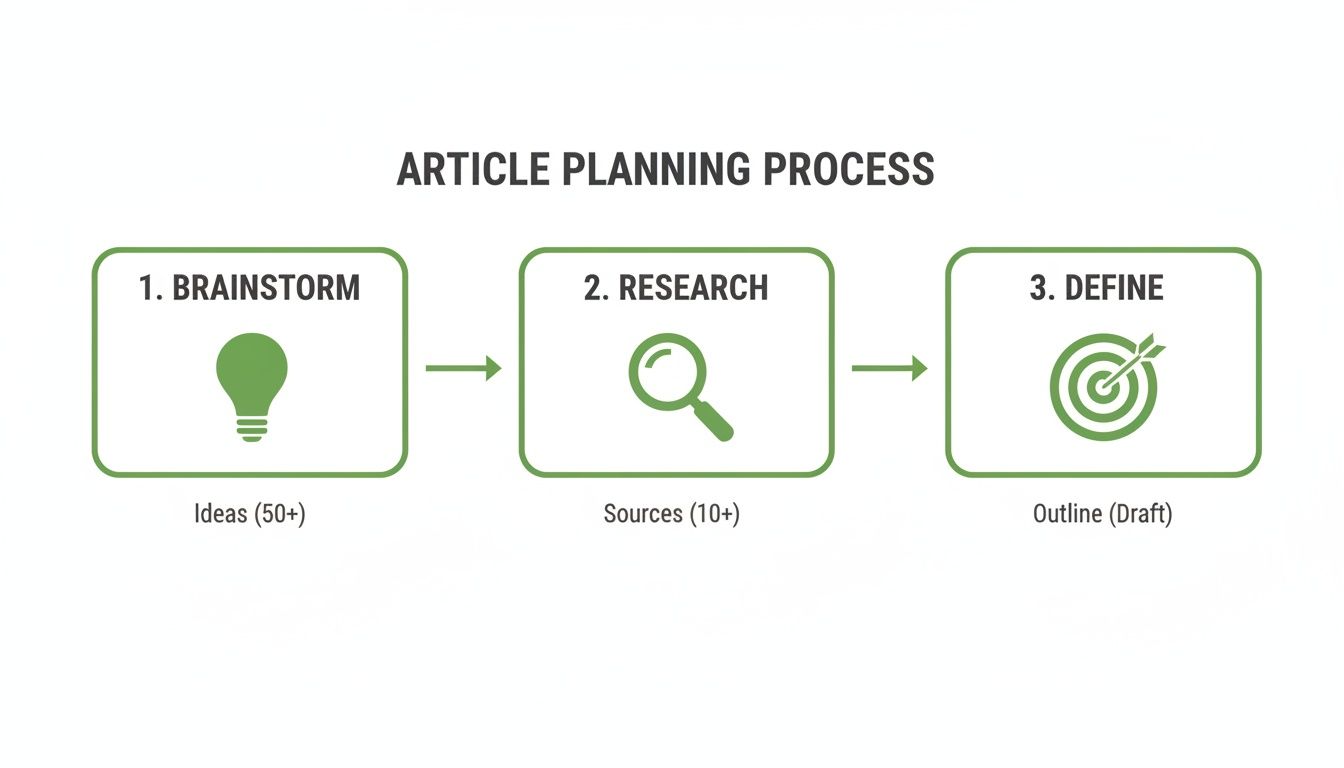
Following this workflow means your article is built on solid ground, not just a hunch.
Defining Your Article's Purpose
With a validated topic in hand, you need to lock in your purpose. What, exactly, do you want your reader to do, think, or feel after they finish reading? Every single piece of content needs a job.
- To Educate: Are you breaking down a complex process or walking someone through a tutorial?
- To Persuade: Is your goal to build a compelling argument and win the reader over to your point of view?
- To Inspire: Are you sharing a case study or a personal story to motivate your reader to take action?
Knowing your objective from the get-go dictates your tone, your structure, and every piece of information you choose to include.
To make sure your article serves a bigger purpose, it helps to plug it into a content marketing strategy template. This keeps your individual articles aligned with your broader goals, turning each one into a genuine asset. The demand for quality writing is only growing; the global content writing services market is expected to reach USD 35.63 billion by 2032. This explosive growth shows just how vital well-crafted content has become.
Before moving on, take a moment to run through this checklist. It’s a simple way to make sure you’ve covered all your bases before you start drafting.
The Pre-Writing Strategic Checklist
Follow these essential planning steps before drafting to ensure your article is set up for success.
| Component | Core Action | Impact on Your Article |
|---|---|---|
| Audience Persona | Define who you're writing for (their job, pains, goals). | Ensures the tone, language, and examples resonate deeply. |
| Core Problem | Identify the single, specific problem you're solving. | Creates a focused, valuable piece instead of a broad overview. |
| Primary Goal | Decide the #1 action you want the reader to take. | Gives your article a clear purpose and call-to-action. |
| Keyword Research | Validate that your topic has an existing audience. | Helps your article get discovered through search engines. |
| Competitive Analysis | Briefly review the top-ranking articles for your topic. | Shows you what's already out there so you can make yours better. |
Completing this checklist solidifies your strategy, making the actual writing process smoother and far more effective.
Crafting a Bulletproof Outline and Structure

Think of your outline as the blueprint for your article. Seriously. If you skip this part, you're essentially just stacking words on top of each other and hoping the whole thing doesn't collapse. A solid outline is what turns a messy pile of research notes and good ideas into a logical, compelling journey for your reader.
It's also the single best weapon against the dreaded "blank page syndrome." An outline breaks the massive task of writing a 3,000-word article into small, manageable chunks. Instead of staring at a mountain, you’re just focused on tackling one small section at a time. This not only makes the process feel less overwhelming but ensures every single paragraph has a clear purpose.
Ultimately, a strong outline is your roadmap. It guides both you and your readers from the introduction to the conclusion without any confusing detours, building momentum and making sure each point flows naturally into the next.
Grouping Ideas into Logical Sections
First things first, you need to get all your thoughts out of your head and onto the page. Just open a document and dump everything: your main points, supporting stats, little anecdotes, and any examples you’ve collected. Don't even think about order at this stage. It’s a brain dump, not a final draft.
Once all your raw material is there, start looking for natural connections. Which ideas belong together? Can you spot any overarching themes? It’s a bit like sorting puzzle pieces—you group all the blue sky pieces here, the green grass pieces there—before you even try to connect them.
Let’s say you’re writing an article about starting a home garden. Your brain dump might include soil testing, choosing a sunny spot, what to plant in spring, common pests, and watering schedules.
From there, you could group them into logical sections:
- Section 1: Preparing Your Garden Bed (soil testing, choosing a spot)
- Section 2: Selecting Your Plants (what to plant in spring)
- Section 3: Garden Maintenance (watering schedules, dealing with pests)
See how that immediately creates clarity? It stops you from jumping from soil prep to pest control and back again. For a deeper dive, our guide on how to write a blog post outline has more templates and strategies you can use.
Developing Compelling Headings
Those section groupings you just created are the perfect foundation for your article's headings (H2s) and subheadings (H3s). But these aren't just labels; they're signposts that guide readers who skim and give your SEO a nice boost. A good heading should be clear, concise, and give a little hint of the value waiting in that section.
So, instead of a boring heading like "Tips," try something more descriptive and action-focused, like "5 Practical Tips for First-Time Gardeners." This tells the reader exactly what they're getting and probably includes keywords people are actually searching for.
Key Takeaway: Headings do double duty. They create a scannable structure for a better reader experience, and they help search engines understand the hierarchy of your content. Well-structured articles with clear headings almost always get better visibility.
Think of each heading as a promise. The content that follows is you delivering on that promise.
Mapping Your Key Arguments
With your sections and headings locked in, it’s time to add the real meat to the bones. Under each heading, use bullet points to map out the specific arguments, data points, examples, or stories you want to include. This is where your outline transforms from a simple skeleton into a detailed plan of attack.
Here’s how that might look for our gardening article:
H3: Essential Watering Techniques for a Thriving Garden
- Explain the "deep and infrequent" watering method.
- Note the best time of day to water (early morning) and why it matters.
- Find a quick statistic on water waste from midday watering.
- Add a personal story about overwatering my first tomato plants.
- Remind myself to find an expert quote on drip irrigation systems.
When your outline is this detailed, the actual writing becomes so much smoother. You’re no longer inventing content on the fly; you’re just connecting the dots you've already laid out. Your bulletproof outline is done, and the path forward is crystal clear.
Writing Your First Draft With Clarity and Impact

Okay, you've got a solid outline. That scary blank page suddenly doesn't seem so intimidating anymore, does it? Now for the fun part: turning that structural blueprint into an actual article. This first draft is where your research, ideas, and unique voice finally get to mix.
Let’s be clear about one thing. The goal right now isn't perfection. It's not even close. The only mission is to get the words down. You have to tell your inner critic to take a hike for a while; we'll invite it back for the editing phase.
Hook Your Reader From the First Sentence
Your introduction is the most valuable piece of real estate in your entire article. It’s your single chance to convince someone to stick around. A flat opening is a guaranteed ticket to a click of the "back" button.
You need to start with a hook that snags their attention immediately. Think about a surprising statistic, a relatable story, or a pointed question that hits on a problem they're desperate to solve.
For example, instead of a snooze-fest like, "This article will discuss time management," try something like: "What if you could reclaim five hours every week with just a few simple tweaks to your workflow?" The second one creates instant curiosity and promises a real benefit. It’s tough to scroll past that.
Build Strong Body Paragraphs
Think of each body paragraph as its own mini-article. It should have one—and only one—central idea. This is the secret to clarity. The moment you start jamming multiple concepts into a single paragraph, you dilute the message and confuse your reader.
Kick off every paragraph with a clear topic sentence that spells out the main point. From there, everything else in that paragraph should support it.
- Evidence: Bring in the data. Statistics and research give your claims weight.
- Examples: Make it real. Use real-world scenarios or personal anecdotes to illustrate your point.
- Explanations: Unpack it. Break down complex topics into simple, digestible terms.
Following this structure makes your writing a breeze to follow and builds a far more convincing argument.
Your first draft is a discovery process. It’s where you figure out what you truly want to say. Don't censor yourself—just write. The magic of clarity often reveals itself in the act of getting messy ideas out of your head and onto the page.
Create a Seamless Flow With Transitions
A great piece of writing feels like a natural conversation, not a jumble of disconnected facts. Transitions are the bridges that connect your ideas, guiding your reader smoothly from one point to the next.
Without them, your writing feels choppy and jarring. Transition words are the signposts that show the relationship between your ideas.
- To add on: Additionally, furthermore, what’s more
- To show a contrast: However, on the other hand, that said
- To give an example: For instance, for example, to illustrate
- To show a result: Therefore, as a result, consequently
Let's say you just wrote a paragraph about the perks of waking up early to exercise. Your next one is about the struggles. A simple transition like, "However, finding the motivation when that 5 a.m. alarm goes off is a whole different ballgame," perfectly connects those two opposing thoughts.
Overcoming Writer's Block and Fear of the Blank Page
Even with the best outline in the world, writer's block happens. The pressure to write something brilliant right out of the gate can be paralyzing. The best way I’ve found to beat it is to lower the stakes and just start moving your fingers.
Try the "freewriting" technique. Set a timer for 10-15 minutes and just write about your topic nonstop. Don’t worry about grammar, spelling, or even if it makes sense. The only goal is to build momentum.
Another trick? Skip the intro. If you're agonizing over the perfect opening, just jump into your first main point. You can always circle back and write the introduction later, once you have a better feel for the article's tone and direction. The first draft is for you and you alone. Let it be messy.
Making Sure Your Article Actually Gets Found
Let's be honest: you can write the most brilliant article in the world, but if no one can find it, it might as well not exist. That's where search engine optimization (SEO) comes into play.
Don't let the acronym scare you. SEO isn't some dark art or technical nightmare. Think of it as creating a clear map for Google, pointing its bots directly to your valuable content so it can show it to the right people. It’s about writing for humans first, but in a way that search engines can understand and reward.
The competition is no joke. A whopping 66% of marketers plan to increase their content marketing budgets, and 60% of them are already churning out content daily just to keep up. It's a crowded space, so you need every advantage you can get.
Where to Place Keywords for the Biggest Impact
Forget everything you've heard about "keyword stuffing." That's an old, spammy tactic that will get you penalized today. Modern SEO is much smarter and more natural.
Your main goal is to place your primary keyword in a few strategic spots where readers (and search engines) look first to understand what your article is about.
- Your Title (H1): This is non-negotiable. It's the biggest signal you can send. A title like "How to Write an Article That Ranks" is direct and immediately tells everyone the topic.
- The First 100 Words: Drop your keyword somewhere in the introduction. This confirms the article's focus right from the get-go.
- At Least One Subheading (H2 or H3): Sprinkling keywords into your subheadings helps break up the text and reinforces the topic of each section.
The golden rule? If it sounds clunky or forced when you read it out loud, you're doing it wrong. The keyword should feel like it belongs there.
Writing Meta Descriptions People Actually Want to Click
You know that little snippet of text under the title in Google search results? That's your meta description. While it doesn't directly affect your ranking, it has a massive impact on your click-through rate. It’s your sales pitch.
A great meta description does three things well:
- Stays around 155 characters so it doesn’t get awkwardly cut off.
- Includes your primary keyword in a natural way.
- Acts like a mini-advertisement, promising a clear answer or benefit to the searcher.
Instead of something vague, try this: "Learn how to write an article from scratch. This guide walks you through outlining, SEO, and editing to create content that people will actually read and share." See the difference? It's much more compelling.
More Than Just Keywords: Quick On-Page SEO Wins
Good SEO is about more than just where you place words. A few other simple tweaks can give your article a serious boost and improve the reader's experience at the same time.
Key Takeaway: Good SEO is really just good user experience. When you make your article easy for people to read, navigate, and understand, you're also making it easy for Google to rank.
Here are a few easy wins you can implement right away:
- Clean URLs: Keep your URLs short and descriptive. Something like
/how-to-write-an-articleis perfect. - Image Alt Text: Always add descriptive alt text to your images. This is crucial for accessibility and gives Google another clue about your content's topic.
- Internal Linking: Link out to other relevant articles on your own website. This is great for keeping readers on your site longer and helps search engines discover more of your content. For a much deeper look at this, check out our guide on how to optimize content for SEO.
Weaving AI and Your Voice into a Polished Final Draft
Okay, you’ve hammered out the first draft. Nicely done. Getting the words on the page is often the hardest part, but the real magic happens now, in the revision. This is where you take that rough draft and shape it into something truly great—a piece that genuinely connects with your reader.
And today, you've got a seriously powerful assistant for this stage: AI.
But let's be clear. Using AI effectively isn't about letting it take the wheel. It's more like a partnership. You let the AI handle the grunt work—the initial cleanup, catching typos, and smoothing out rough patches. This frees you up to focus on what really matters: deepening the substance, refining the tone, and injecting your unique voice and experience into the article.
This approach lets you work smarter and faster without sacrificing the very thing that makes an article memorable: its human touch.
Let an AI Do the First Sweep
Think of your first draft as a rough-cut gem. Before you can do the fine polishing, you need to chip away the obvious imperfections. AI tools are fantastic for this initial, mechanical pass.
Here’s what you can have an AI quickly scan for:
- Grammar and Spelling Errors: It’s easy to become blind to your own typos. An AI will catch them instantly.
- Awkward Phrasing: We all write sentences that are technically correct but just... clunky. AI can flag these for a quick rewrite.
- Repetitive Language: It’s a common pitfall. An AI can point out when you’ve used the same word five times in two paragraphs, helping you mix things up.
This first pass clears the deck. By letting the machine handle the tedious stuff, you can dedicate your brainpower to the high-impact creative work that follows.
A Quick Word of Advice: Treat AI suggestions as exactly that—suggestions. Never just blindly accept every change. The AI has no clue about the specific nuance you're aiming for or your personal writing style. Always ask, "Does this actually make it better, or just different?"
Humanizing Your Content to Build Trust
The use of AI in content creation isn't just a trend; it's the new standard. In 2024, AI adoption among bloggers shot up to 80%, a massive leap from 65% just a year earlier. You can dig into more of these stats in Orbit Media's latest blogging statistics report.
What does this mean for you? It means readers are getting better and better at spotting robotic, soulless text. Your human voice is now your biggest competitive advantage.
This is where the real art of modern editing comes into play. After the AI has done its initial cleanup, your job is to make sure the article feels like it was written by a real person. This is absolutely critical, especially if you used AI to help with the initial draft. Tools like Natural Write are built for this exact purpose, helping you transform stiff, AI-generated text into something that sounds natural and authentic.
Here’s a quick look at what an AI humanizer can do.
See how the tool rearranges sentences and swaps out words to improve the flow? It turns a rigid paragraph into something conversational without losing the core message.
Ethical AI Use and Passing Detection
A big part of this final polish is ensuring your article can pass AI detection tools like GPTZero or Turnitin. Now, this isn't about trying to trick anyone. It’s about proving that you’ve done the work to add significant human value, insight, and originality to the piece.
Here's what to focus on during your human-led edit:
- Vary Your Sentence Structure: AI tends to fall into a monotonous rhythm. Mix it up. Follow a long, detailed sentence with a short, punchy one. It keeps the reader engaged.
- Add Personal Stories: Share a quick, relevant anecdote. AI can't invent your personal experiences, and these stories are what build a genuine connection with your audience.
- Adjust the Tone: Does it actually sound like you? Tweak the vocabulary and phrasing until it matches your natural voice. If you’re informal, use contractions. Be yourself.
- Strengthen Your Arguments: This is huge. Go beyond the surface-level facts an AI can spit out. Add your own unique analysis, opinions, and insights that only you can provide.
With AI tools like ChatGPT becoming go-to information sources, learning How to Rank in ChatGPT is a new and important part of content strategy. It's a whole new frontier of SEO to consider during your refinement process.
By blending the speed of AI with your own thoughtful, human-centric editing, you end up with an article that’s not just error-free, but also authentic, engaging, and genuinely valuable. It’s the perfect recipe for creating top-tier content, efficiently.
The Final Polish Before You Hit Publish
You’ve done the heavy lifting—the research, the outline, the draft, and the revisions. You're so close. This last mile, the final polish, is what truly separates a decent article from a great one. It's all about making a professional and credible first impression.
Don’t just lean on a spell-checker. They’re a good first pass, but they’ll completely miss common mix-ups like "their" vs. "there" or "its" vs. "it's." One of the best tricks I've learned over the years is to read the entire piece out loud. Seriously. It forces you to slow down, and you’ll instantly hear awkward phrasing and catch typos your eyes would have just skipped over.
Fine-Tune Your Formatting for Readability
Let's be honest: how your article looks matters just as much as what it says, especially online. Giant walls of text are a huge turn-off. They're intimidating and send readers clicking the back button before they've read a single word.
The goal is to make your content scannable and easy on the eyes.
- Short Paragraphs: Stick to 1-3 sentences per paragraph. This adds valuable white space and makes the content feel way more approachable.
- Bold Text: Use bolding to make key stats, terms, or takeaways pop. It helps guide the reader's eye through the page.
- Bulleted Lists: Just like this one, lists are perfect for breaking down complex ideas into simple, scannable points.
If you want a more detailed guide, our comprehensive self-editing checklist walks you through every single detail to check before you go live.
Before you even think about hitting publish, do one final, thorough walkthrough. Click every link. Make sure every image loads. Test your calls-to-action. Nothing kills your credibility faster than a broken link or a missing image.
The Pre-Publication Walkthrough
This last check is your final line of defense. It’s a quick but absolutely essential step to ensure anyone who lands on your article has a flawless experience. You need to be confident that every single element works and looks exactly the way you intended. This is the polish that makes your hard work shine.
Common Questions About Writing Articles

Even with a solid game plan, you're bound to run into questions. It happens to everyone. Let's tackle a few of the most common hurdles I see writers face, from beginners to seasoned pros.
One of the biggest hang-ups is always length. Everyone wants to know the magic number, but the honest answer is: there isn't one. The ideal article length is simply however long it takes to solve the reader's problem completely.
A detailed "how-to" guide might naturally stretch to 2,000 words to be truly helpful, while a quick news piece might be a punchy 500 words. Your goal should be to provide comprehensive value, not just to hit a word count.
What Is the Best Way to Overcome Writer's Block?
Ah, writer's block. We’ve all been there, staring at a blinking cursor. The best way I've found to beat it is to take the pressure off. You don't need to write the perfect sentence right now. You just need to write any sentence.
When you feel stuck, give one of these a shot:
- The 15-minute sprint: Set a timer for 15 minutes and just write. Don't stop, don't edit, don't second-guess. This is all about building momentum.
- Talk it out: Grab your phone, open a voice-to-text app, and just start talking through your ideas as if you were explaining them to a friend. You'd be surprised how much this loosens things up.
- Skip ahead: If the introduction is giving you trouble, jump to a section you're excited to write. You can always circle back to the tricky parts later.
The whole point is to just keep moving. Forward motion is the enemy of writer's block.
The most important thing is to give yourself permission to write a bad first draft. The goal isn't to create a masterpiece on the first try; it's to get your raw ideas onto the page so you have something to refine.
How Often Should I Publish New Articles?
This is another big one. My advice? Focus on consistency over sheer frequency.
Publishing one fantastic, deeply researched article every week will do more for you than dropping three rushed, mediocre posts. When your audience knows they can count on you for quality content on a regular schedule, they'll keep coming back.
Start with a pace that you can actually stick to without burning out—maybe that's one or two solid articles a month. Once you nail down your process, you can think about ramping up. In the long run, quality will always beat quantity when it comes to building an audience that trusts you.
Feeling ready to turn your AI drafts into polished, human-sounding content? Natural Write is the free tool designed to help you refine your articles, bypass AI detectors ethically, and keep your authentic voice intact. Start humanizing your text with one click at https://naturalwrite.com.