

Before you ever start writing the first sentence of your manuscript, the real work begins. This initial groundwork is what separates a paper that makes an impact from one that simply adds to the noise. It’s not just about picking a topic; it’s about strategically building a foundation that will hold up the entire structure of your argument.
This process breaks down into a few essential parts:
- Finding a real research gap: You have to dig deeper than a general topic and find a specific, unanswered question. What's the current conversation in your field, and what's the missing piece?
- Doing a deep-dive literature review: This isn't just a book report on existing studies. It's a critical synthesis that maps out the current scholarly landscape, highlights key debates, and ultimately proves why your research needs to exist.
- Crafting a razor-sharp thesis or hypothesis: This one statement is the north star for your entire project. It must be focused, arguable, and clear, acting as a guide for you and your reader.
Pinpointing a Compelling Research Question
Your first task is to find a genuine gap in the current body of literature. Think of it like being a detective at a crime scene—you're not just looking at what's present, but actively searching for what’s missing. A powerful research question often emerges from a contradiction, a tension, or an unresolved puzzle you spot in previous work.
For instance, maybe one set of studies claims a specific policy is a huge success, while another group of papers reports it has serious negative consequences. Your research could dive into why that is, exploring the specific conditions that lead to each outcome. That’s how you move from just describing something to providing real analysis.
A truly impactful scholarly article doesn’t just add another piece of information; it changes the conversation. It forces other researchers to reconsider their assumptions, re-evaluate their methods, or look at a familiar topic through a new lens.
The whole preparatory workflow is a connected process, as this diagram shows.
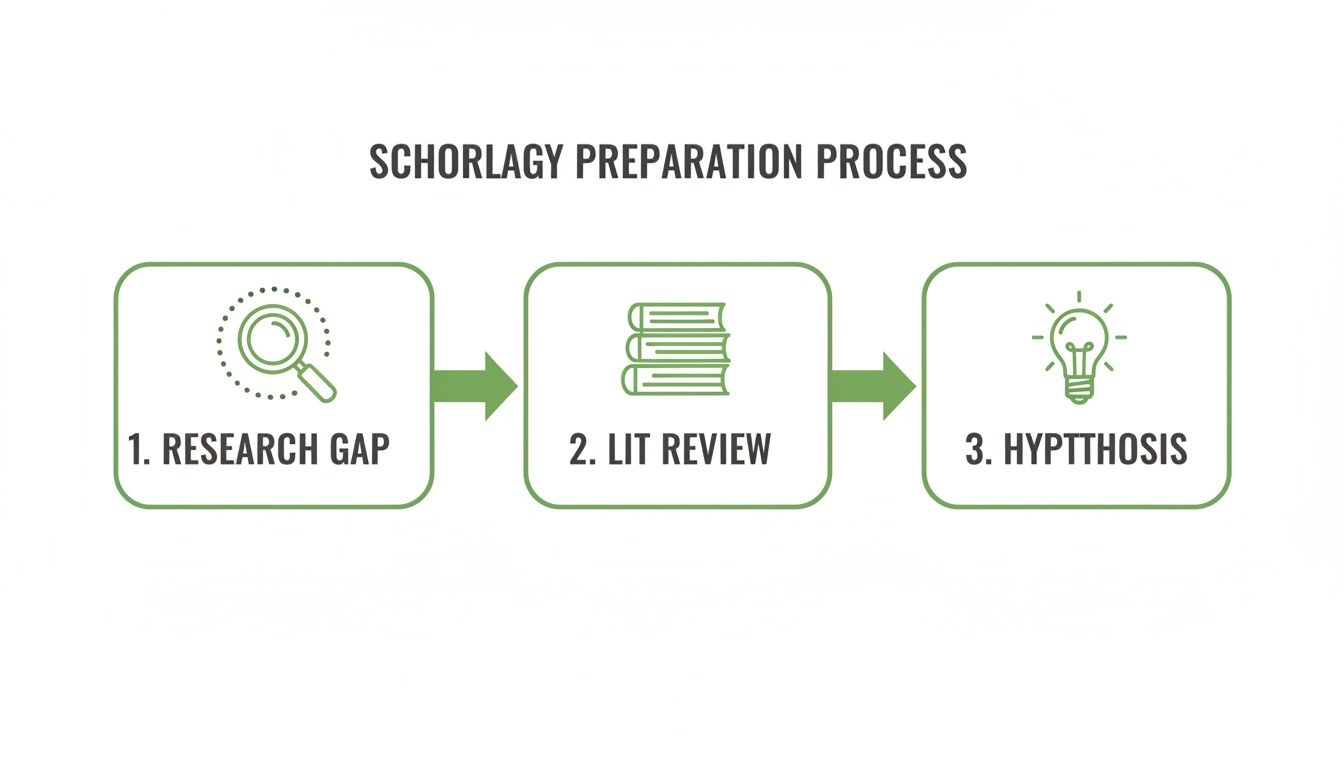
As you can see, a strong hypothesis doesn't come out of nowhere. It's the direct outcome of a rigorous search for a research gap and a thorough synthesis of what's already known.
Mastering the Literature Review
The literature review is where you prove you've done your homework and show exactly where your work fits into the larger academic conversation. Don’t just create an annotated bibliography that lists who said what. Instead, you should weave the literature together, organizing it around the major themes, schools of thought, and ongoing debates.
This analytical approach demonstrates a deep understanding of your field's history and gives you the perfect platform to launch your own contribution. If you want to go deeper, you can learn more about how to write a literature review in our detailed guide: https://naturalwrite.com/blog/how-to-write-a-literature-review.
This foundational work has never been more critical. The sheer volume of published research is staggering, with journal output in science and engineering growing by about 4% each year between 2008 and 2018. That’s a jump from 1.8 million to 2.6 million articles. In a crowded field like that, your work must be not only methodologically sound but also uniquely valuable if you want it to stand out. You can read more about these publication trends to get a sense of the landscape.
Structuring Your Article for Clarity and Impact
Think of your article's structure as its backbone. It holds everything together—every argument, every piece of data, every conclusion. A logical, intuitive framework is what guides your reader from the question that sparked your research all the way to your final, powerful takeaway. Without that solid structure, even the most brilliant findings can get completely lost.
In the world of empirical research, one structure reigns supreme: IMRaD. It’s an acronym for Introduction, Methods, Results, and Discussion. The vast majority of scientific journals expect this format because it creates a clear, predictable path for presenting research. It tells a simple, logical story: what you asked, what you did, what you found, and what it all means.

Many academics visualize IMRaD as an "hourglass." You start broad with the introduction, narrow down to the specifics of your work in the methods and results, and then broaden back out in the discussion to connect your findings to the wider field. This shape is so effective because it mirrors the actual research journey.
The IMRaD Framework Explained
On the surface, IMRaD seems simple, but each section has a very specific job to do. Truly understanding how to write a great scholarly article means getting the nuances of each part right.
Introduction: This is your hook. It sets the scene, points out the gap in the current research that you're about to fill, and clearly states your research question or hypothesis. It’s all about answering, "Why did you even start this project?"
Methods: Here, you lay out exactly what you did, step by step. This section needs to be so clear and detailed that another researcher could, in theory, replicate your study perfectly. It answers the question, "What did you do?"
Results: This is where you present your findings—and only the findings. It should be an objective, straightforward report of the data. Use figures and tables to show, not just tell. This section answers, "What did you find?"
Discussion: Now it’s time to interpret. In the discussion, you explain what your results mean, tie them back to the existing literature you mentioned in the intro, and honestly acknowledge any limitations of your study. It answers the big question: "So what?"
Think of it like a story. The intro sets the stage, the methods describe the action, the results reveal the climax, and the discussion delivers the resolution and explains why it matters.
A well-structured article isn't just about following rules; it's about respecting your reader's time and intellectual energy. The IMRaD format creates a predictable roadmap, allowing readers to quickly find the information they need and focus on the substance of your research.
When to Use Alternative Structures
While IMRaD is the gold standard for empirical studies, it’s definitely not a one-size-fits-all solution. Forcing some types of research into an IMRaD box can feel awkward and might even hide your central argument. Knowing when to break from the mold is just as crucial as knowing how to follow it.
Different fields and article types simply need different organizational flows to make their case effectively. A theoretical paper in the humanities, for instance, won't have a "Methods" or "Results" section like a clinical trial would. It just wouldn't make sense.
Recognizing the right structure for your work is key to its success. Here’s a quick breakdown of common structures beyond IMRaD to help you decide what fits your research best.
IMRaD vs Alternative Scholarly Article Structures
| Structure Type | Best For | Key Sections | Primary Goal |
|---|---|---|---|
| IMRaD | Empirical research, experimental studies, quantitative papers | Introduction, Methods, Results, Discussion | To present original research findings in a standardized, replicable format. |
| Thematic/Topical | Literature reviews, theoretical articles, qualitative analyses | Introduction, Thematic Sections, Conclusion | To synthesize existing knowledge or build a theoretical argument around key themes. |
| Chronological | Historical analyses, case studies, process descriptions | Introduction, Early Period, Middle Period, Late Period, Conclusion | To trace the development of a topic over time or narrate a sequence of events. |
| Problem-Solution | Policy papers, applied research, engineering articles | Introduction (Problem), Proposed Solution, Evaluation, Conclusion | To identify a specific problem and argue for the effectiveness of a proposed solution. |
Ultimately, your choice of structure should be driven by your research question and the story you want to tell. Trying to organize a historical analysis thematically could easily confuse your reader, just as presenting a lab experiment in chronological order would bury your most important findings. Always pick the structure that makes your argument as clear and persuasive as possible.
Writing Each Section Like a Pro
With your structure locked in, it’s time to get down to the actual writing. Think of each section of your paper as having its own unique job and its own voice. Shifting from one part to the next isn't just about filling in a template; it's about changing your perspective, from the 30,000-foot view of the abstract down to the nitty-gritty of your methods.
This is where your research transforms from a collection of data into a story that moves from a broad overview to specific details and, finally, to a meaningful conclusion. Getting this flow right is what separates a good paper from a great one.
The Abstract: Your First and Best Impression
Let's be honest—the abstract is often the only part of your paper someone will read. It’s your elevator pitch, and it needs to be powerful. A great abstract is a complete, self-contained summary of your entire project, packed into a single, compelling paragraph.
It has to nail four key things:
- The Problem: What research question or gap did you tackle?
- The Approach: How did you do it? Give a quick peek at your methods.
- The Findings: What were your most important results?
- The Implications: Why does any of it matter?
Essentially, it's a miniature version of your paper. For a much deeper dive, check out our guide on how to write a research abstract that will make editors sit up and take notice.
The Methods: Building a Foundation of Trust
Your methods section is all about credibility. The main goal here is simple: provide enough detail so that another researcher in your field could replicate your study perfectly. When it comes to methods, clarity and precision are everything.
Skip the long, narrative paragraphs. Instead, break this section down with clear subheadings like "Participants," "Materials," "Procedure," and "Data Analysis." This makes the information much easier for your reader to digest. Get specific about every single tool, measurement, and statistical test you ran. It’s also a good idea to briefly explain why you chose a certain method over an alternative—this adds a layer of authority and shows you've thought critically about your approach.
Here's the ultimate test for your methods section: Could a colleague read it and reproduce your experiment without asking you a single question? If not, you need more detail.
The Results: Just the Facts
In the results section, your job is to report what you found, period. There's no room for interpretation or commentary here. You are presenting your data as clearly and objectively as you can, letting the numbers speak for themselves.
Use figures and tables to help visualize your data, but don’t make the mistake of just repeating that information in the text. Instead, use the text to point out the highlights. For example, you might say, "As shown in Table 1, Group A's mean score was significantly higher (M = 15.2, SD = 2.1) than Group B's (M = 10.8, SD = 1.9)." This combination of a written summary and visual proof is incredibly effective.
The Discussion: Answering "So What?"
Finally, the discussion. This is where you get to connect all the dots. You’ll interpret your findings, explain what they mean, and tie everything back to the research question you introduced at the beginning. This is your chance to answer the most important question of all: "So what?"
A really solid discussion will always do these four things:
- Interpret the Findings: What do your results actually mean? How do they answer your initial question?
- Place Them in Context: How does your work fit in with what's already out there? Does it support, challenge, or add a new angle to the existing literature?
- Acknowledge Limitations: No study is perfect. Being upfront about your study’s limitations shows you're a critical thinker and builds trust with your readers.
- Suggest Future Directions: Where should research go from here? Offer some concrete ideas for studies that could build on your work.
Here, you shift from simply reporting information to building a compelling argument about why it matters. It requires a confident voice, one that’s firmly grounded in the evidence you’ve so carefully laid out in the previous sections.
Refining Your Draft with AI and Humanization
Getting that first draft down is a huge step, but the real work starts now. The revision process is where you take your raw ideas and shape them into a sharp, convincing scholarly article. This isn't just about catching typos; it’s about tightening your arguments, clarifying your points, and letting your unique academic voice come through.
AI tools can be a big help here, but you have to use them smartly and ethically. The idea isn't to let AI write for you, but to use it as an assistant to brainstorm, organize your thoughts, or get past a stubborn case of writer's block. Think of it as a collaborator, not a replacement.
Recent studies on academic writing trends are zeroing in on generative AI and academic integrity. The consensus is clear: technology is a helpful aid, but the final, thoughtful human touch is what elevates the work. This reflects a worldwide push to enhance scholarly communication, and you can discover more about these academic writing trends to see how researchers are adapting.
Using AI Responsibly in Academic Writing
When used thoughtfully, generative AI can be a fantastic partner. If you're bringing AI into your workflow, it's worth understanding how to compare AI models to pick the best one for your specific needs.
Here are a few ethical ways to lean on AI:
- Outlining and Structuring: Stuck on how to organize your discussion section? Ask an AI to suggest a few different structures or propose subheadings for a dense literature review.
- Summarizing Complex Sources: You can feed a complex paper into an AI for a quick summary of its core arguments. This can really speed up your literature review, but remember to always go back to the original source for the details and proper citation.
- Paraphrasing for Clarity: If a sentence sounds clunky, an AI can offer a few smoother alternatives. This isn't about dodging plagiarism—it's about finding the clearest way to present your own idea.
At the end of the day, you must maintain complete ownership of the intellectual work. You’re the author; the AI is just a tool in your belt.
From Robotic Text to Humanized Prose
One of the biggest giveaways of AI-generated content is its robotic, generic tone. It often lacks the distinct voice and nuance of an expert. This is why humanization is so important. You need to transform any AI-assisted text into prose that sounds natural, engaging, and genuinely yours, especially to get past the AI detection software many universities now use.
This is exactly what a tool like Natural Write is built for. It doesn't just swap out words. It analyzes the text's structure and refines it for better flow and tone, all while keeping your original meaning intact.
Your scholarly voice is your unique contribution to the academic conversation. While AI can help organize your thoughts, the final article must reflect your perspective, your analysis, and your intellectual fingerprint. Humanization ensures your voice isn't lost in the process.
For a deeper dive, our guide on how to rewrite AI text to sound human offers a complete walkthrough.
https://naturalwrite.com/blog/rewrite-ai-text-to-human
Classic Editing and Peer Feedback
Don't forget the tried-and-true methods. Self-editing and peer review are still the bedrock of great academic writing.
After you've done all you can, step away from the draft for a day or two. When you come back, read it out loud. You'd be surprised how many awkward phrases and logical holes you'll catch just by hearing the words.
Then, pass your draft to trusted colleagues or mentors. A fresh set of eyes can spot weaknesses you've become blind to, whether it's an unclear explanation or an argument that needs more evidence. Treat constructive feedback as a gift—it's what will push your work from good to great. Be open, listen, and get ready for another round of revisions.
Navigating the Submission and Peer Review Gauntlet
Finishing your manuscript feels like crossing the finish line, but in reality, you've just reached the starting blocks of the final leg: publication. This is where you pivot from researcher and writer to strategist, navigating the intricate world of academic journals, editors, and the often-daunting peer review system. Getting through this stage requires a good plan, a thick skin, and a healthy dose of patience.
The first, and arguably most critical, decision is picking the right journal. This single choice can make or break your paper's chances. It's tempting to just aim for the journal with the highest impact factor, but the real key is finding the best fit. Sending your work to a well-aligned journal ensures it gets reviewed by people who actually understand your niche and, more importantly, gets read by the audience you're trying to reach.
How to Choose the Right Journal for Your Work
Before you even think about hitting 'submit,' draw up a shortlist of three to five potential journals. For each one, you need to do some real detective work. Go straight to their scope and aims section on the website. Then, spend some time browsing the last few issues. Get a feel for the kind of work they publish. Does your methodology feel at home there? Does your topic and tone mesh with what you're seeing?
As you vet each journal, keep these factors in mind:
- Audience: Are they publishing for a broad, interdisciplinary crowd or for hardcore specialists? Your writing style needs to match who'll be reading it.
- Impact Factor (IF) and other metrics: An IF can give you a sense of a journal's prestige, but it isn't everything. Be realistic about your paper's novelty and find a good balance between ambition and practicality.
- Turnaround Time: Some journals are notoriously slow. If getting your work out quickly is a priority, check their website for submission-to-acceptance timelines.
Once you’ve settled on your top choice, follow their author guidelines to the letter. This is no time to cut corners. Ignoring formatting rules is a rookie mistake that screams "amateur" to an editor before they've even read your first sentence.
Putting Together a Winning Submission Package
Your submission isn't just your manuscript. You also need a sharp cover letter to navigate the often-clunky online submission portal. Think of the cover letter as your one chance to have a direct conversation with the editor and pitch your work.
Keep it brief and professional. In a few short paragraphs, introduce your core research question, shine a spotlight on your main findings, and clearly explain why your article is a must-read for their specific audience. This isn't a summary of the whole paper; it's the trailer that makes them want to see the movie.
A great cover letter doesn't just say, "Here is my paper." It says, "Here is a paper that solves a problem your readers care about, and here is why it belongs in your journal specifically."
This level of polish is absolutely essential. We're in a fiercely competitive space where rejection rates at top journals can easily hit 80-90%. Decisions often come down to perceived novelty and simple readability. With the number of academic journals having tripled since 1980 and international co-authorship now involved in over 20% of all papers, the need to stand out with clear, professional writing has never been greater. You can explore more research on scholarly publishing trends to get a better sense of the landscape.
How to Respond to Peer Reviewer Comments
Getting that email with peer reviewer feedback is always a nerve-wracking moment. But whether the editor is asking for minor tweaks or a major overhaul, how you respond is everything. The trick is to be respectful, thorough, and constructive—even when a comment stings.
I always recommend creating a separate "response to reviewers" document. It’s the best way to tackle every single comment, point by point.
- Start with Thanks: Always kick things off by thanking the editor and the reviewers for their time and insightful feedback. A little gratitude goes a long way.
- Go Point-by-Point: Copy and paste every single comment from the reviewers. Underneath each one, write your response and explain exactly how you've changed the manuscript, citing page and line numbers.
- Disagree Gracefully: It’s okay to push back on a suggestion you don't agree with, but you have to do it carefully. Politely explain why your original approach is more appropriate, backing up your reasoning with evidence from your data or the existing literature. Whatever you do, don't be dismissive.
This structured response shows the editor you’ve taken the process seriously and engaged deeply with the critique. It signals professionalism and a genuine desire to improve your work, which can be the very thing that turns a potential rejection into an acceptance.
Frequently Asked Questions About Scholarly Writing
Diving into the world of scholarly publishing can feel like navigating a maze. It’s totally normal to have questions, and this section is here to give you straightforward answers to some of the most common ones that pop up for researchers.

How Long Should a Scholarly Article Be
There’s no one-size-fits-all answer here. The right length is almost always dictated by the journal you're targeting and the norms of your specific field.
As a general rule of thumb, a typical science article might land somewhere between 3,000 and 6,000 words. In contrast, it’s not uncommon for humanities articles to stretch out to 8,000 to 12,000 words, sometimes even more.
Before you write a single word, find the journal's "Author Guidelines" or "Instructions for Authors" page. They’ll give you the hard limits, and following them is non-negotiable. It’s the first sign you give the editor that you're a professional who respects their process.
What Is the Difference Between a Scholarly Article and a Research Paper
People often use these terms interchangeably, but there's a key distinction that matters in academia. A research paper is really a catch-all term for academic writing that’s based on original research. Think of the papers you wrote for your university courses.
A scholarly article is a much more specific beast. It's a type of research paper written by an expert, specifically for publication in a peer-reviewed academic journal. This means it has survived a gauntlet of critical evaluation to become part of the scholarly conversation.
The real dividing line is peer review. A scholarly article has been scrutinized, fact-checked, and ultimately validated by other experts in the field. That’s what gives it the authority a standard student research paper just doesn't have.
How Do I Handle Impostor Syndrome When Writing
That nagging feeling that you're a fraud and are about to be found out? It’s called impostor syndrome, and it is rampant in academic circles. The pressure to contribute something truly original can feel crushing.
My best advice is to shift your focus from the final product to the daily process. Stop thinking about the massive task of "writing an article" and break it down into tiny, manageable wins.
- Today's goal: Just draft one solid paragraph. Don't edit, don't perfect—just get the core idea down.
- This afternoon's task: Find three key sources for your literature review. That’s it.
- Focus for this hour: Create the table for your results section.
By racking up these small victories, you build real momentum. More importantly, you gather tangible proof that you are making progress, which is the best antidote to feeling like an impostor. Every seasoned scholar you admire started exactly where you are: with a blank page and a head full of doubt.
Can I Cite a Blog Post or Website in My Article
The short answer is yes, but you need to be very careful and strategic about it. Your primary sources should almost always be peer-reviewed journal articles, academic books, and established conference proceedings. These are the gold standard.
However, there are times when citing a high-quality blog post from a leading scholar or a statistical report from a government website is perfectly acceptable. This is especially true if that source provides breaking information or a unique viewpoint you can't find in traditional publications.
It all comes down to credibility. Is the author an expert? Is the source reputable? If you do decide to cite it, be sure to follow your style guide (APA, MLA, Chicago, etc.) to the letter for formatting online sources, which usually involves noting the author, date, title, site name, and URL.
Feeling solid about your research but worried the writing comes across as robotic or AI-generated? Let Natural Write step in. Our tool is designed to refine AI-assisted drafts into prose that sounds genuinely human—clear, natural, and persuasive. It helps you maintain your unique academic voice and confidently pass AI detection checks. Polish your scholarly article with one click at https://naturalwrite.com.