
Think of your research abstract as the elevator pitch for your entire paper. It’s a single, powerful paragraph that has to convince a busy reader that your work is worth their time. The secret? Always write it after you've finished the full paper, not before.
Why Your Abstract Is the Most Important Paragraph You’ll Write

In the flood of academic publications, your abstract is the one thing that can make your work stand out. It’s more than just a summary; it’s a discovery tool, the ultimate sales pitch that gets your paper noticed in crowded digital libraries and search engines.
The sheer volume of new research is staggering. The number of global science and engineering journal articles ballooned from 1.8 million in 2008 to 3.3 million by 2022. With this explosion of information, researchers, reviewers, and editors simply don't have time to read everything. They rely almost exclusively on the abstract to filter what's relevant.
It’s a harsh reality, but studies suggest that up to 70% of readers never make it past the abstract. They make a split-second decision based on that short paragraph alone.
This makes the abstract your first—and often only—chance to make an impact. A poorly written one can get a brilliant paper completely ignored, while a compelling one can draw serious attention and citations.
The IMRaD Framework: Your Blueprint for a Killer Abstract
So, how do you craft a summary that hooks readers? The answer lies in the IMRaD framework. This structure is the backbone of most scientific writing, giving your abstract a logical flow that readers have come to expect.
At its core, IMRaD is about answering four key questions. Think of them as the pillars that hold your abstract together.
The Four Pillars of an Effective Research Abstract (IMRaD)
| Component | Core Question It Answers |
|---|---|
| Introduction | What problem did you investigate, and why is it important? |
| Methods | How did you conduct your research? What was your approach? |
| Results | What were your most significant findings? |
| Discussion (Conclusion) | What are the broader implications of your results? |
Each part guides the reader smoothly through your research narrative. Nailing this structure is a fundamental skill for anyone serious about better academic writing.
Interestingly, the principles are quite similar to what you'd find in guides on how to write effective executive summaries, where a concise, impactful overview is just as vital for busy decision-makers. Mastering IMRaD ensures your abstract isn't just informative—it's persuasive.
Building Your Abstract Piece by Piece
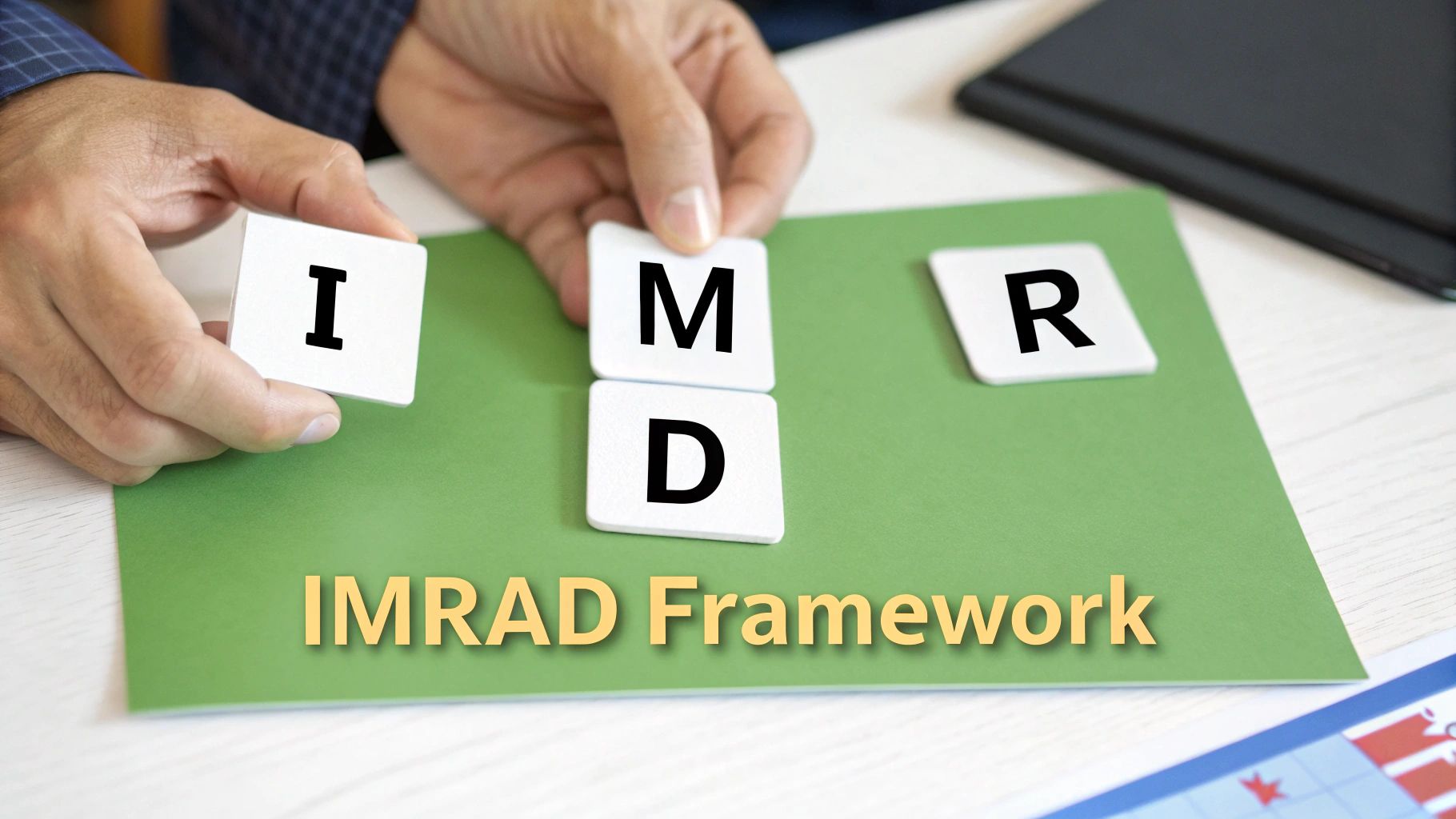
Alright, let's move from theory to actually writing this thing. The best way to tackle an abstract is to build it section by section. Think of the classic IMRaD framework—Introduction, Methods, Results, and Discussion—as a blueprint for telling a story. It’s a logical flow that guides your reader from a problem to your unique solution.
The real trick is telling that whole story in about 250 words. That’s not a lot of space. Your abstract needs to work like a killer elevator pitch, grabbing attention immediately.
We're going to break down each piece, with some real-world examples from different fields to show you how it's done.
Crafting the Introduction (The "Why")
Your first sentence or two has one job: hook the reader. You need to immediately establish the context and explain why your research even matters. This isn't the place for a meandering literature review. Just get straight to the point.
Start by clearly stating the problem or the gap in knowledge.
- For Social Sciences: "Despite the shift to remote work, we know very little about its long-term impact on mentorship and career growth for junior employees."
- For Engineering: "Current lithium-ion batteries are hitting a wall with energy density, which holds back the development of long-range electric vehicles."
- For Health Sciences: "The rise of antibiotic-resistant bacteria is a global health crisis, but the pipeline for new drugs is alarmingly dry."
See how these openings immediately signal what’s at stake? They identify a real, relevant problem that makes the reader want to find out how you solved it.
Describing Your Methods (The "How")
Next, you have to explain how you did what you did. This part needs to be ruthlessly concise. You're not writing a full methodology section here; you’re just giving the highlights. Focus on the core approach, the main variables you looked at, and the general scope of your work.
Unless it’s absolutely standard in your field, skip the heavy jargon. Clarity is key. If you need a refresher, check out these essential samples of methodology in a research paper for ideas on how to summarize this part effectively.
Here’s how our examples might build on their introductions:
- Social Sciences: "We ran a three-year longitudinal study, surveying 500 early-career professionals and their managers to track mentorship quality and promotion rates."
- Engineering: "This study developed a new silicon-graphene composite anode using chemical vapor deposition, then tested its performance in coin-cell prototypes."
- Health Sciences: "Using a high-throughput assay, we screened a library of 10,000 synthetic compounds against MRSA to find potential inhibitors."
Notice the specifics—numbers, key techniques. This adds a layer of credibility without getting bogged down in unnecessary detail.
Presenting Your Results (The "What")
This is the heart of your abstract. You need to deliver your most critical findings, and you need to do it directly. Don't make the reader hunt for it.
Whenever you can, use numbers. Concrete data gives your claims weight.
Pro Tip: Stick to your one or two most important findings. If you try to cram everything in, you’ll just dilute the message and confuse your reader. Pick the data that directly answers your main research question.
Let's look at the results from our ongoing examples:
- Social Sciences: "Our analysis found that fully remote employees reported 40% fewer informal mentorship opportunities and had a 15% lower promotion rate than their in-office peers."
- Engineering: "The new anode showed a 35% jump in specific capacity (to ~570 mAh/g) and kept 92% of its capacity after 500 cycles, blowing past conventional graphite anodes."
- Health Sciences: "The screen flagged one lead compound, HZ-24, which showed powerful antibacterial activity (MIC of 0.5 µg/mL) with low toxicity in human cells."
Each of these states a clear, data-driven finding. There’s no ambiguity. The results speak for themselves. If you're struggling to frame these points, our guide to creating a comprehensive research paper outline can help you structure the core arguments.
Stating Your Conclusion (The "So What")
Finally, you need to tie it all together. What do your results actually mean? This is your chance to connect your findings back to the big picture and explain the implications of your work. It's the ultimate takeaway message.
Your conclusion should answer the "so what" question one last time, giving the reader a sense of closure.
- Social Sciences: "These results indicate that companies need structured virtual mentorship programs to prevent career stagnation among remote staff."
- Engineering: "This anode design offers a real path forward for developing the next generation of batteries for the EV market."
- Health Sciences: "HZ-24 is a promising new scaffold for creating drugs to fight antibiotic-resistant infections."
That final sentence leaves a lasting impression and underscores why your research is important. By building your abstract piece by piece like this, you create a powerful, logical, and compelling summary that anyone can understand.
Mastering the Art of Concise Writing

You've built your abstract piece by piece, but now for the hard part: cramming it all into a tiny word count. Most journals and conferences give you a strict limit, usually somewhere between 150 and 300 words. And trust me, it’s not a suggestion—it’s a hard stop.
This is where you have to get ruthless. Every single word needs to earn its spot. Your goal is a summary that’s dense with information but still flows smoothly. It's an art form, really.
It’s less about just deleting words and more about making smart, strategic choices that maximize your impact.
Trim the Fluff Without Losing the Substance
Let’s be honest: your first draft will be too long. That’s totally fine; mine always are. The trick is to start trimming with a clear strategy, hunting down any language that doesn't add new, critical information.
Keep an eye out for these common word-count hogs:
- Redundant Phrases: Think "future plans." Just say "plans."
- Weak Verb-Adverb Combos: Instead of "quickly ran," why not "sprinted"? It’s shorter and punchier.
- Filler Words: Words like "really," "very," "in order to," and "basically" almost never add real meaning. Get rid of them.
Think of it like packing for a flight with a strict baggage limit. You have to lay everything out, decide what’s absolutely essential, and leave the rest behind. Every sentence must be packed with value.
A great abstract doesn't waste the reader's time. It gets straight to the point because it has to, communicating the core of your research with brutal efficiency.
If you want to go deeper on this, our guide on what is conciseness in writing has more techniques you can apply to all of your academic work.
Use Active Voice and Strong Verbs
One of the fastest ways to tighten your writing is to use the active voice. It's more direct and almost always uses fewer words.
Just look at the difference:
- Passive: "The data was analyzed by the research team." (7 words)
- Active: "The research team analyzed the data." (6 words)
It might not seem like much, but over an entire abstract, those saved words add up fast. Pairing the active voice with strong, specific verbs gives your writing more authority. Instead of saying "our findings show that," try "our findings indicate" or "our findings reveal."
These small shifts make a huge difference in how confident and direct your abstract sounds.
Strategically Weave in Keywords
When you're figuring out how to write a research abstract, remember you're writing for two audiences: humans and search engines. Academic databases like Google Scholar, PubMed, and Scopus rely on the keywords in your title and abstract to index your paper.
To make sure your work gets found, you need to include the right terms.
- First, identify 3-5 key terms that perfectly capture your topic, methods, and main findings.
- Next, weave these words naturally into your sentences. Don't just tack on a list at the end unless the guidelines specifically tell you to.
- Think like another researcher. What would they type into a search bar to find a paper just like yours?
For instance, if your paper is on a new machine learning algorithm for protein folding, you’d want terms like "machine learning," "protein folding," "deep neural network," and "predictive accuracy" to appear organically in your summary.
Your Self-Editing Checklist for a Polished Abstract
Before hitting submit, give your abstract one final pass. This last quality check helps you spot any lingering issues and guarantees your summary is as strong as possible.
Here's a quick checklist I run through every time:
- Is it within the word count? No excuses here. Use a word counter and keep trimming until you make it.
- Is the language clear and direct? Did you cut any jargon that isn't absolutely essential for your field?
- Does it stand alone? Can someone get the gist of your entire project just from these 200 words?
- Are the main findings obvious? Your most important results need to be stated clearly and explicitly.
- Is the active voice used? Hunt down any remaining passive constructions and flip them.
- Have you proofread for typos? A single mistake can undermine your credibility. I always read mine out loud—it’s the best way to catch awkward phrasing.
By methodically working through these steps, you can turn a clunky, oversized draft into a tight, powerful summary that does your research justice.
Common Abstract Mistakes to Avoid

Even the most seasoned researchers can make small missteps that get their papers sidelined. Crafting a powerful abstract isn't just about what you include; it's also about what you leave out. A few common errors can turn a compelling summary into a confusing one, causing reviewers and readers to move on without a second thought.
Learning how to write a research abstract means learning to spot these pitfalls in your own work. By seeing where others go wrong, you can make sure your abstract is clear, accurate, and persuasive.
Mistake 1: Being Too Vague or Mysterious
One of the most frequent mistakes I see is an abstract that reads like a movie trailer—it hints at the findings without actually stating them. You'll see phrases like "the results are discussed" or "implications for the field are explored," which tell the reader absolutely nothing.
The abstract isn't a teaser; it's a spoiler. Readers need to know your key findings right away to decide if the full paper is worth their time.
Don't Bury the Lead: A reader should finish your abstract knowing exactly what you discovered. If your main result is buried or vaguely referenced, you've lost the chance to make an impact.
For example, a weak abstract might say, "This study examined the effects of a new teaching method on student engagement." A much stronger version gets specific: "This study found that a project-based learning method increased student engagement by 25% compared to traditional lectures." See the difference? The second one delivers the core finding directly.
Mistake 2: Overloading with Jargon and Acronyms
Every field has its own specialized language, but a good abstract should be as accessible as possible. Your goal is to attract a broad audience, including researchers from adjacent fields who might not be familiar with every bit of your specific terminology.
If you cram your summary with technical jargon and undefined acronyms, you're just putting up a barrier. A good rule of thumb is to ask yourself: could a smart colleague from another department understand this? If the answer is no, it’s time to simplify.
Clarity is more critical than ever. With academic output soaring to 3.3 million science and engineering papers in 2022 alone, your work needs to be understood quickly. Sadly, this high volume has also seen a rise in retractions, with over 10,000 in 2023, sometimes stemming from abstracts that mask flawed work. You can discover more insights about global S&E research on the NSF's website to see these publication trends for yourself.
Mistake 3: Overstating Your Claims
Confidence is good; overclaiming is a huge red flag for any experienced reviewer. Your abstract must accurately reflect what your data can support. Avoid making sweeping generalizations or claims of certainty if your evidence is preliminary or limited in scope.
Using cautious but clear language like "our findings suggest" or "this study provides evidence for" is far more credible than definitive statements like "this proves." Let the results speak for themselves.
Mistake 4: Including Unnecessary Background
An abstract has a strict word count for a reason. Wasting that precious real estate on extensive background information is a rookie move. Yes, you need a sentence to set the context, but you definitely don't need a mini literature review.
Jump straight to the problem your paper addresses. Assume your reader has a basic understanding of the field. Every single word should serve the purpose of summarizing your unique contribution, not rehashing what's already known.
Here’s a quick checklist I share with my grad students to help them keep their abstracts grounded and effective.
Abstract Pitfall Prevention Checklist
This quick reference table can help you spot and fix some of the most common issues before you submit.
| Common Mistake | How to Fix It |
|---|---|
| Vague Results | State your most important finding directly. Use specific data or numbers whenever you can. |
| Excessive Jargon | Define essential acronyms and swap highly technical terms with simpler language where possible. |
| Overstated Claims | Make sure every statement in the abstract is directly supported by the data in your full paper. |
| Unfocused Narrative | Stick to the IMRaD structure (Introduction, Methods, Results, Conclusion) to keep the summary tight. |
Keeping these points in mind is a simple but powerful way to ensure your abstract does its job—getting the right people to read your paper.
Adapting Your Abstract for Any Audience
It’s a classic mistake to think your abstract has only one job: getting past a journal reviewer. But in reality, a well-crafted abstract is one of the most versatile tools in your academic arsenal. Think of it as a chameleon. It can be adapted for conference proposals, grant applications, and even those quick networking conversations.
Learning to tweak your abstract for different contexts is a real game-changer. The core of your research—the methods and results—doesn't change. What does change is the frame you put around it, shifting the emphasis to match what a specific audience actually cares about.
Tailoring for Conference Submissions
Conference reviewers are a tough crowd. They’re usually swamped with submissions and have to make snap decisions. Your abstract needs to hook them immediately and prove your presentation will be a valuable addition to the program.
When you're adapting your abstract for a conference, the focus shifts slightly:
- Emphasize the "Hook." You have to stand out. Start with a bold claim about the problem or a surprising finding.
- Highlight Relevance. Spell it out for them. Explicitly connect your research to the conference theme or a specific session.
- Focus on the Takeaway. Reviewers want to know what attendees will walk away with. Clearly state the practical implications or the main takeaway from your talk.
You’re not just summarizing a paper; you're pitching a session. The goal is to show how your work will spark conversation and contribute to the event's energy.
A journal abstract proves your research is sound. A conference abstract proves your research is interesting. Your adaptation has to highlight the novelty and broader appeal to convince organizers you deserve a spot on the stage.
Reframing for Grant Proposals
When you're writing for a grant funding committee, the stakes are totally different. These folks aren't just curious—they’re making a financial decision. They need to see a clear return on their investment, which means your abstract must do more than summarize. It has to persuade.
For a grant proposal, the abstract (often called a project summary) needs to answer one core question: "Why should we fund this?"
To do that, you'll need to adjust your emphasis:
- Foreground the Problem's Significance. Spend more time detailing why the research gap you're addressing is so important and urgent.
- Connect to Funder Priorities. Align your project's goals directly with the funding body's mission. Don't be shy about using their own keywords and language.
- Stress Future Impact. The conclusion should lean heavily on the potential long-term benefits, broader applications, and how your work will move the field forward.
This version is less about what you found and more about what you plan to find—and why it matters on a much larger scale.
From a thesis defense summary to a quick elevator pitch at a networking event, your core abstract can be reshaped for almost any professional scenario. Each version is an opportunity to communicate the value of your work, push your research forward, and open doors for your career. Mastering this adaptability turns a simple paragraph into a strategic asset.
A Few Lingering Questions About Abstracts
Even after you nail the basic structure, a few tricky questions always seem to pop up. Getting these small details right can be the difference between a submission that sails through review and one that gets held up for simple, avoidable mistakes.
Think of this as the final checklist before you hit submit. We're tackling the common queries that trip up even seasoned academics, making sure your abstract is not just well-written, but perfectly aligned with what journals and conferences expect.
How Long Should an Abstract Be?
There’s no single magic number here. The word count is almost always dictated by the journal, conference, or university you're submitting to. That said, the most common range you'll see is 150 to 300 words.
Your first, non-negotiable step is to check the submission guidelines. Seriously. They aren't suggestions; they're rules. If for some strange reason no guidelines are provided, aiming for around 250 words is a safe bet. That's usually enough room to cover all the key components without getting bogged down in detail.
Can I Put Citations in an Abstract?
The short answer is no. Almost never. An abstract has to stand on its own as a self-contained summary of your work. It needs to make sense without forcing the reader to go look up another source. Because of this, most journals and style guides explicitly forbid citations.
If you absolutely must reference a foundational theory or a specific method that isn't yours, just state it directly. For example, you might write, "Using a grounded theory approach..." or "Based on the principles of cognitive dissonance..." Save the formal citations for the main body of your paper, where they belong.
Should I Write the Abstract First or Last?
This one is easy: always write the abstract last.
It might be the first thing people read, but it should be the last thing you write. It’s a summary of a finished product. You can't accurately summarize your methods, results, and conclusions until the entire manuscript is locked in.
Trying to write the abstract first is a classic rookie mistake. It almost always leads to a summary that doesn't quite match the final paper, creating glaring inconsistencies that you'll have to fix later. Save yourself the headache and do it at the very end.
What Tense Should I Use?
A good abstract doesn't stick to a single tense. Instead, it strategically mixes them to tell the story of your research.
Here’s a simple way to think about it:
- Present Tense: Use this for background information and established knowledge. (e.g., "Anxiety is a common comorbidity...")
- Past Tense: This is for describing what you did—your methods and results. (e.g., "We surveyed 500 participants," or "The analysis revealed a significant correlation...")
- Present Tense (Again): Switch back to the present for your conclusions and implications. (e.g., "These findings suggest a new approach...")
This blend creates a natural flow, moving the reader from a general problem to your specific work and, finally, to the broader meaning of what you found.
Crafting an abstract that’s both concise and compelling takes real finesse. If your AI-generated draft still feels robotic or unnatural, Natural Write can help. Our platform instantly refines your text, ensuring it reads like a human-written piece while bypassing AI detection. Polish your abstract with confidence at https://naturalwrite.com.