At its heart, a narrative essay is about telling a true story with a point. To pull it off, you need to dig up a significant personal memory, shape it into a compelling story, and pack it with details that make your reader feel like they were right there with you. The final piece of the puzzle? Reflecting on what that whole experience actually meant.
Unlocking the Power of Personal Storytelling

Unlike a research paper that lays out facts or a persuasive essay that builds an argument, a narrative essay uses your own life to explore a theme. You’re not just listing what happened; you're revealing a personal truth you uncovered along the way. Think of it as a short story from your own life that has something important to say.
The real goal is to make your reader feel what you felt. You're their guide through a specific moment, showing them the sights, sounds, and emotions that made it real. This is where the magic happens—it’s how you build a powerful connection and turn a private memory into a shared experience.
Before we dive into the nitty-gritty of writing, let's get a clear picture of the core components you'll be working with. This table breaks down the essential building blocks of a strong narrative.
Core Components of a Narrative Essay at a Glance
| Component | Purpose | Key Action |
|---|---|---|
| A Specific, Real Event | To ground the story in a genuine personal experience. | Choose a single, focused memory with a clear beginning and end. |
| A Central Point or Theme | To give the story a reason for being told; the "so what?" | Identify the lesson learned or the main idea your story reveals. |
| Vivid, Sensory Details | To immerse the reader in the story's setting and atmosphere. | Describe what you saw, heard, smelled, tasted, and touched. |
| A Clear Story Arc | To structure the narrative with a beginning, middle, and end. | Build from an introduction to rising action, a climax, and a resolution. |
| A Consistent Point of View | To maintain a clear and authentic narrative voice. | Write from the first-person ("I") perspective. |
| Personal Reflection | To connect the events of the story to its deeper meaning. | Conclude by explaining the significance of the experience. |
Think of these as your ingredients. Mastering how to blend them together is what will make your story resonate with readers long after they've finished it.
Why Narrative Essays Matter
Learning to write a narrative essay is so much more than checking off an academic box. It’s a skill that fundamentally sharpens your ability to communicate with empathy and clarity. In almost any field you can imagine, from marketing to medicine, framing information within a compelling story gives you a massive advantage.
Mastering this style helps you build several crucial abilities:
- Emotional Intelligence: You learn to pinpoint and articulate complex feelings, which makes your writing incredibly relatable.
- Reflective Thinking: It forces you to pause, look back on your own life, and find the real meaning in your experiences.
- Creative Expression: You get a chance to play with literary tools like pacing, dialogue, and imagery to bring your story to life.
A great narrative essay doesn’t just tell a story—it shows why that story is worth telling. It connects a personal moment to a universal human truth.
The Growing Importance of Storytelling
The value of personal storytelling isn't just a hunch; the numbers back it up. The demand for strong narrative skills has grown right alongside the essay writing platform market, which hit a value of USD 1.8 billion in 2023 and is on track to reach USD 4.5 billion by 2032. This trend shows just how vital effective, human-centric writing has become.
One of the best ways to get a feel for this style is to see it in action. Reading through powerful examples of narrative stories can provide a ton of insight and inspiration. Seeing how other writers weave their experiences into impactful tales is an invaluable part of the learning process.
This guide is designed to give you a practical, no-fluff approach to help you craft a story that feels authentic and leaves a lasting mark on your reader.
Finding a Story Worth Telling
The heart of a great narrative essay isn't fancy language or a complicated plot. It’s a story that actually means something to you. Before you even think about crafting that killer opening line, you have to dig up an experience that carries some real emotional weight. Honestly, this is where most people get stuck.
So many writers start with an idea that’s way too big, like "my summer vacation in Italy" or "my high school graduation." These are subjects, not stories. The real story is hiding inside those big events—it’s the five minutes of pure panic when you got separated from your family in the Colosseum, or the flash of uncertainty you felt just before they called your name at graduation.
From Vague Ideas to Focused Stories
The best narratives zoom in on one specific, transformative moment. Your job is to trade a general idea for a single, emotionally-charged incident that shows the reader something important about who you are. You're not just listing what happened; you're exploring why it mattered.
Let's break it down:
Instead of: "My first job was hard."
Try: "The day my manager publicly blamed me for a mistake I didn't make, and I had to decide whether to speak up or stay silent."
Instead of: "I learned to play guitar."
Try: "The afternoon I nearly threw my guitar against the wall in frustration but finally strummed my first clear chord, teaching me what perseverance actually feels like."
Getting this specific is everything. It’s a bit like giving a great speech—good advice often emphasizes the power of focusing on a single, core story to connect with the audience. The same rule applies here. A narrow focus doesn't shrink your story; it makes it stronger.
Brainstorming Techniques That Actually Work
Staring at a blank page is the worst. Don't just sit there waiting for a lightning bolt of inspiration—go hunt for your story by digging into your own emotional past. Good ideas rarely show up perfectly formed. You have to coax them out by exploring the memories that have stuck with you for a reason.
Give these methods a shot:
- Emotion Mapping: Pick a powerful emotion—embarrassment, relief, pure joy, anger. Now, close your eyes and pinpoint the first time you remember feeling it intensely. Jot down everything you can about that moment. Where were you? Who was there? What did you hear or smell?
- The "Firsts and Lasts" List: Quickly list some significant firsts and lasts. The first time you drove a car alone. The last time you talked to a grandparent. The first day at a new school. These are natural turning points, and turning points are where great stories live.
- The Object Trigger: Find an object from your past that’s loaded with meaning. A faded concert ticket, a beat-up baseball glove, a chipped coffee mug. Describe it, then free-write about the memory attached to it. What story is that object waiting to tell?
The most compelling narratives almost always spring from moments of change, conflict, or realization. Look for the turning points in your life, even the ones that seemed small at the time. Your task is to show the reader why that moment was a big deal.
Vetting Your Story Idea
Okay, so you’ve got a few potential ideas. Before you dive in and start writing, you need to make sure your story has legs. Not every memory makes a good essay.
Run your idea through this quick checklist. Ask yourself:
- Is there a clear point? What’s the "so what?" Why are you telling this story? What did you figure out about yourself or the world?
- Is there conflict? Conflict doesn’t have to be a massive fight. It can be an internal struggle, a tough choice, or an unexpected hurdle.
- Did it change you? A strong narrative shows a shift. How were you different after this experience than you were before? The change can be subtle, but it has to be there.
- Can I "show" more than "tell"? Does this memory come with enough sensory details—sights, sounds, smells, textures—to pull the reader right into the scene?
If you can confidently say "yes" to these questions, you’ve probably landed on a winner. This little bit of vetting can save you hours of work on a story that was doomed from the start.
Building Your Narrative's Framework
So you’ve landed on a story you’re excited to tell. That’s a huge first step. But a great idea isn't enough; the real magic happens when you give that story a solid structure.
A powerful narrative isn't just a list of things that happened. It's a carefully crafted journey that grabs your reader by the collar and doesn't let go until the very end. This structure, often called the story arc, is the invisible skeleton holding everything together. It’s what gives your story its punch.
This visual breaks down the crucial first phase of finding that story—the foundation you need before you start building the framework itself.
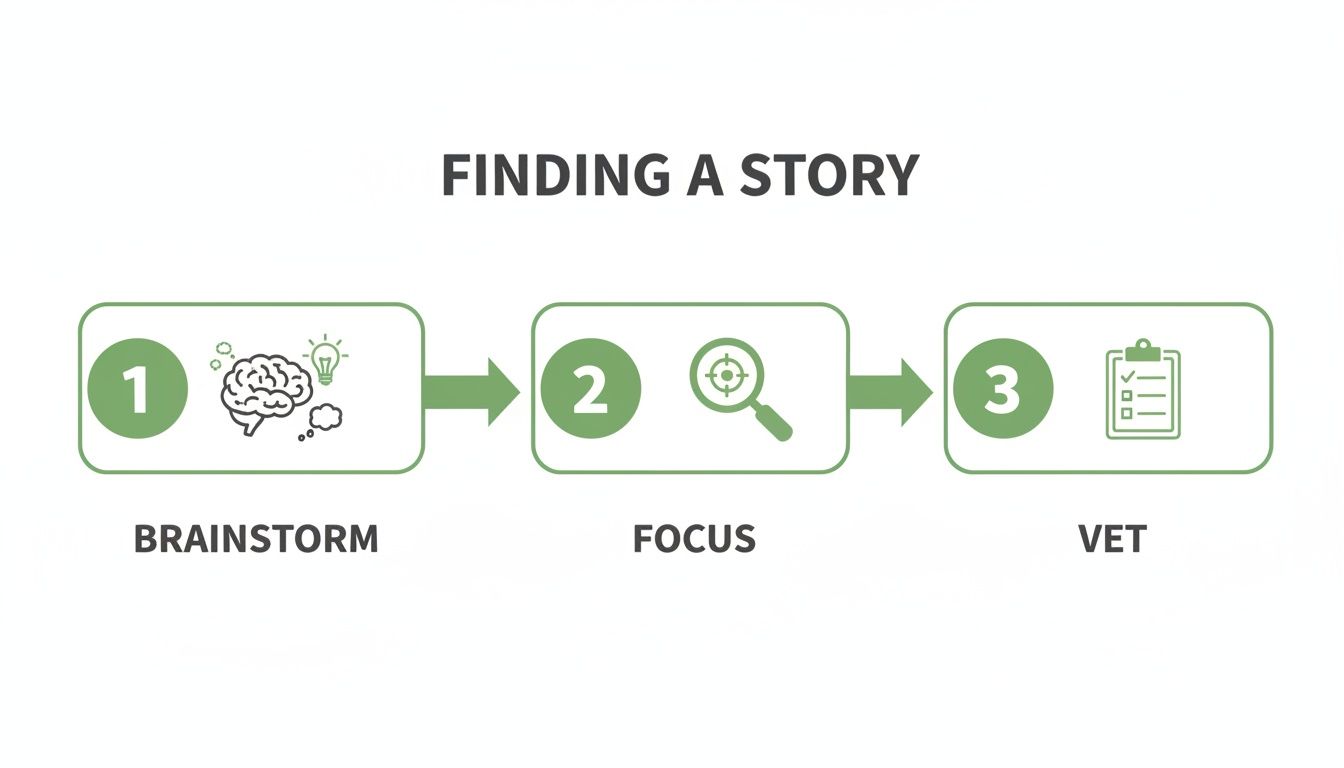
Once you've brainstormed, focused, and vetted your idea, you're ready to start building the actual narrative.
Mastering the Classic Story Arc
The classic story arc is a storyteller's best friend. It’s a time-tested blueprint for building tension and delivering a satisfying payoff. Think of it less as a rigid formula and more as a flexible guide to shaping your reader's experience.
Here’s how the pieces typically fit together:
- Exposition: This is where you set the scene. You introduce your characters (usually yourself), establish the setting, and give the reader just enough background to understand what’s going on.
- Rising Action: Now the story kicks into gear. A series of events and conflicts start to unfold, raising the stakes and creating suspense. Each step should logically build on the last, pushing you toward the story's peak.
- Climax: This is the turning point—the moment of maximum tension. It's where the central conflict comes to a head and something has to give. A strong climax is what the entire story has been building toward.
- Falling Action: After the fireworks of the climax, things start to wind down. The immediate aftermath is explored, and you begin tying up the loose ends.
- Resolution: This is where you land the plane. The conflict is resolved, and you take a moment to reflect on what happened. This is your chance to connect the dots and reveal the central theme or the lesson you learned.
Getting a feel for this flow is key. You can explore different essay structure examples and guides to see how professional writers put these elements into practice.
Crafting a Hook That Grabs Your Reader
Your first paragraph has one job: make someone need to read the next one. This is your hook, and it has to be sharp. An opener like, "I'm going to write about a time I learned an important lesson," will put your reader to sleep.
Instead, throw them right into the action.
The best narratives often start in media res—in the middle of a moment. It forces the reader to play catch-up and immediately become invested in what’s happening.
Try one of these powerful hook strategies:
- Startling Dialogue: Open with a line that makes you ask questions. “Don’t look down,” he whispered, but it was already too late.
- Vivid Sensory Detail: Drop the reader into a specific sensation. The metallic smell of rain on hot asphalt hung in the air, a split second before the screech of tires.
- A Mysterious Statement: Lead with a sentence that piques curiosity. I never would have gotten on that bus if I’d known it was the last time I’d see my hometown as I knew it.
The goal is to create instant intrigue.
Choosing Your Timeline Chronological or Non-Linear
Most narrative essays follow a simple chronological order. This is the most straightforward path, moving from the beginning to the end, and it's fantastic for building tension naturally. When in doubt, this is your safest and often most powerful bet.
But sometimes, breaking from a linear path can add incredible depth. A flashback, for example, can drop in a crucial piece of the past that sheds light on what's happening in the present. If you decide to jump in time, just make sure it’s for a good reason. Ask yourself: does this detour make the main story stronger, or does it just muddy the waters?
Ultimately, this is all about the art of storytelling—a skill that’s valuable far beyond the classroom. In fact, 42.1% of content creators worldwide now actively use storytelling in their professional work to connect with audiences. That same principle applies here: you're using a personal story to tap into a universal truth. A strong framework is the first step to making that connection resonate.
Making Your Story Come Alive

You’ve got your structure mapped out. Now for the fun part: breathing life into the words on the page. This is where you go from simply reporting a sequence of events to creating a living, breathing experience for your reader.
Your goal is to pull them out of their chair and drop them right into your memory. You want them to feel what you felt, see what you saw, and walk away feeling like they were really there.
The single most powerful way to do this? It’s the old, golden rule of writing: show, don't tell. This advice is repeated so often for a reason—it’s the fundamental difference between a story that feels like a police report and one that feels like a personal memory.
Telling is just stating a fact. Showing uses sensory details and actions to let the reader arrive at that fact on their own.
The Power of Showing Over Telling
Let's break this down with a real example. It's so easy to just state how you felt, but it’s a shortcut that robs your story of its power.
- Telling: "I was nervous before my speech."
- Showing: "My heart hammered against my ribs like a trapped bird. My palms were slick with sweat, and I could feel a tremor in my knees as I clutched the podium."
See the difference? The second version never uses the word "nervous." It doesn't need to. By painting a picture of the physical sensations, it forces the reader to feel that anxiety right alongside the narrator. You’re not just informing them; you’re creating an authentic emotional connection.
The core of a narrative essay is empathy. 'Show, don't tell' is your primary tool for building it. Instead of explaining your feelings, give the reader the evidence and let them draw their own emotional conclusion.
This technique is absolutely essential. If you're looking to build up your storytelling arsenal, exploring a guide on 10 essential narrative writing techniques can give you even more tools to make your writing pop.
Engaging the Five Senses
To truly immerse your reader, you have to go beyond just what things look like. The most powerful stories create a rich atmosphere by tapping into all five senses.
Think about walking into an old library. You don't just see the books. You smell the dry, sweet scent of aging paper. You hear the soft rustle of turning pages and the distant, muffled cough. You feel the cool, polished wood of the table under your hands. Those are the details that make a scene stick.
Try to weave these sensory layers into your own narrative:
- Sound: Was the silence heavy and absolute, or was it punctuated by the drip of a leaky faucet and the hum of a refrigerator?
- Smell: Did the air smell like fresh-cut grass after a summer rain, or did it carry the stale scent of disinfectant in a hospital hallway?
- Taste: Can you describe the bitter shock of burnt coffee or the juicy, sun-warmed sweetness of a peach?
- Touch: What did the splintery wood of the park bench feel like? Was the air thick and humid, or was there a crisp, cold bite to it?
Layering these details creates a world so tangible that your reader can’t help but step inside.
Finding and Honing Your Narrative Voice
Your narrative voice is, simply, the personality that shines through in your writing. Narrative essays are almost always written in the first person ("I"), so that voice has to feel real and consistent. It's what makes the reader trust that they're hearing a genuine story from a real person.
Your voice comes from a combination of things:
- Word Choice (Diction): Are you using formal, academic language or casual, everyday slang? The words you choose should match who you were at that point in your life.
- Sentence Structure: Are your sentences long and descriptive or short and punchy? Mixing them up creates a rhythm that keeps the reader engaged. A short sentence after a long one can hit like a punch.
- Tone: Is your story funny? Reflective? Somber? Anxious? Your tone should shift to match the emotions of the scene you're describing.
The best trick for finding your voice is to write like you talk, and then clean it up. Read your work out loud. Does it sound like something you would actually say to a friend? If it sounds stiff or robotic, rewrite it until it feels like you. A believable voice is what earns your reader's trust and makes your story truly matter.
Refining Your Essay for a Polished Finish
Turning a solid draft into a truly memorable narrative essay all happens in the revision stage. This isn't just a final sweep for typos and grammar mistakes; it's where you step back, look at the big picture, and shape your story into its most powerful form. This is how you take your work from "good" to "unforgettable."
Your first revision pass shouldn't get bogged down in commas and spelling at all. Instead, zoom out and focus purely on the story itself. Does your main theme really come through? Is the reflection at the end earned, or does it feel tacked on as an afterthought? A great trick I always recommend is reading your essay out loud. You'll instantly catch clunky sentences and weird pacing issues that your eyes might just glide over.
The Reverse Outline Technique
One of the most powerful, and frankly underused, tools for this process is the reverse outline. Instead of planning your essay before you write, you create an outline from what you've already written. Just go through your draft, paragraph by paragraph, and jot down the main point of each one in a single sentence.
This simple exercise is incredibly revealing and helps you see your story's skeleton with fresh eyes.
- Spot Redundancies: Do you have three different paragraphs essentially saying the same thing?
- Check the Flow: Does each point build on the last, creating a smooth, logical momentum?
- Find the Gaps: Are there any jarring jumps in logic or missing pieces in your story's arc?
Looking at your essay this way makes it easy to see where the narrative gets tangled or loses its way, so you can untangle it and restructure for the biggest impact.
Revising is your chance to “find” your story all over again. A reverse outline lays out all the puzzle pieces you've created, letting you decide if they're in the right place or if some need to be reshaped—or removed entirely.
Honing Your Draft with Modern Tools
In today's world, knowing how to use technology as a writing partner is a huge advantage. AI can be a great starting point for brainstorming or busting through writer's block. The problem is that raw AI output almost always sounds generic and lacks the personal voice that makes a narrative essay connect with a reader.
The use of AI in writing is exploding. Recent data shows a staggering 73.6% of students and researchers are now using AI for their work, with many relying on it for complex tasks. As this data on AI trends in research shows, the challenge isn't avoiding these tools but learning how to transform their robotic output into something that sounds genuinely human.
This is where that final polish becomes absolutely critical. Once you've nailed the story and structure, your last job is to make sure every sentence sounds like you. A tool like Natural Write can be a lifesaver here. It’s designed specifically to smooth out that clunky, AI-generated feel and improve the natural rhythm of your writing.
Using a humanizer ensures your final draft holds onto your unique perspective and avoids the pitfalls of AI detection, giving your authentic ideas the compelling voice they deserve. For a deeper dive, check out our comprehensive guide on how to revise an essay.
Your Narrative Essay Revision Checklist
To make sure you cover all your bases, I've put together this checklist. It breaks down the revision process into manageable steps, focusing on both the art of storytelling and the nitty-gritty technical details.
| Check Area | Key Question to Ask | Actionable Tip |
|---|---|---|
| The Hook | Does my first paragraph immediately pull the reader in? | Try starting with a line of dialogue, a vivid sensory detail, or a mysterious statement. |
| Pacing & Flow | Does the story's speed feel right? Are there slow moments for tension and faster sections for transitions? | Read the essay aloud to hear the rhythm of your sentences. Shorten sentences to speed up action; lengthen them to slow it down. |
| Sensory Details | Have I used "show, don't tell" to engage the reader's senses? | Scan your draft for emotion words like "happy" or "nervous." Replace them with descriptions of physical sensations or actions. |
| The "So What?" | Is the story's central theme or lesson clear by the end? | Your conclusion should reflect on the experience, not just summarize it. Explicitly state what you learned or how you changed. |
| Word Choice | Have I used strong verbs and specific nouns? | Use a thesaurus to replace generic words (like "walk") with more descriptive ones (like "stroll," "stride," or "stumble"). |
| Final Polish | Have I proofread for grammar, spelling, and punctuation errors? | Read your essay backward, sentence by sentence. This forces you to focus on each word individually, making it easier to spot errors. |
Think of this checklist as your final pre-flight inspection. Running through these questions will help you catch any remaining issues and feel confident that you're submitting your absolute best work.
Got Questions About Narrative Essays? Let's Get Them Answered.
When you're staring down the barrel of a narrative essay assignment, a few questions always seem to surface. It's totally normal. Getting these sorted out can be the difference between spinning your wheels and hitting the ground running. Let's clear up some of the most common ones.
How Long Should This Thing Be?
Most of the time, your instructor is looking for something in the ballpark of 500 to 1,500 words. But always, always check your assignment sheet first—that’s your source of truth.
The real trick isn't just hitting a number, though. It's about making the story fit the space you're given. A shorter essay might zoom in on a single, powerful moment, like the three minutes before you gave a big speech. A longer one gives you room to breathe, letting you build out a few different scenes and explore the aftermath.
My advice? Tell the story first. Worry about the word count later. It's much easier to trim a story that's too long or flesh out one that's a bit short than it is to write to a specific number from the get-go.
Is It Okay to Use Dialogue?
Not just okay—it's a great idea! Dialogue is your secret weapon for making a story feel alive. It breathes life into your characters and can break up dense paragraphs of description, which is a big win for your reader.
Just be sure to use it with purpose. Don't just add conversation to fill space. Every line should do some heavy lifting, whether that's revealing a character's personality, cranking up the tension, or moving the plot forward.
A few sharp, memorable lines of dialogue will always beat pages of aimless chatter. Think about how people actually talk—it's rarely in perfect, complete sentences. Keep it real.
When dialogue feels authentic, your characters stop being names on a page and start feeling like actual people.
Narrative vs. Descriptive Essays: What’s the Real Difference?
This one trips a lot of people up because both styles are all about using vivid, sensory details. It’s easy to see why they get mixed up.
The key difference is the purpose.
- A descriptive essay is a snapshot. Its goal is to paint a picture with words, immersing you in a specific place, person, or object. Think of it as a detailed photograph. There's no real plot.
- A narrative essay is a movie. It uses those same descriptive details to tell a story that moves through time. It has a beginning, a messy middle with some conflict, and an ending that offers a resolution or reflection.
So, while both might describe a stormy beach, the descriptive essay would focus on the look and feel of the waves and wind, while the narrative essay would tell the story of someone surviving that storm.
How Do I Stick the Landing with a Strong Conclusion?
A weak ending can sink an otherwise great story. Your conclusion is more than just a quick summary of "what happened." It's your chance to answer the most important question of all: So what?
This is where you connect the dots for your reader. Why did this story matter? What did you learn? How did this experience change you? Your goal is to zoom out from the specific events of your story and touch on a bigger, more universal truth.
To get there, ask yourself a few questions before you write that final paragraph:
- What’s the one thing I want my reader to remember?
- How am I different now than I was before this happened?
- What’s the bigger lesson here, beyond just my own experience?
Leave your reader with something to chew on—a new perspective, a powerful emotion, or a lingering thought. That’s the mark of a truly memorable ending.
Once you've poured your story onto the page, the final polish is everything. If you've used an AI assistant to get your thoughts down, you might find some parts feel a little stiff or unnatural. Natural Write is built for this exact moment. It helps smooth out any robotic phrasing, turning your draft into prose that sounds genuinely human, all while keeping your original voice intact. Give your essay the final touch it deserves at https://naturalwrite.com.