
An AI humanizer tool is what you reach for when machine-generated text just doesn't feel right. It takes that clean, but often sterile, output and gives it a human touch. It works by rewriting the content—varying sentence structure, swapping out predictable word choices, and generally mimicking the unique patterns of human writing. This not only helps the text connect better with readers but also helps it fly under the radar of AI detection systems.
What Is an AI Humanizer Tool

Think of an AI humanizer as a sophisticated translator. It’s not translating from one language to another, but from the predictable, often lifeless language of an AI into the nuanced, flowing prose of a human. Its main job is to polish that machine-written text until it feels authentic and engaging.
It’s like the final editing pass that closes the gap between the efficiency of a machine and the warmth of a real person. We all know AI-generated content can feel a bit repetitive or lack a certain rhythm. A humanizer tool is designed to fix exactly that, injecting a sense of naturalness and variability.
The Role in Modern Content Creation
In a world where AI is pumping out articles, emails, and reports left and right, these tools are becoming less of a novelty and more of a necessity. They help you hold onto a genuine brand voice, which is absolutely critical for building trust with your audience. After all, content that sounds authentic is far more likely to grab and keep someone's attention.
At its core, an ai humanizer tool is built to do a few key things:
- Improve Readability: It reorganizes sentences and paragraphs to create a smoother, more logical flow that people can actually follow.
- Enhance Authenticity: The tool mixes in human-like variations in tone, style, and vocabulary, so the text feels less like it came off an assembly line.
- Bypass AI Detection: By tweaking the very linguistic patterns that AI detectors look for, it helps your content appear genuinely human-written.
- Maintain Brand Voice: Many tools even let you customize the output, making sure the final text aligns with your specific personality or style guide.
An AI humanizer doesn't just swap a few synonyms. It re-engineers the text’s DNA. It plays with sentence length, complexity, and word choice to create the "burstiness" you see in human writing—where short, punchy sentences are mixed in with longer, more descriptive ones.
Why It Matters More Than Ever
The explosion of AI writing assistants has been a massive win for content production. Creators can now churn out drafts faster than ever before. But that speed often comes with a trade-off in quality. Raw AI output can get flagged by detection systems, which could potentially hurt your SEO and credibility. To learn more about this, you can check out our guide on what is AI-generated content.
Ultimately, an ai humanizer tool acts as an essential layer of quality control. It makes sure your content doesn’t just inform but also connects, resonates, and actually engages with the people you’re trying to reach—not just algorithms. For marketers, writers, and businesses trying to produce great content at scale, that makes it an indispensable part of the toolkit.
How AI Humanizer Tools Work Behind the Scenes

Think of an AI humanizer tool like a master editor, but one who does more than just fix typos. Instead, this editor’s job is to completely reshape a piece of writing to sound like it came from a specific person, not a machine. It’s a sophisticated process that goes way beyond just swapping out a few words.
The tool starts by taking the AI-generated text and looking for the classic fingerprints of a machine. These are things like perfectly consistent sentence lengths, a predictable vocabulary, and a general lack of rhythm. It’s essentially looking for the bot’s signature—efficiency without a soul.
Deconstructing and Rebuilding Text
Once the tool has a good read on the text, the rewriting engine gets to work. This is where the real magic happens. It doesn’t just patch the text; it rebuilds it from the ground up, injecting the kind of complexity and variation you see in human writing.
This rebuilding process involves a few key moves:
- Sentence Restructuring: The tool intentionally mixes things up, adding short, punchy statements alongside longer, more descriptive ones.
- Vocabulary Enhancement: It replaces common AI word choices with more interesting or context-specific synonyms that a human would be more likely to use.
- Paragraph Reflowing: The logic and flow of paragraphs are re-engineered to feel more like a natural, engaging story.
This focus on deep structural changes is what sets a humanizer apart from a simple paraphrasing tool. You can see similar principles at play in how AI video translator technology uses multiple AI layers to deliver natural-sounding dialogue in different languages.
Targeting Key Linguistic Metrics
At the heart of any good AI humanizer tool are two critical linguistic concepts: perplexity and burstiness. These are the metrics that separate robotic text from authentic human writing, and the tool is designed to tweak them both.
Perplexity is just a fancy way of measuring how unpredictable text is. AI-generated content often has low perplexity because it sticks to safe, common language patterns. A humanizer will intentionally introduce less common words and sentence structures to raise the perplexity score, making it much harder for detection algorithms to flag.
Burstiness, on the other hand, is all about variety. Humans write in bursts—a few short sentences, then a long, complex one. AI models tend to produce sentences of uniform length. A humanizer works to mimic this natural rhythm by actively varying the sentence structure. You can learn more about the tech behind this in our guide on what is Natural Language Processing.
By manipulating perplexity and burstiness, an AI humanizer doesn't just disguise the text. It fundamentally changes its character, giving it a rhythm and texture that feels genuinely human.
The Evolution of Humanization Technology
The technology behind these tools has come a long way. Around 2025–2026, AI humanizers became a standard part of the content creation workflow, especially in marketing, customer service, and e-commerce. Early reviews from that time show that the best tools were being benchmarked on clarity and linguistic authenticity. Enterprise-level tools, in particular, were focusing on deep edits to improve the readability of long-form content.
This evolution marks a shift away from just trying to beat AI detectors. The goal now is to create genuinely high-quality, engaging content. The best tools today don't just make text undetectable; they make it better. They make it clearer, more impactful, and a much better experience for the human on the other side of the screen.
Why Bother Humanizing AI Content? (It’s Not What You Think)
Using an AI humanizer tool isn't just about sneaking past detection software. That’s a small part of the picture. The real win comes from the strategic edge it gives your content, which directly shapes how people see—and respond to—your brand.
Think of it this way: humanizing your content isn't a defensive move. It's an offensive play in a world overflowing with generic, robotic text.
When you take a flat, machine-written draft and inject some warmth and personality, you're massively improving the reader's experience. This isn't just a "nice-to-have"; it has a real impact on your metrics. Readers stick around longer, which drops your bounce rate and tells search engines your content is actually worth reading.
It's a Game-Changer for SEO
Search engines like Google are getting smarter. They're no longer just looking for keywords; they're rewarding content that shows E-E-A-T: Experience, Expertise, Authoritativeness, and Trustworthiness.
Raw AI text almost always falls short here. It can't fake a genuine, experienced voice. It sounds generic, lacks a real point of view, and struggles to build the kind of trust that both readers and algorithms are looking for.
This is where humanized content bridges the gap. By refining the text to sound more authentic and credible, an AI humanizer tool helps your content align with what search engines want to see. This can lead to:
- Better Rankings: Content that people actually enjoy reading gets rewarded with higher spots in search results.
- More Organic Traffic: Higher visibility means more people find you without you having to pay for ads.
- Stronger Engagement Signals: Lower bounce rates and more time spent on your page are powerful signals that can give your SEO an extra boost.
Bottom line: you’re making your content more appealing to both humans and the algorithms that serve them.
Protect Your Brand's Unique Voice
Your brand voice is your personality. It’s what makes you you and helps you connect with the right people. Relying too heavily on generic AI output is a surefire way to dilute that voice until you sound like everyone else. For any brand trying to stand out, that's a massive risk.
An AI humanizer tool acts like a guardian for your brand identity. It takes the efficient but soulless draft from an AI and reshapes it to match your specific style and tone, keeping everything consistent.
This ensures that whether someone is reading a blog post, a social media update, or an email, they feel like they're hearing from you, not a machine. That consistency is everything when it comes to building lasting brand trust.
Build a Real Connection with Your Audience
At the end of the day, content is about connection. You want your audience to feel seen, understood, and engaged. But when content reads like a machine wrote it, an invisible wall goes up between you and the reader. A real connection becomes almost impossible.
Humanized text, with its natural rhythm and relatable language, tears down that wall. It builds trust, sparks conversation, and makes your audience feel like they're interacting with a real person. This emotional hook is what turns casual browsers into loyal fans and customers.
And getting this right doesn't just feel good—it delivers real business results. Industry reports show teams using humanizers can get content published 30–60% faster, all while seeing better engagement. You can dig into more of these productivity stats in these industry analyses on humanizeai.com.
AI Versus Humanized Text: A Side-by-Side Comparison
You really see the magic of an AI humanizer tool when you put its work side-by-side with the original AI draft. The difference isn't just a few swapped words; it's a complete shift in the rhythm, tone, and feel of the writing. It's often night and day.
Let's walk through a real-world example. Say you ask an AI to whip up a quick intro for a blog post on sustainable gardening. The first draft might come out looking a little stiff.
Before: The Raw AI Draft
"Sustainable gardening is a method of gardening that is very important. It focuses on using practices that do not harm the environment. Sustainable gardening helps to conserve natural resources. It also supports local ecosystems. This type of gardening is beneficial for the planet and for people. It is a good way to grow food."
Notice the repetition? "It focuses on...", "It also supports...". The vocabulary is flat ("very important," "good way"), and the whole thing reads like a textbook definition. It gets the point across, but it’s completely devoid of personality. Functional, but boring.
After: The Humanized Version
Now, let's see what happens when we run that same text through an AI humanizer tool.
"What if your garden could do more than just grow beautiful plants? Sustainable gardening offers a way to cultivate a thriving outdoor space that gives back to the planet. By focusing on eco-friendly practices, you can conserve precious resources and support the delicate balance of your local ecosystem. It’s a powerful approach that benefits both you and the world around you, turning every harvest into a win for nature."
See the difference? It kicks off with a question that pulls you in. It swaps out sterile phrases for more vivid language like "cultivate a thriving outdoor space" and "delicate balance." The sentences now have a natural rhythm, mixing different lengths to create a much smoother reading experience.
The core message hasn't changed, but the delivery is worlds apart. This is exactly what an AI humanizer tool does—it takes robotic text and gives it a human touch, making it something people actually want to read.
To break this down even further, here’s a table that highlights the specific shifts these tools make.
AI Text vs. Humanized Text Comparison
| Characteristic | Typical AI-Generated Text | Humanized Text |
|---|---|---|
| Sentence Structure | Repetitive and predictable. Often uses similar sentence lengths. | Varied and dynamic. Mixes short, punchy sentences with longer, more descriptive ones. |
| Tone of Voice | Formal, neutral, and often overly academic or sterile. | Conversational, engaging, and tailored to a specific audience. Uses personality. |
| Word Choice | Relies on common, safe, and sometimes generic vocabulary. | Employs more vivid, specific, and evocative language. Avoids clichés. |
| Flow and Rhythm | Can feel disjointed or "blocky." Lacks a natural cadence. | Smooth and logical flow with a natural rhythm that's easy to read. |
| Originality | Tends to use predictable phrases and structures seen across the web. | Introduces unique phrasing, rhetorical questions, and personal touches. |
| Engagement | Informs the reader but rarely inspires or connects with them emotionally. | Aims to connect with the reader through storytelling, questions, and relatable language. |
The goal isn't just to fool an AI detector; it's to create content that resonates with real people, holds their attention, and feels authentic.
This infographic neatly summarizes how humanizing your AI content pays off in very real ways for your brand, SEO, and reader engagement.
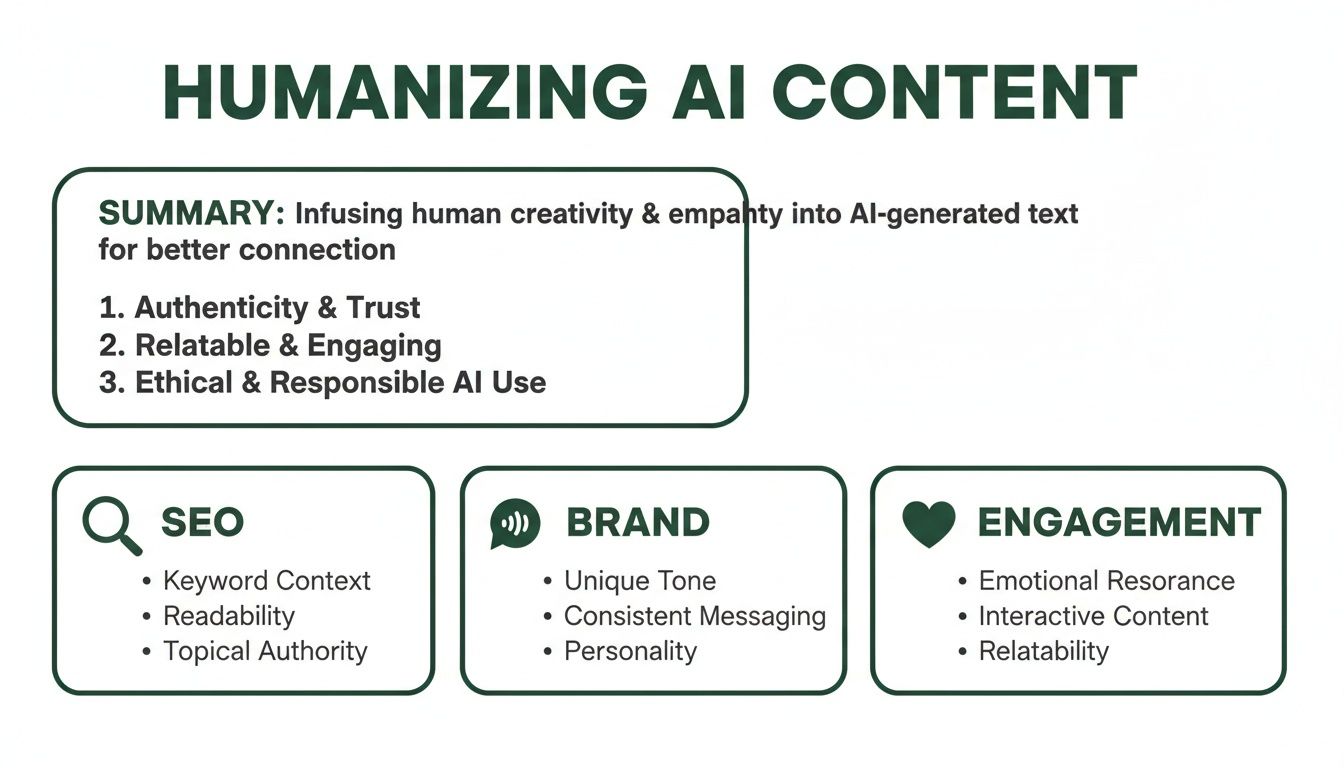
The key takeaway here is that all these benefits feed into each other. When your brand voice is stronger, you get better engagement, which sends all the right signals to search engines.
How to Choose the Right AI Humanizer Tool
With so many AI humanizers popping up, picking the right one can feel a bit like throwing a dart in the dark. But not all of them are built the same, and the best choice really boils down to what you need it for. A good decision here means finding a tool that actually makes your life easier, not just one that adds another tedious step to your process.
Let’s be honest: the most important thing is the output quality. Does the final text actually sound like a human wrote it? That’s the whole point, right? A great tool won't just swap a few words around. It will intelligently restructure sentences, smooth out the rhythm, and get rid of that robotic stiffness, all without losing the core of your message.
This is where the tech behind the tool really makes a difference. A simple paraphraser might change the words, but a true AI humanizer makes the writing better. It should feel more natural, more engaging, and completely authentic.
Evaluating Key Features and Performance
Beyond just sounding human, a few key features determine whether an AI humanizer tool will be a genuinely useful part of your workflow. You're looking for something that's not just effective but also fast and simple to use.
Here’s what you should be looking for:
- AI Detection Bypass Rate: This is a big one. The tool has to create content that consistently sails past major AI detectors like GPTZero, Originality.ai, and Turnitin. Look for companies that are open about their success rates and constantly update their models to stay ahead of the curve.
- Tone and Style Customization: One size never fits all. A good humanizer lets you pick a tone—like professional, casual, or academic—so the output matches your brand’s voice or the specific goal of your writing.
- User Interface (UI) and Ease of Use: The platform should be intuitive. A clean, simple interface means you can get your text humanized in seconds without having to watch a bunch of tutorials. Paste, click, and you're done.
A clunky or confusing tool just slows you down, which defeats the entire purpose of using something designed to make you more productive.
The best AI humanizer acts as a seamless extension of your editing process. It should empower you to refine AI drafts with confidence, not create friction with a complicated system.
Considering Practical and Security Factors
Okay, so you’ve found a tool that works well. Now it’s time to look at the practical side of things. These factors ensure the tool actually fits your budget, workflow, and security needs, making it a viable long-term solution.
Speed and Processing Time are huge, especially if you’re creating a lot of content. A tool that leaves you waiting for minutes to process one article is a workflow killer. You want something that delivers high-quality results almost instantly. At Natural Write, for instance, we’ve optimized our platform for real-time processing to keep you moving.
Next up, check the Privacy Policy. You’re pasting your work—sometimes sensitive or proprietary stuff—into this tool. You need to know how that data is handled. Stick with providers who have a clear, privacy-first policy and don’t store or sell your input text.
Finally, look at the Pricing and Value. Most tools have different tiers, from free trials to unlimited subscriptions. Think about the word limits, the features you get, and whether the cost makes sense for how much you’ll use it. If you're just getting started, finding an ai humanizer free trial is a great way to test the waters.
By carefully weighing these criteria—output quality, features, speed, privacy, and cost—you can confidently pick the perfect AI humanizer tool to elevate your content.
Fitting an AI Humanizer into Your Content Workflow
Bringing an AI humanizer tool into your process doesn't mean you have to tear everything down and start over. Think of it less like a major overhaul and more like adding a final, powerful finishing step. It slides right in between creating your AI draft and giving it a final human polish.
The whole thing is refreshingly simple. You can keep using your go-to writing assistant to get that first draft on the page. In fact, the smoothest workflows often involve pairing a humanizer with popular AI content generation tools, making it easy to clean up those initial outputs.
Once you have your AI-generated text, you just copy and paste it into the humanizer. With a click, the tool gets to work, transforming that robotic, predictable text into something that reads like it was written by a person. It does the heavy lifting of adjusting the tone, rhythm, and flow.
The Human Review: Your Most Important Step
After the tool has done its thing, it’s your turn. This is the most critical part of the process. While an AI humanizer tool is incredibly good at what it does, it's an assistant—not a replacement for your own judgment. Now’s your chance to add your unique perspective and make any final tweaks.
Read through the humanized text and ask yourself: does this sound like me? Does it match my brand’s voice? Look for any phrases that feel slightly off or could be sharpened with a personal touch. This final polish is what makes the content truly yours.
Your final read-through is non-negotiable. It's the step that bridges the gap between great AI-assisted content and a truly exceptional piece that reflects your expertise and unique point of view.
This "human-in-the-loop" approach is the sweet spot. You get the speed of AI combined with the irreplaceable nuance of a human eye. It’s the perfect blend of efficiency and authenticity.
Pro Tips for a Seamless Integration
To really get the most out of this new workflow, a few best practices can go a long way. These simple habits will help you get better, more refined results every single time.
Here are a few tips to make the process even smoother:
- Work in Smaller Chunks: Instead of dumping an entire long-form article into the tool at once, try humanizing it section by section. This often produces more context-aware results, as the tool can focus on the specific topic of each paragraph.
- Play with Tone Settings: If your humanizer has different modes or tone settings (like professional, casual, or friendly), don't be afraid to experiment. See which one best captures the voice you're going for in a blog post versus, say, a formal email.
- Never Skip the Final Check: I’ll say it again—always do a final human read-through. This is where you catch subtle errors, add a personal story, or make sure the piece is perfectly polished for your audience. That final touch makes all the difference.
Common Questions About AI Humanizers
As AI-generated content becomes more common, it's natural to have questions about the tools that help refine it. An AI humanizer is a powerful addition to any writer's toolkit, but knowing how to use it well—and responsibly—is what really matters. This section tackles some of the most frequent questions to give you clear, straightforward answers.
We'll dig into the difference between humanizers and paraphrasers, touch on the ethics, and set some real-world expectations about bypassing AI detection. The idea is to pull back the curtain on this technology so you can decide how it fits into your own workflow.
What's the Difference Between an AI Humanizer and a Paraphrasing Tool?
While both tools rewrite text, they have completely different goals. Think of a standard paraphrasing tool (sometimes called a "spinner") as a word-swapper. Its main job is to rephrase sentences and swap out words to get around plagiarism checkers. The output is often grammatically okay, but it can feel clunky and unnatural.
An AI humanizer tool, on the other hand, is doing something much deeper. It’s not just playing synonym roulette; it's re-engineering the text's DNA. It works to mimic the subtle rhythm, tone, and flow that make human writing feel... well, human.
A humanizer focuses on making the content:
- Engaging and Readable: It mixes up sentence lengths and structures to create a natural cadence.
- Authentic in Tone: It shifts the language to sound more conversational, professional, or whatever style you're aiming for.
- Undetectable: It specifically targets and reworks the predictable linguistic patterns that AI checkers are built to spot.
A paraphraser changes the words. A humanizer changes the vibe, turning a dry list of facts into something that actually connects with a reader.
Is Using an AI Humanizer Tool Cheating?
The ethics of using an AI humanizer tool really come down to one thing: intent. There’s no simple "yes" or "no" here, because the rules change depending on where you are.
In an academic setting, using a humanizer to pass off AI-generated work as your own original thought is a huge problem. It misrepresents where the ideas came from and violates academic integrity policies. Most schools and universities would absolutely consider this cheating, plain and simple.
But in professional fields like marketing, content creation, or business communications, it's a completely different story. Here, an AI humanizer is just an advanced editing tool. It’s not all that different from using a grammar checker like Grammarly, working with a human editor, or using an AI assistant to get a first draft on the page.
In a professional context, the goal is to produce high-quality content efficiently. An AI humanizer helps you polish an AI-assisted draft until it meets your brand's voice and quality standards. The key is to use it responsibly—as a tool to refine and improve, not to deceive.
Can Humanized Text Still Be Detected by AI Checkers?
This is the big question. While the best AI humanizers are incredibly effective at making text undetectable, no tool can offer a 100% foolproof guarantee every single time. It's a classic cat-and-mouse game: as AI writing models get smarter, so do the AI detection models designed to catch them.
Top-tier humanizers work by injecting the complexity and variation found in human writing, which dramatically lowers the chance of detection. They are very successful against most AI checkers out there today. However, there's always a slight possibility a piece of text could get flagged, especially as detection algorithms get more advanced.
The smartest approach is to treat the humanized text as a polished final draft, not the finished product. Let the tool do the heavy lifting—restructuring sentences and refining the tone—but always give it a final read-through yourself. That last human touch is where you can add a personal story, a unique insight, or a subtle tweak that erases any lingering AI fingerprints and makes the content truly yours.
Ready to see what a difference it can make? Natural Write turns robotic AI text into engaging, human-like content that connects with your audience and bypasses AI detectors. Try our free AI humanizer today and elevate your content in a single click. Learn more at Natural Write.