

The methodology in a research paper is the blueprint or recipe you followed to conduct your study. It lays out the exact steps and techniques you used to gather and analyze your data, making it possible for another researcher to, in theory, replicate your work. This transparency is what gives your findings real credibility and weight.
Your Research Blueprint: What the Methodology Section Really Is

Think of your methodology as the "how-to" guide for your entire study. Your introduction set the stage—it explained what you researched and why it mattered. Now, the methodology explains how you actually did it. It’s a clear, logical walkthrough of every choice you made to arrive at your answers.
Without a solid methodology, your results are just claims floating in the air, lacking a foundation. But with one, your findings become verifiable contributions to your field. This section is your chance to prove you conducted your research with rigor and care. It’s the engine room of your paper, powering the credibility of every conclusion you draw.
The Purpose of the Methodology Section
So, what's the point? The main goal is to give a crystal-clear account of your research process. This serves a few critical functions:
- Transparency: It lets other researchers see exactly what you did, from how you picked participants to the way you crunched the numbers.
- Replicability: It provides enough detail for someone else to repeat your study. This is a cornerstone of the scientific method.
- Credibility: A well-written methodology shows you know what you’re doing and convinces readers your results are trustworthy.
It really comes down to answering the fundamental questions: who, what, where, when, and how. A strong methodology is non-negotiable if you want to get published and have your work taken seriously. This section flows directly from your initial planning; for a deeper look at that, our guide on what is an outline of a research paper can help set the stage.
A methodology isn’t just a list of tasks; it’s a reasoned argument for why your chosen procedures were the best possible way to answer your research question. It's about justification, not just description.
Ultimately, this section is what transforms your research from a private project into a public, verifiable piece of knowledge. It’s the bridge connecting your research question to your findings, showing the precise path you took to get from one to the other.
Building Your Study: The Key Components of a Methodology
Alright, let's move from the "why" to the "how." A strong methodology is really just your research recipe—a detailed list of the ingredients and instructions you used. You need to explain each component clearly so anyone reading can see that you've built a solid, logical study.
A well-explained methodology leaves no room for doubt. It shows you were systematic and that your findings weren't just a happy accident but the result of a deliberate, well-thought-out process. Let’s break down the core pieces you need to nail down.
Your Overarching Research Design
First up is your research design. Think of this as the master plan for answering your research question. It's the big-picture strategy that guides every other choice you make. Are you just observing something in its natural habitat, or are you actively poking and prodding variables to see what happens?
Some common designs you'll see are:
- Experimental: This is where you actively manipulate one variable to see its effect on another, usually with a control group for comparison. It's the classic "cause and effect" setup.
- Correlational: Here, you're not interfering at all. You just measure two or more variables to see if there's a statistical relationship between them.
- Descriptive: The goal here is simple: to accurately describe a group, situation, or phenomenon as it is.
- Case Study: This involves a deep, detailed dive into a specific person, group, or event.
But just naming your design isn't enough. You have to justify it. Explain why this particular approach was the absolute best fit for tackling your research problem.
Participants and Sampling Methods
Next, tell us who (or what) you actually studied. You need to define your target population—that's the entire group you hope your findings will apply to. But since you probably can't survey every single person in that group, you'll describe your sample, which is the specific slice you collected data from.
This part is critical: you have to explain your sampling method. How did you choose the people in your sample? This choice directly affects how much you can generalize your findings. Did everyone in the population have an equal shot at being picked (like in random sampling)? Or did you go with a more practical approach (like convenience sampling)? Be super specific about your sample size and who they were (demographics).
Data Collection Instruments and Procedures
This is where you get into the nitty-gritty. What instruments did you use to gather your data? These are your tools—things like surveys, interview questions, observation checklists, or even fancy lab equipment. If you used a well-known tool, like a standardized psychology scale, name it and give credit to the creators. If you built your own, you'll need to explain how you did it and what you did to make sure it was reliable.
Then, walk us through the step-by-step procedures.
- How did you find and get people to participate?
- What instructions did you give them?
- Where and when did all this happen?
- How long did it take for each person?
You need to provide enough detail that another researcher could come along and do the exact same thing. This blueprint for replication is what gives your work validity. Global standards often shape this, with the OECD's Frascati Manual serving as a key guide for its 38 member countries since 1963. This push for standardization is happening as research output explodes; the NSF reported 3.3 million science and engineering articles in 2022, a 59% jump from 2012. Methodologies need to be crystal clear, especially as focus areas differ—U.S. research leans into health sciences (37%), while China's is heavy on engineering (25%). If you want to learn more, you can discover insights about research process types on quantilope.com.
Data Analysis Methods
So you've collected all this data. Now what? This section is where you explain your data analysis methods. For a quantitative study, this means telling us exactly which statistical tests you ran—t-tests, regressions, ANOVAs, you name it. Don't forget to mention the software you used, like SPSS, R, or Stata.
For qualitative work, you'll describe how you made sense of all the text or observations. Did you do a thematic analysis to find patterns? A content analysis to count specific words? A discourse analysis to study language? Explain your process for pulling out key themes and insights from the raw data.
Key Takeaway: Your analysis should always circle back to your research questions. Make it obvious which analytical tool you used to answer each specific question. This closes the loop and shows your design was intentional.
Ensuring Validity, Reliability, and Ethical Conduct
Finally, you need to prove your research is high-quality and trustworthy. Talk about the steps you took to ensure validity (that you actually measured what you intended to measure) and reliability (that your results are consistent and could be repeated).
And don't forget to cover ethical considerations. This is where you mention getting informed consent, protecting participant anonymity, and getting approval from an institutional review board (IRB). This shows you're not just a rigorous researcher, but a responsible one, too.
Choosing Your Approach: Quantitative, Qualitative, and Mixed Methods
Picking the right research methodology is a lot like choosing the right tool for a job. You wouldn't use a hammer to saw a piece of wood. In the same way, your research question determines which approach will give you the clearest, most accurate answer. There are three main toolkits to choose from, and each offers a totally different way of seeing your topic.
Think of quantitative research as using a wide-angle lens. It’s all about capturing the big picture by focusing on numbers, statistics, and large-scale patterns. This approach is perfect for answering questions about "how much" or "how many" and is your go-to when you need to test a hypothesis across a large group.
On the flip side, qualitative research is like switching to a macro lens. It zooms way in to capture the tiny, intricate details. This method helps you explore the "why" behind what people do, digging deep into their experiences and motivations through things like interviews or observations. Here, words and stories are your data, not numbers.
Understanding Quantitative Methods
Quantitative research is all about objective, numerical data. If your goal is to measure something, test a theory, or predict an outcome, this is probably the path for you. The information you gather will be structured and statistical, which means you can often generalize your findings to a much larger population.
This focus on numbers has made it the heavyweight champion in many fields. In 2023, for instance, quantitative methods accounted for a massive 70% of the global market research industry's revenue, while qualitative methods only made up 14%. The preference for hard data is especially strong in Europe, where 76% of all research is quantitative. It just goes to show how much weight people put on statistical proof.
Exploring Qualitative Methods
But what if your research question is more exploratory? That’s where qualitative methods really shine. This approach gives you the depth you need to understand complex social situations, uncover what truly motivates people, or just explore a brand-new idea in rich detail.
Instead of surveying hundreds of people, you might work with a small, focused group to get incredibly deep insights. The goal isn't breadth; it's richness. Sometimes, this kind of deep dive is a vital first step before you launch a bigger quantitative study. Other times, it stands on its own as a powerful piece of research. A solid literature review will often signal when you need to start with this kind of exploratory work. To get that part right, check out our guide on how to write a literature review.
This decision tree gives you a quick visual for figuring out if your goals are better suited to explaining and testing (quantitative) or exploring and understanding (qualitative).
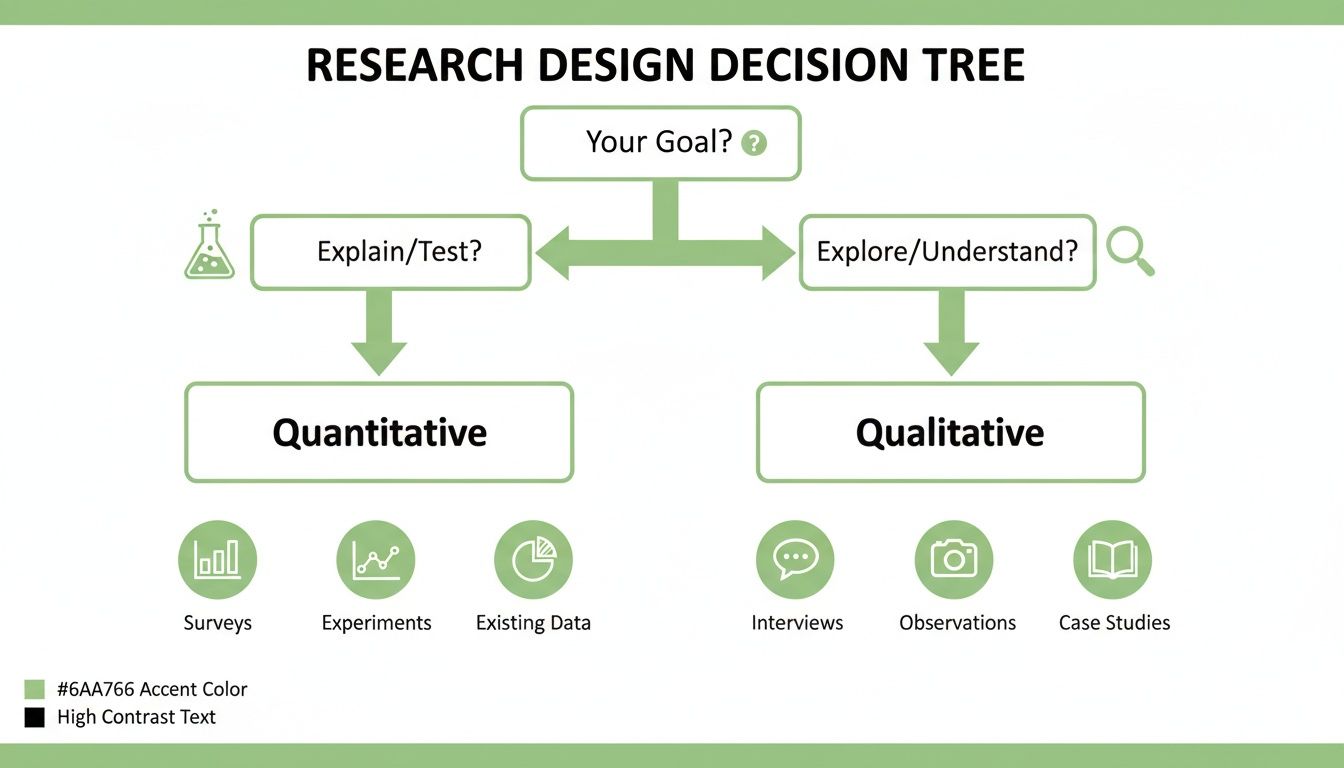
As you can see, it all comes back to what you're trying to find out. Your question is your compass.
Leveraging Mixed Methods
Of course, sometimes you don’t have to choose. A mixed-methods approach brings quantitative and qualitative techniques together in a single study. This lets you have your cake and eat it, too—you get the bird's-eye view from the numbers and the on-the-ground story from people's experiences.
By combining both, you can cross-check your findings, gain insights you’d otherwise miss, and make sense of surprising results. For example, you could run a quantitative survey that reveals what trend is happening, then follow up with qualitative interviews to figure out why it's happening.
This process, sometimes called triangulation, creates a much stronger, more complete picture. It adds layers of validity to your conclusions and gives you a far more robust answer to your research question.
To make the choice a little clearer, here’s a quick breakdown of how these three approaches stack up against each other.
Quantitative vs. Qualitative vs. Mixed Methods at a Glance
| Aspect | Quantitative | Qualitative | Mixed Methods |
|---|---|---|---|
| Primary Goal | To test hypotheses, measure variables, and establish cause-and-effect. | To explore ideas, understand experiences, and uncover underlying meanings. | To get a comprehensive view by combining breadth and depth. |
| Data Type | Numbers, graphs, and tables. | Words, images, and observations. | Both numerical and textual/observational data. |
| Key Questions | How many? How much? What is the relationship? | Why? How? What are the experiences? | Both sets of questions, integrated to inform each other. |
| Sample Size | Large, to ensure statistical significance and generalizability. | Small, to allow for in-depth, detailed data collection. | Varies; can be large, small, or involve multiple samples. |
| Data Analysis | Statistical analysis, mathematical modeling. | Interpretation of themes, patterns, and narratives. | A combination of statistical and thematic analysis. |
| Strengths | Objective, generalizable, allows for comparison. | Rich, in-depth understanding of context and nuance. | Provides a more complete picture, validates findings. |
| Weaknesses | Lacks context, can't explain the "why." | Not generalizable, can be subjective. | Complex, time-consuming, requires expertise in both methods. |
Ultimately, there's no single "best" method—only the one that is best suited to answer your specific research question.
How to Write a Powerful Methodology Section Step by Step
Alright, you've got the key components down. Now it’s time to put pen to paper. Writing a great methodology is a skill, and the goal is to create something clear, compelling, and easy for anyone to follow. Let's walk through how to turn your research plan into a powerful section that builds trust with your reader.
First, a quick but important rule of thumb: write this section in the past tense. You're reporting on what you did, not what you plan to do. Phrases like "participants were recruited" or "data were analyzed" frame your work as a completed, verifiable process. It's a simple tense shift that adds a ton of credibility.
Justify Every Single Choice
If you remember one thing, make it this: justify everything. Don’t just list what you did; explain why you did it. Why a survey instead of a series of interviews? Why that specific statistical test? Every decision you made should feel deliberate and aimed squarely at answering your research question.
Think of yourself as a lawyer building a case for your research. Each methodological choice is a piece of evidence, and your justification is the argument that proves its validity. This simple mindset shift turns a dry description into a persuasive story, showing your reader that your approach was rigorous and thoughtfully designed.
A great way to strengthen your case is to tie your choices back to established practices in your field. Citing literature that supports your chosen methods shows you’ve done your homework and aren't just making things up as you go. For a refresher on the mechanics of this, our guide on how to cite sources in a research paper has you covered.
Pro Tip: Don't make your reader work hard. Use clear subheadings that mirror the key components (e.g., "Research Design," "Participants," "Data Collection"). This creates a logical roadmap and makes your methodology a breeze to follow.
Start Writing with Confidence
Staring at a blank page is the worst. To get the ball rolling, lean on some established phrasing to structure your thoughts. These sentence starters aren't cheats; they’re a way to ensure you're speaking the language of academic research right from the get-go.
Here are a few examples to kick things off:
- "This study employed a [quantitative/qualitative/mixed-methods] design to..."
- "Participants were recruited from [population] using a [sampling method]..."
- "Data were collected using a [instrument name], which is a..."
- "The primary instrument for this study was a survey adapted from..."
- "Following data collection, a [type of analysis] was conducted using [software name] to..."
Using frameworks like these helps you stay precise and thorough. Remember, the goal isn't just to explain what you did—it's to convince the reader that it was the right way to do it.
Common Mistakes That Will Sink Your Methodology Section

You could have the most groundbreaking findings in the world, but if your methodology section is weak, your paper is dead on arrival. This part of your research is put under a microscope, and a few common pitfalls act as giant red flags for reviewers, often leading straight to rejection.
Getting this right is all about demonstrating rigor and earning the reader's trust. Let's walk through the mistakes that trip up even experienced researchers.
One of the most common errors? Insufficient detail. Your methodology needs to be a crystal-clear, step-by-step recipe. If another researcher can’t follow your instructions to replicate your study, it loses all scientific credibility. Don't just name a technique—explain exactly how and why you used it.
Mismatching Your Methods and Questions
This one is a fatal flaw: a total disconnect between your research question and the method you chose to answer it.
Think about it. If you want to deeply understand the lived experiences of a small community, blasting out a quantitative survey to thousands of people is the wrong tool for the job. On the flip side, you can't generalize findings to an entire population based on ten qualitative interviews.
This kind of misalignment shows a basic misunderstanding of research design. Your methodology has to be the logical bridge that connects your question to your answer.
- Before: "We used a survey to collect data on employee burnout." (Vague. Why a survey?)
- After: "To measure the prevalence of burnout across the tech sector, this study employed a quantitative survey, specifically the Maslach Burnout Inventory. We chose this validated instrument because our goal was large-scale population assessment." (Specific, justified, and clear.)
Failing to Justify Your Choices
Simply listing what you did isn't enough. You have to defend your choices. Why that particular sampling technique? Why did you pick one statistical test over another? Every decision you make shapes your results, and reviewers need to see the strategic thinking behind it.
Without that justification, your methods can seem random or, even worse, chosen for convenience.
For example, if you're using trend analysis, a detailed account of your process is non-negotiable. Strong trend methodologies are designed to prevent common errors. Poor data cleaning alone is blamed for up to 20% of analysis failures, which makes a transparent process essential for credible research. You can explore more about trend analysis methods on market-xcel.com.
A strong methodology doesn't just list the facts; it builds a compelling argument. It systematically convinces the reader that your approach was the single most appropriate and rigorous way to tackle the research problem.
Ignoring Limitations and Brushing Off Ethics
Finally, a critical mistake is pretending your study is perfect. It isn't. Every single research project has limitations—maybe it's a small sample size, a focus on a specific demographic, or a reliance on self-reported data.
Ignoring these weaknesses doesn't make them vanish; it just makes you look naive or, worse, dishonest.
Acknowledging your study's limitations shows you have a sophisticated understanding of its scope and boundaries. It builds credibility and gives readers the context they need to interpret your findings properly. In the same vein, glossing over ethical considerations like informed consent or data privacy is a massive red flag that can undermine your entire paper.
Transparency is non-negotiable. Be upfront about both your limitations and your ethical safeguards.
Your Top Methodology Questions, Answered
Let's clear up some of the most common points of confusion researchers have. These are the questions that come up time and time again about what a methodology section really needs to do.
How Long Should My Methodology Section Be?
There’s no magic word count. The length depends entirely on how complex your study is. A simple quantitative survey might only need a few paragraphs, while a deep-dive mixed-methods study could easily stretch over several pages.
The real goal here is clarity and replicability. Think of it this way: could another researcher pick up your paper and repeat your study exactly? If the answer is yes, it's long enough. If not, you need more detail. Focus on being thorough, not just hitting an arbitrary length.
Where Does This Section Actually Go?
The methodology section is the bridge between your theory and your findings. It almost always comes right after the introduction and literature review.
The flow is logical:
- Introduction: You explain the what and the why of your research problem.
- Literature Review: You show what's already known.
- Methodology: You detail how you did it.
- Results: You present what you found.
Placing it here allows you to connect the background of your study to the concrete data you're about to share.
Is It Okay to Use or Adapt Methods From Another Study?
Absolutely. In fact, it's not just okay—it's often a sign of strong research. Using an established, validated method adds a layer of credibility to your own work. It shows you're building on the shoulders of others.
But you can't just copy and paste their description. You have to:
- Cite the original source: Always give full credit where it's due.
- Summarize it in your own words: Briefly describe the method.
- Justify why you chose it: Explain why that specific method was the right tool for your research question.
- Detail any changes you made: If you tweaked the original method at all, you must explain what you changed and why.
This brings up a crucial point: the difference between 'methods' and 'methodology.' Methods are the tools you use (like a survey or an interview). Methodology is your overarching strategy and rationale—the "why" behind your choices.
Grasping this distinction is what separates a good methodology section from a great one. It shows you've thought strategically about your research design, not just listed a series of steps.
Ready to transform your research drafts into polished, professional writing? Natural Write offers a free, one-click solution to humanize AI-generated text, ensuring your work is clear, natural, and bypasses AI detection with ease. Try it now.