TL;DR: Faulty parallelism is a grammatical error that occurs when matching items in a sentence (like items in a list or parts of a comparison) do not follow the same structural pattern, making the sentence sound awkward and unclear. When sentences break parallel structure, they increase cognitive load and sentence processing time because readers have to stop and mentally recalculate the pattern, as explained by the University of Waterloo Writing and Communication Centre.
You’re probably here because you read a sentence that sounded off, but you couldn’t immediately explain why. Maybe it was your own paragraph. Maybe ChatGPT gave you a draft that looked polished at first glance, then somehow felt stiff, uneven, or slightly unnatural once you read it aloud.
That feeling often comes from faulty parallelism.
It’s one of those grammar issues that hides in plain sight. A sentence can have correct spelling, acceptable punctuation, and a clear topic, yet still feel clunky because its parts don’t match. Once you learn to spot the pattern, the problem becomes much easier to fix.
Why Some Sentences Just Feel Wrong
Some sentences make you work harder than you should have to. You read the first part, expect a certain rhythm or structure, and then the sentence suddenly shifts shape. The meaning is still there, but the path to it gets bumpy.
That bump has a name. It’s often faulty parallelism, a mismatch between sentence parts that are supposed to work as equals.
The reason it feels wrong isn’t just style preference. When sentences violate parallel structure, they increase cognitive load and sentence processing time by forcing readers to perform syntactic recalibration at each violation point, according to the University of Waterloo Writing and Communication Centre. In plain language, your reader has to pause and rebuild the sentence in their head.
You don’t need to know grammar jargon to notice faulty parallelism. Your ear usually catches it first.
Think about this sentence:
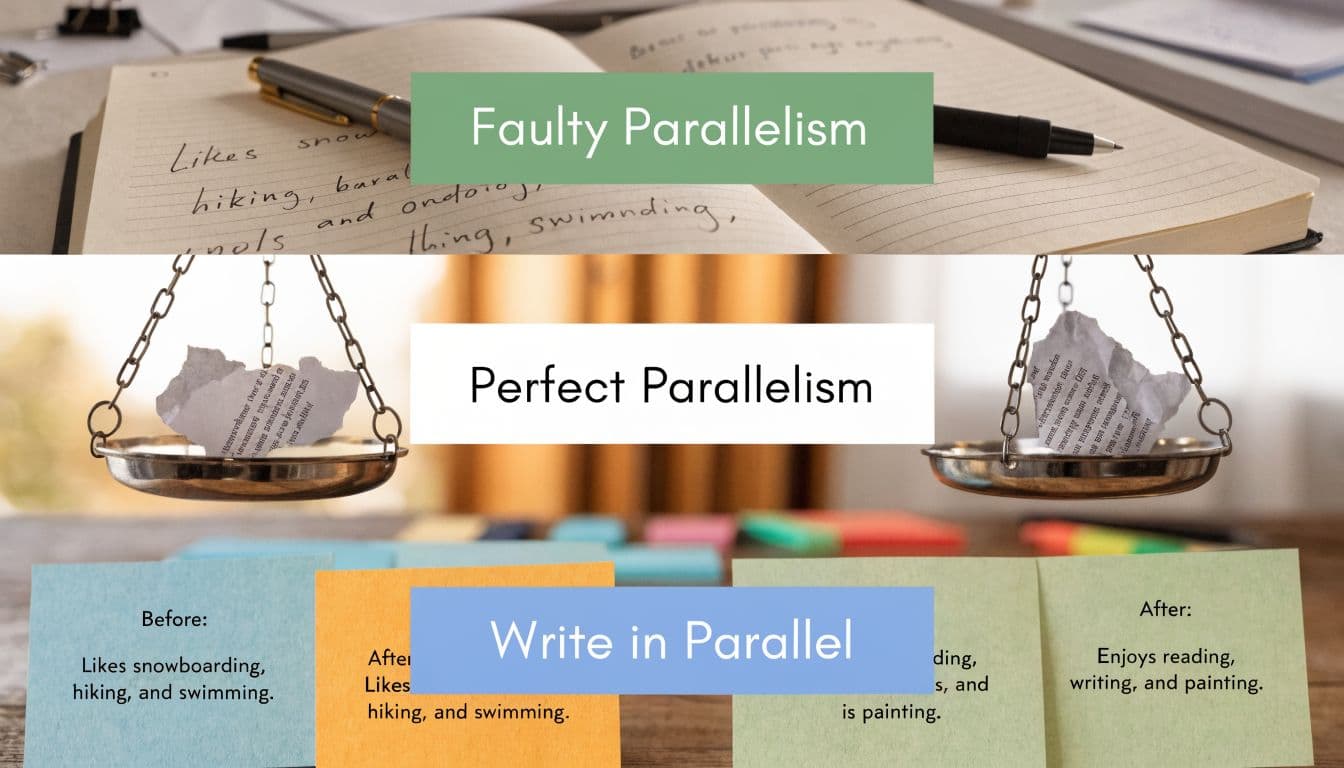
- She likes reading, to jog, and movies.
Nothing is wildly broken. But the list doesn’t match. One item is a gerund, one is an infinitive, and one is a noun. Your brain expects a pattern and doesn’t get one.
A smoother version would be:
- She likes reading, jogging, and watching movies.
Or:
- She likes books, exercise, and movies.
What readers often confuse
Many people assume a sentence is fine if the idea is understandable. But grammar isn’t only about being technically understandable. It’s also about making meaning easy to absorb.
Writers run into this in essays, emails, landing pages, captions, and reports. If a sentence feels uneven, your reader may not stop and diagnose the problem. They’ll just feel that the writing is less smooth, less confident, or less polished.
The Core Idea of Parallel Structure
Parallel structure is a consistency rule. If a sentence sets up matching parts, those parts should use the same grammatical form.
A simple way to think about it is a recipe. If one ingredient is measured in cups, another in tablespoons, and another with a vague “some,” the recipe feels messy. Sentence structure works the same way. Matching parts should be measured in the same grammatical unit.

The formal idea is straightforward. Faulty parallelism happens when related grammatical elements fail to maintain the same form, creating what the University of Toronto writing guide calls cognitive processing friction because readers expect the pattern to continue once it begins, as explained in the University of Toronto advice on faulty parallelism.
What counts as a matching form
Parallel elements can be:
Words
Example: clear, concise, and accuratePhrases
Example: to research the topic, to draft the outline, and to revise the paperClauses
Example: the manager reviewed the draft, the designer updated the graphics, and the editor checked the final copy
The key is that equal ideas should look grammatically equal.
A fast intuition test
Read this pair aloud:
- The job requires attention to detail, solving problems, and that you communicate clearly.
- The job requires attention to detail, problem-solving, and clear communication.
The second sentence feels balanced because each item plays the same role in the list.
Practical rule: If items are connected as equals, make them look like equals.
Why this matters beyond grammar class
Parallelism improves readability, flow, and balance. It helps readers move through a sentence without tripping. It also makes your writing sound more deliberate.
That matters in academic writing, where uneven structure weakens your argument. It matters in business writing, where awkward rhythm can make a message sound rushed. It also matters in AI-assisted writing, where small structural mismatches often make text sound machine-generated even when the ideas are good.
The Main Rules for Maintaining Parallelism
Most parallelism problems show up in a few predictable places. Once you know where to look, editing gets much faster.

Keep list items in the same form
Lists are the most common trouble spot. If you start with nouns, stay with nouns. If you start with verbs, keep the verbs in the same pattern.
For example:
- Faulty: The intern was asked to write the report, checking the data, and presentation design.
- Correct: The intern was asked to write the report, check the data, and design the presentation.
A useful editing move is to isolate each list item and ask, “What grammatical form is this?”
- to write
- check
- design
If one item doesn’t match, revise it to fit the pattern.
Match both sides of a comparison
Comparisons need balance too.
- Faulty: Writing with a clear structure is better than when ideas are arranged randomly.
- Correct: Writing with a clear structure is better than arranging ideas randomly.
The sentence compares two things, so those two things should be built in comparable ways.
Watch coordinating conjunctions
Words like and, or, and but often join elements that should be parallel. When they connect uneven pieces, the sentence starts wobbling.
Examples:
- Faulty: The campaign was bold, persuasive, and it reached the right audience.
- Correct: The campaign was bold, persuasive, and well-targeted.
Or:
- Correct: The campaign was bold, persuasive, and effective at reaching the right audience.
If you want more practice identifying these patterns inside longer sentences, this guide to sentence structure examples helps build that habit.
Balance correlative pairs
Correlative conjunctions demand extra attention. These include:
- not only ... but also
- either ... or
- both ... and
- neither ... nor
The form after each half should match.
- Faulty: She is not only skilled at research but also writing clearly.
- Correct: She is skilled not only at research but also at clear writing.
- Also correct: She not only researches well but also writes clearly.
If a sentence uses a pair like “either ... or,” check the structure immediately after each half. That’s where the mismatch usually hides.
Repeat small words when needed
Parallelism sometimes depends on tiny words like to, the, or in.
- Faulty: The policy applies to managers, interns, and the freelance team.
- Better: The policy applies to managers, to interns, and to the freelance team.
You don’t always need to repeat the function word, but when omission creates imbalance or confusion, repetition helps.
Faulty Parallelism Examples Before and After
Examples make this concept easier than definitions do. The fastest way to learn what is faulty parallelism is to compare a clunky sentence with a clean one and notice exactly what changed.
Fixing Faulty Parallelism in Practice
| Context | Faulty Version (Before) | Corrected Version (After) |
|---|---|---|
| Academic writing | The study aimed to collect data, analyzing trends, and the interpretation of results. | The study aimed to collect data, analyze trends, and interpret results. |
| Essay thesis | Good academic writing requires clear evidence, careful reasoning, and to revise thoroughly. | Good academic writing requires clear evidence, careful reasoning, and thorough revision. |
| Marketing copy | Our new software is fast, reliable, and saves you money. | Our new software is fast, reliable, and cost-saving. |
| Marketing copy | The platform helps teams planning campaigns, tracking performance, and better collaboration. | The platform helps teams plan campaigns, track performance, and collaborate better. |
| Business email | We need to review the proposal, meeting with the client, and send a revision. | We need to review the proposal, meet with the client, and send a revision. |
| Resume bullet | Managed onboarding, training new hires, and was responsible for documentation. | Managed onboarding, trained new hires, and handled documentation. |
| Student sentence | I value studying carefully, to take notes, and active discussion. | I value studying carefully, taking notes, and engaging in active discussion. |
| AI draft | The tool improves productivity, reduces costs, and provides better user experience. | The tool improves productivity, reduces costs, and enhances user experience. |
Why these fixes work
Most of these corrections follow one simple principle. The revised version chooses one structure and sticks with it.
Take this example:
- Faulty: The study aimed to collect data, analyzing trends, and the interpretation of results.
The list begins with to collect, so readers expect that pattern to continue. Instead, they get analyzing and the interpretation, which are built differently.
The fix restores the rhythm:
- Correct: The study aimed to collect data, analyze trends, and interpret results.
All three items now function as verbs in the same sequence.
AI-generated text often slips here
AI drafts often produce sentences that are almost right. That’s what makes them tricky. They don’t always create glaring grammar mistakes. They often create near-misses.
For instance:
- The brand focuses on creating trust, increasing visibility, and strong customer relationships.
That last item shifts from verb phrases to a noun phrase. A human editor usually hears the stumble quickly. AI often doesn’t catch it on the first pass.
A sentence with faulty parallelism often sounds polished until you read it aloud. Then the uneven part becomes obvious.
That’s why this issue shows up so often in student papers and marketing drafts generated with tools like ChatGPT. The content may be useful, but the sentence architecture still needs human review.
Common Mistakes and How to Fix Them Quickly
Some patterns appear again and again. If you learn these common mistakes, you can fix many parallelism errors in seconds.

Mixing verb forms
This is the classic error.
- Faulty: She wants to edit the draft, improving the flow, and a stronger conclusion.
- Quick fix: Match everything to the first item.
- Correct: She wants to edit the draft, improve the flow, and strengthen the conclusion.
If the first item starts with to, either keep to for all items or build the sentence so the verbs clearly match.
Mixing phrases with single words
Writers often combine a noun, an adjective, and a full phrase in one list.
- Faulty: The app is efficient, easy to use, and reliability.
- Quick fix: Decide what the list is made of, then rebuild it.
- Correct: The app is efficient, easy to use, and reliable.
Or:
- Correct: The app offers efficiency, ease of use, and reliability.
Shifting voice or sentence pattern
A sentence can lose balance when one part is active and another is passive.
- Faulty: The team wrote the copy, designed the graphics, and the final page was approved by the manager.
- Quick fix: Keep the same actor and action pattern.
- Correct: The team wrote the copy, designed the graphics, and approved the final page.
A short checklist helps:
- Find the list or pair: Look for words joined by and, or, but, or a correlative pair.
- Label the form: Is each item a noun, verb, phrase, or clause?
- Match the outlier: Revise the item that breaks the pattern.
- Read aloud: Your ear catches awkward rhythm fast.
This short lesson is useful if you want to hear the pattern in action:
How to Edit for Parallelism and Polish Your Writing
The best parallelism edits usually happen during revision, not drafting. When you’re getting ideas down, it’s easy to build a sentence halfway in one pattern and finish it in another.
Use a simple manual check
Try this on any paragraph that feels slightly off:
- Circle conjunctions like and, or, but, either, and not only.
- Box the matching parts on each side.
- Name the form of each part. Noun? Verb phrase? Clause?
- Revise the odd one out so the forms match.
Reading aloud helps too. Parallel sentences usually have a smooth rhythm. Faulty ones often make your voice hesitate.
For a broader revision routine, a practical self-editing checklist for cleaner drafts can help you catch structural issues before you submit or publish.
Pay special attention to AI drafts
This matters even more if you use ChatGPT or other AI writing tools to draft essays, emails, or marketing copy. AI language models frequently produce sentences with faulty parallelism, such as lists that mix gerunds and noun phrases, and many grammar guides don’t address these AI-specific failures, as noted in this explanation of faulty parallelism examples in AI-style writing.

What to look for in machine-written sentences
AI often creates sentences that are grammatically close enough to pass a quick scan. Watch for:
- Lists with a mismatched last item
- Comparisons that switch structure halfway through
- Taglines that mix adjectives, verbs, and noun phrases
- Sentences that sound polished but feel oddly stiff when spoken aloud
Read every AI-generated list one item at a time. If you can’t describe all items with the same grammar label, revise the sentence.
This one habit catches a surprising amount of awkwardness.
Writing with Balance and Clarity
Faulty parallelism is straightforward. If sentence parts are meant to match, they should share the same structure. When they don’t, readers feel the friction even if they can’t name the rule.
That’s why parallelism matters. It makes writing easier to read, easier to trust, and easier to remember. Whether you’re editing an essay, a landing page, or an AI draft, look for lists, comparisons, and paired ideas. Then make them match. Once you start hearing the pattern, your writing gets clearer fast.
If you use AI to draft essays, emails, or marketing copy, Natural Write can help you smooth out robotic phrasing and catch issues like faulty parallelism before they make your writing sound unnatural. Paste in a draft, review the sentence flow, and polish it into language that reads more like you.