
Ever read a sentence and had to stop, backtrack, and figure out what the writer was actually talking about? Chances are, a vague pronoun was the culprit.
A vague pronoun is a word like it, this, or which that doesn't clearly point back to a specific noun. It's like a blurry signpost on a highway—it tells you something is up ahead, but you can't quite make out what.
Understanding the Vague Pronoun Problem

Pronouns are fantastic shortcuts. Instead of repeating a noun over and over, we swap in words like "he," "she," "it," and "they" to make our sentences flow. When a pronoun has a clear connection to its noun (what grammar folks call the antecedent), writing feels smooth and elegant.
But when that connection gets fuzzy, the whole meaning of a sentence can fall apart.
Imagine writing, "The car passed the truck, and it was speeding." Who was speeding? The car? The truck? The pronoun "it" could refer to either one, forcing your reader to hit the brakes and guess. That little moment of confusion is the heart of the vague pronoun problem.
The Impact of Unclear Pronouns
This isn't just a minor grammar nitpick; it has real consequences. In any professional or academic setting, clarity is king. Vague pronouns can make your arguments seem flimsy, your instructions confusing, and your entire message feel amateur.
And this issue is more common than you might think. A 2022 review of 1,200 undergraduate papers found that a whopping 28% had at least one vague pronoun, with "it" and "which" being the usual suspects. This ambiguity actually caused graders to lower readability scores by an average of 12%. That shows a direct link between clear pronouns and how well your writing is received.
A vague pronoun forces the reader to become a detective, searching for clues to decipher your intended meaning. Great writing doesn't create work for the reader; it delivers a clear message effortlessly.
Quick Fixes for Vague Pronouns
The best way to get a handle on this is to see it in action. Let's look at a few common vague sentences and how to fix them.
A quick side-by-side comparison makes it easy to spot the problem and see how a simple tweak brings instant clarity.
Quick Fixes for Common Vague Pronouns
| Vague Pronoun Example | Why It's Vague | Clear Revision |
|---|---|---|
| Sarah told her mom she was tired. | Who is "she"? Sarah or her mom? | Sarah told her mom that Sarah was tired. |
| I got a promotion, which made me happy. | What made you happy? The promotion? The news? | Getting a promotion made me happy. |
| The team reviewed the report, but it was unclear. | What is "it"? The report or the review? | The team reviewed the report, but the report was unclear. |
As you can see, the fixes are usually straightforward, often just involving replacing the pronoun with the specific noun it was meant to represent.
Getting a solid grip on how different words function in a sentence is the foundation for fixing these kinds of issues. If you want to brush up on the fundamentals, you might find a guide to practicing parts of speech really helpful.
Why Vague Pronouns Weaken Your Message
Think of a vague pronoun as a speed bump in your writing. It's more than just a small grammatical oops; it actively sabotages the reader's journey through your text.
Imagine telling a great story, but your friend has to keep interrupting with, "Wait, who are you talking about now?" That's exactly what happens when pronouns like 'it,' 'they,' or 'this' float around without a clear anchor. This kind of ambiguity forces your reader to hit the brakes, backtrack, and try to figure out what you meant.
Every time they have to do that, you're increasing their cognitive load—the mental work needed just to understand the sentence. Instead of gliding through your ideas, they're stuck solving a puzzle you accidentally created. This constant stopping and starting shatters the flow of your argument and drains its power.
The Real-World Consequences of Vague Language
This isn't just a theoretical problem; fuzzy language has tangible costs in different fields. For students, it can mean lower grades because it signals muddy thinking or a weak grasp of the material. In the professional world, the stakes are even higher.
Take marketing, for instance. Vague copy leads to confusing calls-to-action and a brand message that feels wishy-washy. If your audience has to struggle to understand what you're offering, why would they trust you enough to buy it? The same goes for writing impactful achievements on your CV—clarity is everything. You can't afford to have your accomplishments sound vague.
A vague pronoun shifts the burden of clarity from the writer to the reader. Effective communication never makes the audience do the heavy lifting; it delivers a precise message with ease and confidence.
The damage is measurable, too. Linguistic studies show that forcing a reader to resolve pronoun ambiguity can increase their cognitive load by as much as 35%. One analysis of 800 academic papers found that the usual suspects—'it,' 'there,' and 'this'—were behind a staggering 55% of vague subject errors. And in a HubSpot review of over a million campaigns, content riddled with vague pronouns saw 21% lower engagement.
Why Precision Matters for Readers and Search Engines
At the end of the day, clear writing is all about building trust. When every pronoun has a clear, specific job to do, your sentences become sharp and persuasive. Your arguments hit harder, your instructions are a breeze to follow, and your voice sounds more confident and authoritative.
And it’s not just your human readers who appreciate this precision. Search engines are getting smarter every day. Clear, unambiguous content is much easier for algorithms to crawl, index, and understand. When a search engine like Google truly gets what your content is about, it's far more likely to show it to the right people.
- Improved User Experience: When people can read without stumbling, they stick around longer. This lowers your bounce rate and sends a strong quality signal to search engines.
- Enhanced Topical Authority: Precise language helps Google (and your readers) see you as an expert on your topic.
- Better Engagement: A smooth reading experience encourages people to share your content, leave comments, and ultimately, convert.
Spotting the Four Most Common Culprits
Now that we've covered the damage vague pronouns can cause, let's put the main offenders in a lineup. While any pronoun has the potential to be vague, four words are responsible for most of the confusion you'll find in everyday writing.
Think of these as the usual suspects your inner editor needs to watch out for: it, this, that, and which. Once you train your eye to flag them, you'll be surprised how often they sneak into sentences without a clear job to do, creating tiny speed bumps for your reader.
The Ambiguous It
The pronoun ‘it’ is probably the most notorious of the bunch. It has a nasty habit of showing up without a clear antecedent, forcing the reader to guess its meaning from the context. This little pause to figure things out is enough to break the flow of your entire message.
Vague Example: "The marketing team launched the new campaign, but it failed to generate leads."
What exactly failed here? The campaign? The launch event? A specific ad? The word ‘it’ is too fuzzy and leaves the real story untold.
Clear Revision: "The marketing team launched the new campaign, but the campaign failed to generate leads."
The Problematic Pair: This and That
‘This’ and ‘that’ are troublemakers because we often use them to refer to an entire idea or situation from the previous sentence. That might work when you're chatting with a friend, but it creates a ton of ambiguity in formal writing. When ‘this’ or ‘that’ stands alone, it acts like a blurry pointer.
Vague Example: "Our website traffic is down by 20%, and our bounce rate has increased. This is a problem."
What, specifically, is 'this' problem? Is it the drop in traffic, the high bounce rate, or the combination of both? To fix it, all you have to do is add a clarifying noun right after the pronoun.
Clear Revision: "Our website traffic is down by 20%, and our bounce rate has increased. This trend is a problem."
The Clause-Confusing Which
The word ‘which’ gets messy when it refers to an entire clause—a whole idea—instead of the single noun that comes directly before it. It’s a super common grammatical slip-up that can make sentences feel clunky and unclear.
Vague Example: "He arrived late for the meeting, which annoyed his manager."
So, what annoyed the manager? The simple fact that he arrived? Or the fact that he was late? The word ‘which’ points vaguely to the entire preceding thought.
Clear Revision: "His lateness for the meeting annoyed his manager."
This isn't a new problem, either. A landmark 1963 survey found vague pronouns lurking in 17.8% of high school papers, with ‘which’ ambiguously referring to a whole clause in a whopping 51% of those cases. Fast forward to today, and a 2023 analysis of social media posts showed that vague uses of 'it' and 'this' increased reader confusion and dropped retweet rates by 11%.
These seemingly small errors can snowball into much larger communication problems, as this infographic shows.
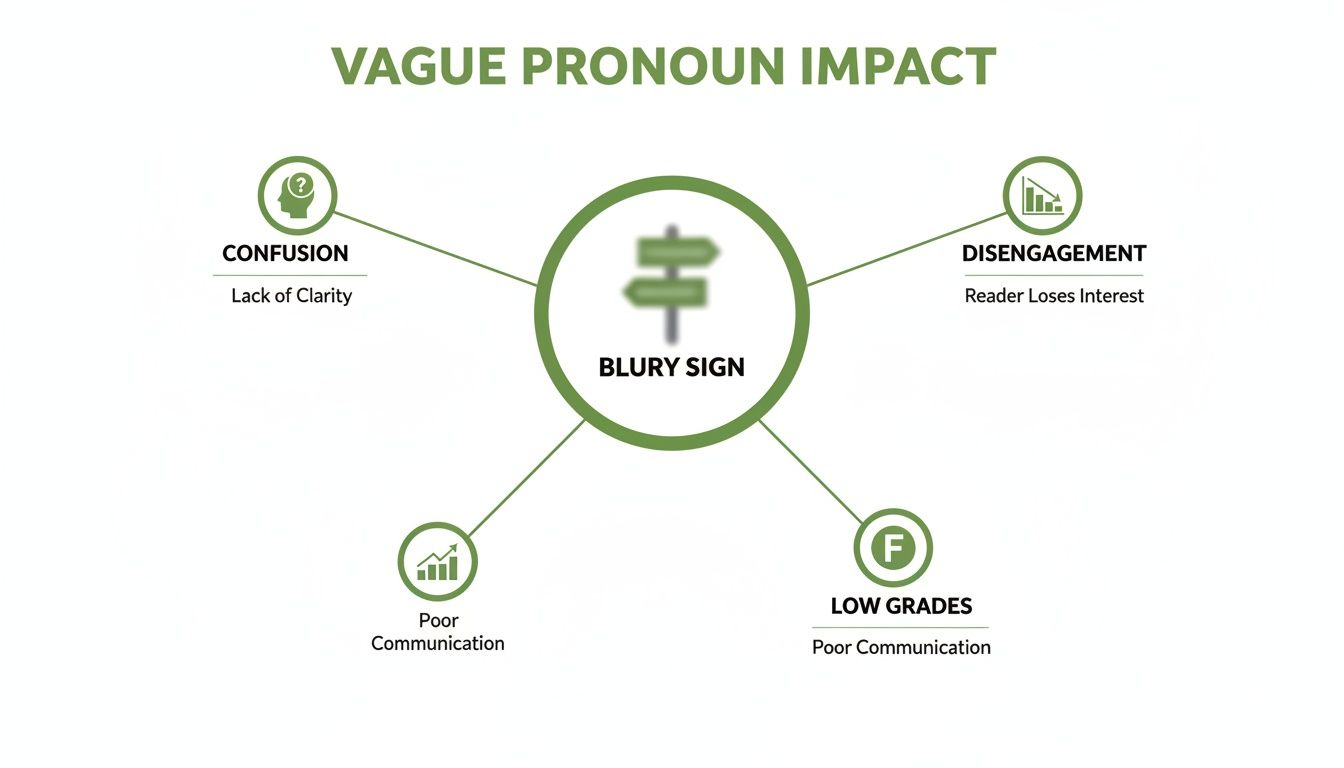
The visualization makes it crystal clear: vague pronouns act like blurry signposts. They lead directly to reader confusion, disengagement, and even lower grades in academic settings.
If you want to dive even deeper, check out our guide on vague pronoun examples for a more detailed look.
Your Practical Toolkit for Fixing Vague Pronouns
Spotting a vague pronoun is half the battle. The real magic happens when you know exactly how to fix it without breaking a sweat. Think of this as your hands-on workshop for turning confusing sentences into crystal-clear statements.
I’m going to walk you through three powerful, easy-to-learn techniques. These aren't complicated grammatical puzzles; they're simple, direct fixes you can start using right away to make your writing stronger. Once you get the hang of these, you’ll be editing your own work—and even AI-generated text—with a new level of confidence.
Technique 1: Replace the Pronoun Directly
Often, the simplest solution is the best one. When a pronoun like ‘it,’ ‘he,’ or ‘they’ leaves your reader guessing, just swap it out for the specific noun it’s supposed to represent. It’s a direct approach that instantly clears up any confusion.
- Vague Example: "The committee met with the board, but it didn't agree." (So, who disagreed? The committee or the board?)
- Clear Revision: "The committee met with the board, but the board didn't agree."
See? That one simple swap makes the meaning impossible to miss. It takes a second to do, but the payoff in reader comprehension is huge.
Technique 2: Add a Noun to Clarify
Sometimes, pronouns like ‘this’ or ‘that’ feel fuzzy because they point to an entire idea, not just one specific thing. The fix here is wonderfully simple: just add a clarifying noun right after the pronoun. This little addition gives your reader the context they need without you having to rework the whole sentence.
- Vague Example: "Our social media engagement dropped by 30%. This needs to be addressed." (What exactly is 'this'? The drop? The engagement rate?)
- Clear Revision: "Our social media engagement dropped by 30%. This decline needs to be addressed."
This trick is a lifesaver in business and academic writing, where you have to be absolutely precise about the problem, trend, or finding you’re discussing. For more ways to sharpen your sentences, check out our guide on how to rewrite sentences for maximum clarity.
Key Takeaway: Think of adding a specific noun after 'this,' 'that,' or 'which' as adding a signpost for your reader. It points them directly to your intended meaning and shuts the door on any potential misinterpretation.
Technique 3: Restructure the Entire Sentence
For sentences that are a bit more tangled, don't be afraid to just rewrite them. This is especially true when a pronoun like ‘which’ vaguely refers to the entire clause that came before it. A quick restructure lets you state the relationship between ideas much more directly.
- Vague Example: "Harry was late for the third time this week, which annoyed the teacher." (What was annoying? The lateness itself, or the fact it was the third time?)
- Clear Revision: "Harry’s lateness annoyed the teacher."
It might seem small, but fixes like these are game-changers. Some writing experts estimate that simple revisions can boost clarity by as much as 40%. With over 100 million writers creating content every month, making sure your message lands with impact is more important than ever. You can explore detailed resources on pronoun clarity to see more on how these tweaks make a difference.
Refining AI Content By Eliminating Vague Pronouns
AI can pump out drafts in seconds, yet it often fumbles when pronouns enter the scene. Those stray “it” or “this” references leave readers pausing, hunting for what exactly a sentence refers to.
Pronouns drifting without clear antecedents turn a smooth read into a guessing game. Spotting and tightening them up is the secret sauce for making AI text feel genuinely human.
Why AI Struggles With Pronoun Clarity
At its core, an AI stitches together patterns but doesn’t truly understand them. That gap in comprehension makes it prone to dropping vague references.
- Mimicked structures over real context
- Unclear links between pronouns and nouns
- Choppy connections that derail flow
Research shows machines botch vague pronouns in 67% of translation cases across ten languages, driving up marketing copy errors. To grasp the full picture, explore these linguistic challenges in automated systems: learn more about these linguistic challenges in automated systems
Key Takeaway: Hunting down every ambiguous it, this, that, or which transforms a robotic draft into clear, engaging prose that resonates with readers.
This screenshot shows how a tool can detect robotic writing patterns, helping you spot issues like vague pronouns.
The highlighted text pinpoints spots where the flow stalls due to fuzziness. From there, you can apply targeted fixes and watch the clarity improve immediately.
Humanizing Your AI-Generated Text
Polishing AI drafts comes down to a few decisive moves. You want to keep your original thoughts intact while giving them the smooth, human touch they need.
- Be a Ruthless Editor: Hunt for every “it,” “this,” “that,” and “which.”
- Clarify and Specify: Swap vague pronouns for precise nouns or concepts.
- Rewrite for Flow: Don’t shy away from reshaping sentences so they sound natural.
For a deeper dive, check out our complete guide on how to rewrite AI text to sound human
Common Questions About Vague Pronouns
No matter how quickly you learn to flag a vague pronoun, a handful of questions pop up. Let’s clear them away so you can edit with confidence and precision.
Think of this section as your quick-reference toolkit for those “what if” hiccups in the middle of a revision.
Are It And This Always Bad To Use
Not at all. Words like it and this are part of natural, conversational English. The real problem only appears when they leave the reader guessing their antecedent.
Consider: “The dog chased the ball, and it was fast.” There’s no mystery—it obviously points to the ball. Now compare that to: “The team missed the project deadline, which was a disaster.” Which part was disastrous? The missed deadline? Angry clients? Suddenly, which feels like a vague pointer.
Every pronoun needs a one-to-one link to a single noun. When that link breaks, your reader trips.
How Can I Spot Vague Pronouns In My Own Writing
Your brain already knows what you mean, so it glosses over fuzzy pronouns. To see them from a fresh angle, try these tactics:
- Read Aloud: Hearing your own words can expose stumbling points. If you hesitate, there’s likely a vague reference hiding.
- Search Smart: Hit Ctrl+F and look for ‘it,’ ‘this,’ ‘that,’ and ‘which.’ For each hit, ask, “Which noun did I mean?” If you can’t answer immediately, flag it for rewording.
These small habits quickly turn into second nature. Before long, you’ll catch every loose pointer in a single scan.
Does Fixing Vague Pronouns Really Affect SEO
Search engines don’t run a pronoun-checker, but they do care about reading comfort. Clarity keeps people on the page and happy, which sends positive signals to Google and friends.
Unclear language drives readers away. That shows up as:
- Higher Bounce Rates: When visitors land on a confusing sentence, they hit back or close the tab.
- Lower Time on Page: If they can’t follow your argument, they won’t stick around.
Those two metrics—bounce rate and time on page—can indirectly nudge your rankings downward. By tightening up pronouns, you keep readers engaged. Engaged readers mean better performance in search results.
Ready to strip out vague pronouns and give your AI drafts a human polish in seconds? Natural Write spots robotic phrasing and smooths your text for crystal-clear communication. Try it for free at Natural Write.