
A topic sentence for a body paragraph is the one sentence that lays out the main idea you’re about to discuss. Think of it as a mini-thesis statement for that specific paragraph—it makes a claim, and the sentences that follow need to back it up with evidence, examples, or explanation.
The Blueprint for a Perfect Paragraph

Imagine trying to build a house without a blueprint. You'd probably end up with a mess—walls in the wrong places, maybe a room that doesn’t even connect to anything. A body paragraph without a clear topic sentence is pretty much the same: just a jumble of ideas with no clear direction.
The topic sentence is that blueprint. It tells you exactly what to build in that paragraph and, just as importantly, shows your reader what to expect. It's the foundation holding everything together.
Why This Blueprint Matters
Nailing this skill is what separates rambling, unfocused paragraphs from tight, persuasive arguments. A strong topic sentence forces you to get your thoughts straight before you start writing.
This is more important than ever, especially for students and professionals who are trying to clean up AI-generated drafts. Those tools can churn out text, sure, but they often miss the logical thread that a human writer provides.
A well-crafted topic sentence delivers a few key things:
- Creates Clarity for the Reader: It’s a signpost. It tells your reader exactly what point the paragraph is going to make.
- Maintains Focus for the Writer: It keeps you honest. It stops you from wandering off-topic and makes sure every sentence serves the main idea.
- Builds a Coherent Argument: Each topic sentence clicks into place like a puzzle piece, connecting back to your overall thesis and making your entire argument stronger.
This whole idea of a paragraph blueprint fits right in with structured writing methods like the TEEL paragraph structure, which is built around this very concept.
A great topic sentence promises the reader one specific idea and then delivers on that promise. It's the contract between writer and reader for that section of text.
When you learn to write a precise topic sentence for a body paragraph, you give your writing a solid backbone. To see how these individual paragraphs fit into the bigger picture, you can learn more about proper paragraph structure in our guide. It's the key to making every paragraph you write clear, purposeful, and effective.
What a Topic Sentence Is and Why It Matters
Think of a topic sentence for a body paragraph as a mini-thesis. It's the one sentence that leads the pack, making a clear promise to the reader about what's coming next. It does two critical jobs: it states the paragraph's main idea, and it ties that idea back to your overall argument.
This small but mighty sentence is what brings order to your writing. For the reader, it’s a signpost that makes your logic easy to follow. For you, it’s a focusing tool that keeps your thoughts from wandering off track.
The Foundation of a Strong Argument
Without a solid topic sentence, paragraphs can quickly become a confusing mess of ideas. It's the backbone of your paragraph, giving it a clear point that all your supporting evidence has to connect back to.
A topic sentence is the contract you make with your reader for that paragraph. It clearly states, "Here is the one point I am going to prove to you," and the rest of the paragraph must deliver on that promise.
This kind of structure is more important than ever. With AI being used for 71.7% of content outlining and 57.4% of drafting, a lot of raw AI output lacks that essential human logic. Mastering the topic sentence is how you turn a robotic draft into something that actually connects with a human reader.
Linking Paragraphs to Your Main Idea
A good topic sentence doesn't just manage its own paragraph—it's a crucial link in the chain of your entire essay. Each topic sentence should echo a piece of your main thesis, building your argument one paragraph at a time.
This connection is what makes for strong, persuasive writing. Just as a strong paragraph needs a clear focus, a strong essay needs a clear central claim. If you're looking to sharpen that main argument, our guide on how to write a thesis statement is the perfect place to start. When every topic sentence supports your thesis, you create a powerful piece of writing where every paragraph has a purpose.
The Two Essential Parts of a Topic Sentence
Every powerful topic sentence is built from two key components. Think of it like a simple recipe: Topic + Controlling Idea = An Effective Topic Sentence. Getting this balance right is what turns a bland statement into a signpost for your reader, telling them exactly where you're headed.
The topic is the easy part—it’s just the subject of your paragraph. The real magic comes from the controlling idea. This is your specific angle, claim, or perspective that the rest of the paragraph will spend its time proving.
Understanding the Formula
Let's break these two parts down. The topic simply names what you're talking about, but the controlling idea tells the reader how you'll talk about it. It narrows the focus and gives your paragraph a purpose.
- Topic: The general subject matter.
- Controlling Idea: Your specific opinion, angle, or claim about that subject.
Without a controlling idea, you just have a fact, not a guide for a paragraph. For example, "Social media platforms connect people" is a fact. It's not going anywhere. But, "Social media platforms create psychological dependency" gives the paragraph a clear, debatable direction. Now you have something to prove.
This concept map shows how these two parts work together to link the paragraph’s main point back to your overall argument.
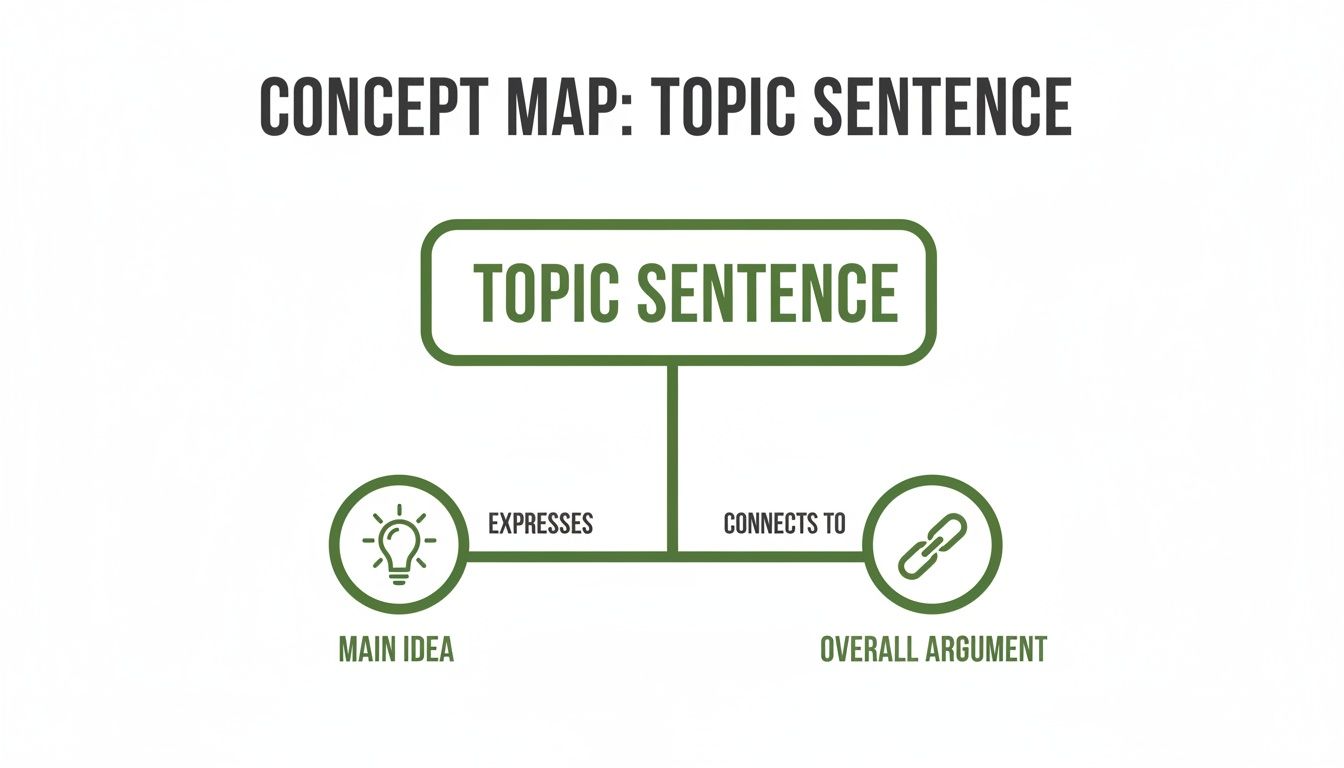
As the visual shows, a topic sentence has to serve two masters: the paragraph it introduces and the larger piece of writing it belongs to.
A great topic sentence doesn't just introduce information; it makes a specific claim that requires proof. It sets up an argument that the following sentences must support with evidence and explanation.
This human-led structure is more important than ever. Academic AI detectors, for example, have significant limitations, and researchers have found that simple paraphrasing can slash detection rates. Unrefined AI text often lacks the strong, clear topic sentences that signal human authorship, making it a red flag for tools like Turnitin. You can learn more about the challenges of AI detection from recent research. By focusing on this fundamental formula, you ensure your writing is logical, persuasive, and feels distinctly human.
Putting Topic Sentences into Practice
Knowing the theory is one thing, but seeing a topic sentence for a body paragraph out in the wild is where it all starts to click. Let’s break down a few examples to see how this simple tool guides readers and sharpens an argument.
In each case, you'll see how the topic and controlling idea team up to make a clear promise to the reader.
Example 1: Persuasive Essay
Imagine you're writing an essay arguing for a four-day school week. A body paragraph might kick off with this:
A compressed four-day schedule significantly improves student attendance and reduces burnout.
Here, the topic is clearly "a compressed four-day schedule." But the magic is in the controlling idea: it "improves student attendance and reduces burnout." Now, the rest of the paragraph has to deliver on that promise with stats, studies, or stories that prove it. No tangents allowed.
Example 2: Business Proposal
Now, let's switch gears to a business proposal trying to get funding for new software. A critical paragraph could open like this:
Implementing the new software platform will streamline our internal workflows, leading to a projected 15% increase in team productivity.
The topic is "implementing the new software platform." The powerful controlling idea is that it will "streamline our internal workflows" and deliver a "15% increase in team productivity." This sentence immediately tells stakeholders the benefit and what proof to look for next—no fluff, just a clear, measurable claim.
This kind of structural clarity is also what separates human-like writing from generic AI output. Today's commercial AI detectors are incredibly good at spotting robotic text, achieving near-zero false positives. You can find more details on the effectiveness of modern AI detection. Superficial edits aren't enough anymore; real coherence starts with a strong, human-crafted topic sentence.
When every sentence lines up to support that one main idea, you build a paragraph that feels tight and logical. This is the foundation of good cohesion in your writing, making your points hit harder and your arguments much easier to follow.
Common Topic Sentence Mistakes and How to Fix Them

Even the pros get topic sentences wrong sometimes. The good news? Most of these missteps are pretty easy to catch once you know what you’re looking for. Getting familiar with the common traps is the first step to writing paragraphs that are sharp, focused, and persuasive.
Two of the biggest culprits are sentences that are too broad—promising an epic saga but only delivering a short story—and those that are too narrow, leaving you with absolutely nothing left to say.
Think of a topic sentence as the perfect frame for your paragraph’s content. It shouldn’t be so big that the picture gets lost, or so small that it cuts off all the good parts.
Let's dive into these common issues and see how to fix them, so every topic sentence for a body paragraph sets you up for success.
Mistake 1: It's Way Too Broad
A topic sentence that’s too broad is trying to do too much. It feels vague and unfocused, kind of like a movie trailer that shows clips from five different films. Your reader is left wondering what the paragraph is actually about.
- Before: "The internet has changed society in many ways."
- After: "The rise of online streaming services has fundamentally altered how families consume entertainment."
See the difference? We went from the massive concepts of "the internet" and "society" down to the specific impact of "streaming services" on "family entertainment." The revised version gives the paragraph a clear, manageable job to do.
Mistake 2: It's Just a Fact
This one is a classic. You state a simple fact instead of an actual argument. A fact is a dead end—there’s no controlling idea, which means the rest of your paragraph has nothing to prove, explain, or expand on.
- Before: "Many companies use social media for marketing."
- After: "Companies that use authentic, story-driven content on social media build stronger customer loyalty than those focusing on direct sales."
The second sentence is so much better because it goes beyond a boring fact to make a debatable claim about how to use social media effectively. It gives the paragraph a real purpose and a clear direction to follow.
Common Questions About Topic Sentences
Okay, you get the theory. But when you actually sit down to write, the real-world questions pop up. Think of this section as your go-to guide for those nagging little uncertainties about using a topic sentence for a body paragraph. Let's clear up the confusion so you can get back to writing with confidence.
These are the practical hurdles every writer faces, from "Where does this thing actually go?" to "Do I really need one for every single paragraph?" The goal here is to move from knowing what a topic sentence is to knowing how to use it effectively.
Where Should a Topic Sentence Go?
For the clearest, most direct writing, your topic sentence should almost always be the very first sentence of the paragraph. No exceptions. Placing it right at the top instantly tells your reader, "Hey, this is what we're about to talk about," and sets the stage for all the proof that follows.
Sure, some advanced writers play with this structure for stylistic flair, but putting it first is the gold standard. It’s a simple rule that guarantees your reader never gets lost.
Think of it like a contract with your reader: "Here's the point I'm going to prove to you." Starting anywhere else is like asking them to sign before they've even read the terms.
Can a Topic Sentence Be a Question?
As a rule, no. A topic sentence needs to make a solid claim or state a clear point that the rest of the paragraph can back up. A question just introduces a subject; it doesn't give the reader a guiding argument to follow.
It's much stronger to just state your point directly. You can then spend the rest of the paragraph exploring the answer, laying out the evidence and details your reader is looking for. This approach swaps ambiguity for a confident, clear assertion.
Does Every Single Paragraph Need One?
In academic, professional, or any kind of argumentative writing, the answer is a hard yes. Just about every body paragraph needs a sharp topic sentence to keep your writing focused and to signal to the reader that you're moving on to a new, distinct point.
But there are a few exceptions. Super short transitional paragraphs—the ones that just serve as a bridge from one big idea to the next—can often get by without one. Creative writing plays by its own rules, too. A good rule of thumb is: if the paragraph is making its own unique point, it needs a topic sentence.
How Specific Should a Topic Sentence Be?
This is all about finding the sweet spot. A great topic sentence has to be specific enough that you can cover it completely in a single paragraph, but broad enough to actually introduce the paragraph's main idea.
If it's too broad, you'll never be able to deliver on your promise, and your reader will feel let down. If it's too narrow (like a simple fact), you'll have nothing left to say, and the paragraph will die before it even gets started.
Ready to turn robotic AI drafts into polished, human-like text? Natural Write instantly refines your writing for clarity and flow, ensuring it bypasses all major AI detectors. Try it for free and see the difference at https://naturalwrite.com.