When you "rewrite this sentence," you're not just shuffling words around. You're re-shaping an idea to make it clearer, stronger, or more persuasive, all while keeping the core meaning intact. It's the one skill that truly elevates writing from simply good to genuinely great.
Why Good Writing Is All About Rewriting
Let's be honest: first drafts are often a mess. They're supposed to be. Their only job is to get your thoughts out of your head and onto the page. The real magic happens when you go back and start refining—when you decide to rewrite this sentence, and then the next, and the next.
Think of it like a sculptor chipping away at a block of marble. The basic shape is there from the start, but the art emerges through careful, deliberate refinement. This isn't just about fixing typos; it's a strategic process of improving communication.

The need to rewrite well pops up everywhere. A marketer needs to turn a dry product feature list into a story that sells. A student has to sharpen a clunky thesis into a powerful argument. Even a quick email can be rewritten to prevent a simple request from being misinterpreted.
The True Goals of Rewriting
Once you start focusing on the rewrite, you move past just correcting mistakes. Your goals become much bigger and far more impactful.
- Achieve Crystal-Clear Meaning: Your reader should get your point on the first pass. No confusion, no rereading. Just instant understanding.
- Establish a Specific Tone: How do you want your words to feel? Rewriting gives you control, letting you dial the tone from formal and professional to casual and friendly.
- Maximize Reader Engagement: Great sentences pull the reader forward. By mixing up your sentence length and structure, you create a natural rhythm that keeps people invested and reading.
The secret to good writing is to say what you're trying to say, directly and simply. Often, the best version of a sentence is buried paragraphs deep in a first draft.
In the end, every single word counts. One well-rewritten sentence can change the entire feel of a paragraph, transforming a passive observation into a call to action or a vague concept into a sharp, vivid image. This is how you make your content not just understandable, but memorable.
Your Rewriting Game Plan Before You Touch a Word
Jumping straight into editing without a clear goal is like starting a road trip with no destination. You'll definitely move around, but you won't get anywhere meaningful. Before you even think about how to rewrite this sentence, take a moment to map out your strategy. This one small step turns random tweaking into focused, effective editing.
The best writers I know don't just ask, "How can I make this sound better?" Instead, they start with three foundational questions that guide every single change they make.
Core Questions for Effective Rewriting
Before you touch a single word, get crystal clear on these three points. Your answers will become your compass, ensuring every adjustment you make serves a real purpose.
What is the core message? Your absolute top priority is protecting the central idea. Try to distill the sentence down to its essential meaning before you start adding flair or cutting words. If you lose the meaning, nothing else matters.
Who is my audience? Are you writing for an expert who lives and breathes industry jargon, or a complete beginner who needs simple, direct language? Your reader dictates your word choice, complexity, and even sentence length.
What tone do I need? The feeling behind your words is everything. Are you aiming to be persuasive, purely informative, reassuring, or urgent? This will guide whether your sentence should sound formal and authoritative or casual and friendly.
The first thing I do is discard their current draft…and just ask them to explain their idea to me like I was hearing about it for the first time. Every single time, it's immediately so much better than what they'd written before.
Your goals will shift dramatically depending on the context. For instance, rewriting a sentence for a technical manual has a completely different objective than rewriting one for a sales page. The first demands absolute clarity and precision, while the second needs to build an emotional connection.
This table shows how your focus changes based on the writing task. Knowing your goal upfront makes the editing process 10x easier.
Rewriting Goals Based On Audience and Purpose
| Context | Primary Goal | Key Focus Areas for Rewriting |
|---|---|---|
| Technical Manual | Unambiguous Clarity | Precision, eliminating jargon, direct instructions |
| Sales Page | Persuasion | Emotional connection, highlighting benefits, creating urgency |
| Academic Paper | Authority & Credibility | Formal language, logical flow, supporting claims |
| Blog Post | Engagement | Conversational tone, readability, creating rhythm |
See how different the priorities are? A blog post can be playful and rhythmic, but that same style would be a disaster in a technical manual where every word must be exact. Clarifying your goal first is the secret to rewriting effectively.
Practical Techniques for Transforming Your Sentences
Alright, once you know your goal, it's time to roll up your sleeves and get to work. The best way to learn how to rewrite sentences is by mastering a few core techniques. These aren't just abstract theories; they're repeatable, hands-on actions that get you immediate results. Think of them as the tools you'll use to shape a clunky first draft into a polished, compelling piece of writing.
Let's dig into four of the most effective methods I use. Each one tackles a different aspect of what makes a sentence work, from its basic structure to its rhythm and flow. Get these down, and you’ll be able to handle pretty much any writing challenge that comes your way.
Simplify and Clarify Your Structure
Long, meandering sentences are usually the number one cause of confusion. They force your reader to juggle too many ideas at once, and the main point gets lost in the noise. The solution? Break them down.
- Before: The initiative, which was designed to improve our operational efficiency across multiple departments, ultimately failed to deliver the expected results due to a lack of clear communication and stakeholder buy-in.
- After: The initiative failed to deliver results. It was meant to improve operational efficiency but lacked clear communication and stakeholder buy-in.
See that? Splitting one tangled sentence into two simple ones makes the message land with so much more punch. It's instantly clearer and easier to digest.
Switch to the Active Voice
Passive voice just sucks the life out of your writing. It feels weak, indirect, and often obscures who is actually doing something. When you shift to the active voice, your sentences become more direct, energetic, and confident.
My favorite trick for spotting passive voice is the "by zombies" test. If you can add "by zombies" after the verb and the sentence still makes sense, you're in the passive voice. For example: "Mistakes were made (by zombies)." It works!
- Before: The report was written by the marketing team.
- After: The marketing team wrote the report.
It's a small tweak, but it makes the sentence instantly clearer and gives it a forward momentum. You know exactly who did what.
Upgrade Your Word Choice
Vague, generic words are the enemy of good writing. Words like "good," "nice," or "important" are basically placeholders—they don't paint a picture for your reader. The goal here is to swap them out for words that are precise and powerful.
- Before: The new software is a very good tool for the company.
- After: The new software is an essential tool that streamlines our company's workflow.
Using specific verbs and descriptive adjectives gives your sentences real substance. You're showing the reader what you mean instead of just telling them. If you're looking for new ways to phrase things, a good AI paragraph rewriter can be a fantastic assistant for exploring different word choices and sentence structures.
Vary Your Sentence Rhythm
Finally, listen to the sound of your writing. A long string of short, punchy sentences can feel robotic. On the other hand, too many long, complex sentences will exhaust your reader. The trick is to create a pleasant rhythm by mixing up the length and structure of your sentences.
This variety is what keeps a reader hooked and makes the writing flow smoothly. If you want to dive deeper into this, you can learn more about creating rhythm by exploring the principles of sentence fluency.
How to Humanize AI-Generated Text
AI writing tools are great for getting a first draft out the door in minutes. The problem? The output often feels a bit… soulless. While it’s usually grammatically perfect, it's missing the rhythm, personality, and distinct voice that actually connects with people. That’s because AI models are trained on massive datasets, and they tend to stick to safe, predictable patterns.
So, your job is to breathe some life into that robotic foundation. This isn't just about a simple "rewrite this sentence" fix here and there; it’s about thoughtfully refining the entire piece to make it sound like it was written by a real person, for a real person. You're polishing the draft, not overhauling the core message.
This simple workflow gets to the heart of turning AI text into something more natural.
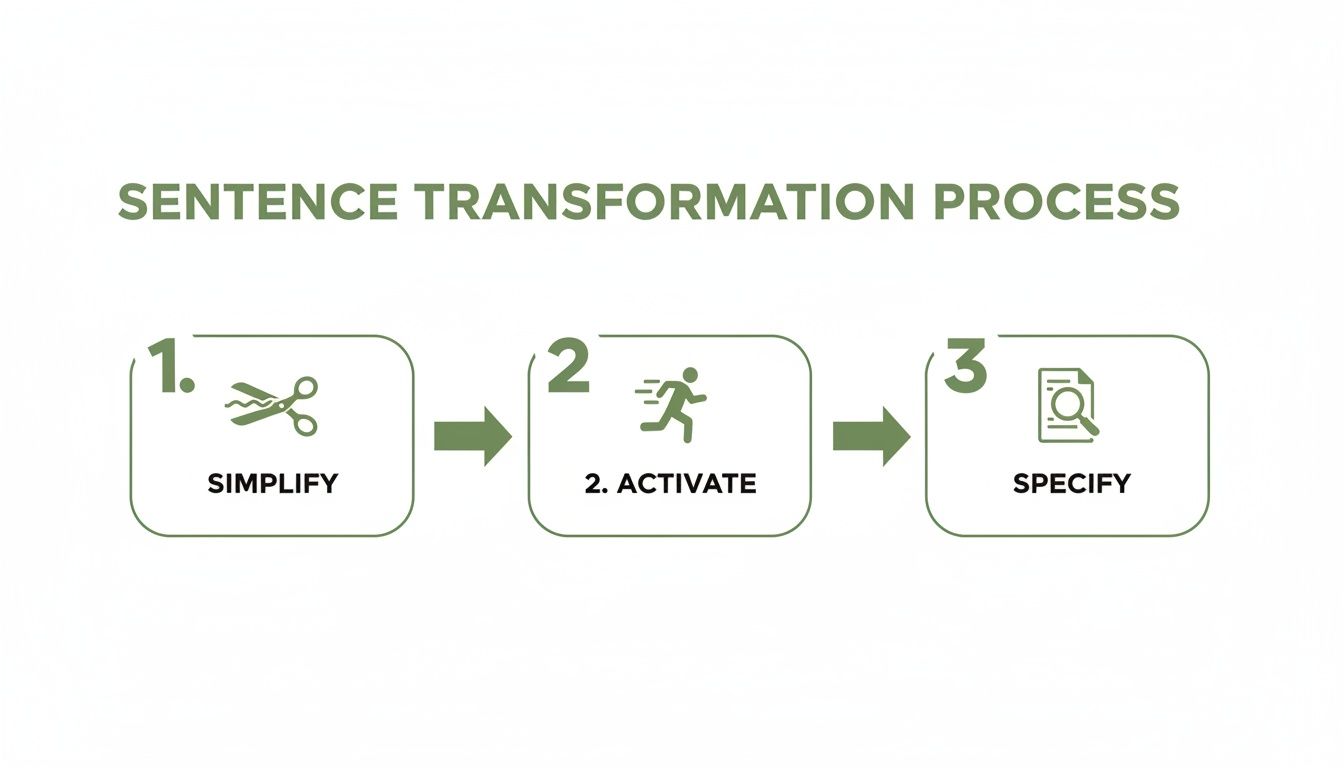
This process—simplify, activate, and specify—is your roadmap. It’s a constant reminder to make your writing more direct, vivid, and engaging than the generic output you started with.
A Practical Workflow for Humanizing Text
Getting authentic results from an AI draft really comes down to targeted editing. Don't just accept the first version. You need to actively hunt for those robotic giveaways and swap them out for natural, human language.
This skill is becoming non-negotiable. With Europol estimating that by 2026, as much as 90% of online content could be synthetically generated, the value of authentic-sounding text is only going to skyrocket.
Don't just edit for grammar—edit for voice. Read the sentences aloud. Do they sound like something a real person would say? If not, keep simplifying them until they do.
Here’s a quick workflow you can use with a tool like Natural Write to speed things up:
- Add personal stories. Weave in a short, relevant anecdote or personal insight. AI simply can't fake lived experience.
- Use contractions and idioms. Words like "it's," "don't," and "you're" immediately make writing more conversational and less formal.
- Vary your sentence structure. Break up those long, winding AI sentences. Mix short, punchy statements with longer, more descriptive ones to create a better reading rhythm.
- Look for overused words. AI has its favorites—those "safe" words it falls back on. Find them and replace them with stronger, more interesting synonyms.
By focusing on these specific areas, you can effectively rewrite AI text to sound human, ensuring your message truly connects with your audience and easily bypasses AI detectors.
Common Rewriting Mistakes You Need to Avoid
We've all been there. You're trying to perfect a sentence, and suddenly, you've edited it so much that it's worse than when you started. It's a common trap. In our rush to strengthen our writing, we can accidentally weaken it.
Knowing what these pitfalls look like is the best way to steer clear of them.

One of the biggest culprits is over-editing. This is where a perfectly clear idea gets reworked into a tangled mess of complex words and convoluted phrasing. The goal is always clarity, not complexity.
Another frequent mistake is accidentally changing the original meaning. When you start swapping words or rephrasing clauses, you have to be vigilant that the core message stays exactly the same. Even a subtle shift in wording can send your sentence off in a completely new direction.
Overcomplicating Your Ideas
It's tempting to reach for sophisticated vocabulary to sound more authoritative, but this usually backfires. Forcing in "smart" words where simple ones would do just creates awkward, unnatural sentences that are a slog for your readers. Stick to clear language.
For example, don't let a simple concept get lost in a sea of jargon.
- Mistake: "The synergistic implementation of our strategic assets effectuated a paradigm shift in operational efficiency."
- Correction: "Using our resources together made our operations much more efficient."
The corrected version is direct and confident. It gets the point across without making the reader work for it.
Your goal is to communicate, not to impress someone with your vocabulary. If a simpler word works better, use it. Every time.
Be especially wary of AI tools that just swap synonyms without understanding the context. Nuance is everything, which is a key reason why AI-generated content often falls short without a human editor at the helm. Your job is to guide the edits and make sure they genuinely improve the sentence.
This often involves spotting and fixing other issues that pop up, like unclear references. You can learn more by checking out our guide on how to fix vague pronoun examples, which are a common side effect of rushed rewrites.
Answering Your Trickiest Rewriting Questions
Even when you know the ropes, rewriting can throw you a curveball. Let's tackle some of the most common questions that pop up, with practical answers to help you edit with a clearer head.
How Can I Make a Sentence Sound More Professional?
A professional tone really comes down to clarity and precision, not just using bigger words. The first thing I always do is scan for any casual language or slang and swap it out for more standard, formal terms.
Then, look at your verbs. Are they weak? Instead of "look into," try "investigate." Instead of "think about," use "consider." These stronger, more specific verbs instantly add a sense of authority. Combine that with solid grammar and a logical sentence structure, and you've got a professional feel without sounding stuffy.
A professional tone isn't about complexity; it's about using the right words. Precision will always sound more authoritative than just being wordy.
What's the Quickest Way to Rewrite a Whole Paragraph?
If speed is what you're after, a good rewriting tool is your best bet. Manually reworking every single sentence gives you maximum control, sure, but it's a huge time sink when you're dealing with a big chunk of text.
I've found that platforms like Natural Write are built for this exact challenge. You can drop in an entire paragraph and let its humanizer feature do the heavy lifting. It's designed to intelligently improve the flow and word choice across the whole section at once, which is a massive time-saver.
Does Rewriting for Clarity Actually Help with SEO?
Yes, it makes a huge difference. These days, readable, high-quality content is a major player in SEO. When you rewrite your sentences to be clearer and more direct, you're making the user experience on your site better.
Just put yourself in Google's shoes for a second.
- Better Engagement: When content is easy to digest, people stick around longer to read it.
- Lower Bounce Rates: Clear writing stops visitors from getting confused and hitting the back button.
- Signals Authority: Clean, well-structured content naturally comes across as more expert and trustworthy.
All these positive signals tell search engines that your page is valuable, which can absolutely help you climb the rankings over time.
How Can I Rewrite Something Without Losing the Original Meaning?
This is the big one, the most important skill to master. The trick is to learn how to separate the core idea of a sentence from the specific words and structure used to say it. First, pinpoint the main subject and the primary action. That's the heart of the sentence, and it can't change.
From there, your job is to present that same core idea more effectively. Maybe you break a long, winding sentence into two shorter, punchier ones. Or perhaps you reorder the phrases to create a better rhythm. If you reach for a thesaurus, be careful—make sure any synonym you choose fits the exact context. I always read my new version aloud and then compare it to the original, just to be certain the message is still perfectly intact.
Ready to transform your text with ease? Natural Write instantly humanizes your AI-generated drafts, ensuring they are clear, engaging, and bypass all major AI detectors. Try it for free at https://naturalwrite.com.