
Writing a synthesis essay isn't just about summarizing a bunch of sources. It's about creating something new—a coherent argument you build by connecting ideas from multiple texts.
Think of yourself as a detective building a case. Your sources are your witnesses and evidence. Your job is to weave their testimonies together to prove your own unique thesis. You’re essentially joining an ongoing conversation and adding your own informed perspective.
So, What Exactly Is a Synthesis Essay?
Imagine you're hosting a dinner party. Your guests are the authors of your sources, and each one has a strong opinion on the topic at hand.
Your role isn't to let each guest give a long, separate speech. That would just be a string of summaries. Instead, as the host, you guide the conversation. You point out where they agree, where they clash, and then, you offer your own concluding take on the whole discussion.
That's the heart of a synthesis essay. It’s an academic conversation that you create, lead, and conclude.
This skill is a cornerstone of higher education for a reason. It pushes you beyond simple reporting and forces you to think critically, analyze different viewpoints, and construct a compelling argument. You're not just repeating facts; you're creating new meaning by connecting threads from different places.
Argumentative vs. Explanatory Essays
Synthesis essays usually come in two flavors. Nailing your assignment means knowing which one you're supposed to write.
- Argumentative Synthesis: This is the most common type you'll encounter. You take a firm stance on a topic and use the sources to build a case that backs you up. Your thesis is debatable, and your goal is to convince the reader that your interpretation is the most logical one.
- Explanatory Synthesis: This style is less about persuasion and more about illumination. Here, your goal is to explain a topic in depth, connecting information from various sources to give your reader a complete picture. While you still have a thesis, it’s focused on clarifying connections rather than proving a point. For a deeper dive, check out our complete guide on what is expository writing.
The demand for this kind of thinking is huge. The market for academic writing support has ballooned to an estimated $1.8 billion globally, largely because assignments like synthesis essays test such complex skills. This trend highlights their importance, with one study finding that 44% of students now use a mix of AI tools and human editing to meet these high standards.
The biggest mistake I see students make is summarizing sources one by one. True synthesis happens when you organize the essay around your own points, pulling evidence from multiple sources into each paragraph to support your argument.
Ultimately, learning to write a synthesis essay is about mastering how to manage and present information effectively. It’s a skill that translates directly to the professional world, where you’ll constantly need to evaluate different reports, opinions, and data to make informed decisions and present a cohesive strategy. It's about becoming a thoughtful contributor, no matter what conversation you're in.
Core Components of a Successful Synthesis Essay
To really knock your synthesis essay out of the park, you need to master a few key elements. This table breaks down the essentials.
| Component | Description | Why It's Crucial |
|---|---|---|
| A Clear Thesis | Your unique, debatable claim that steers the entire essay. It's the central argument you're proving. | Without a strong thesis, your essay becomes a collection of summaries with no clear purpose or direction. |
| Source Integration | Weaving quotes, paraphrases, and ideas from multiple sources within the same paragraph to support your points. | This demonstrates your ability to connect ideas and shows you're not just reporting on one source at a time. |
| Thematic Organization | Structuring your body paragraphs around your own original points or themes, not around individual sources. | This is the hallmark of synthesis. It puts your argument in the driver's seat and uses sources as evidence, not as the structure itself. |
| Critical Analysis | Going beyond what the sources say to explain why they matter and how they support your thesis. | This is where you add your own voice and show you've thought deeply about the topic, not just skimmed the readings. |
| Proper Citation | Consistently and accurately citing all source material according to the required style (MLA, APA, etc.). | This gives credit to the original authors, adds credibility to your argument, and helps you avoid plagiarism. |
Think of these components as your checklist for an A-grade paper. If you can confidently say you've hit all five, you’re well on your way.
Mastering Your Sources Before You Write a Word
The best synthesis essays are won or lost long before you type the first sentence of your intro. It all comes down to how you handle your sources. Just reading through and highlighting a few key phrases won't cut it. You have to actively engage with the material—questioning, connecting, and dissecting the texts to build a rock-solid foundation for your argument.
Think of yourself as an investigator, not just a reader. Your job is to transform a pile of articles into an organized arsenal of evidence. First, you need to understand what each source is saying on its own. Then, you can figure out how they speak to one another.
This concept map shows how your central argument acts as the brain of the essay, connecting your thesis with the sources and the evidence you pull from them.
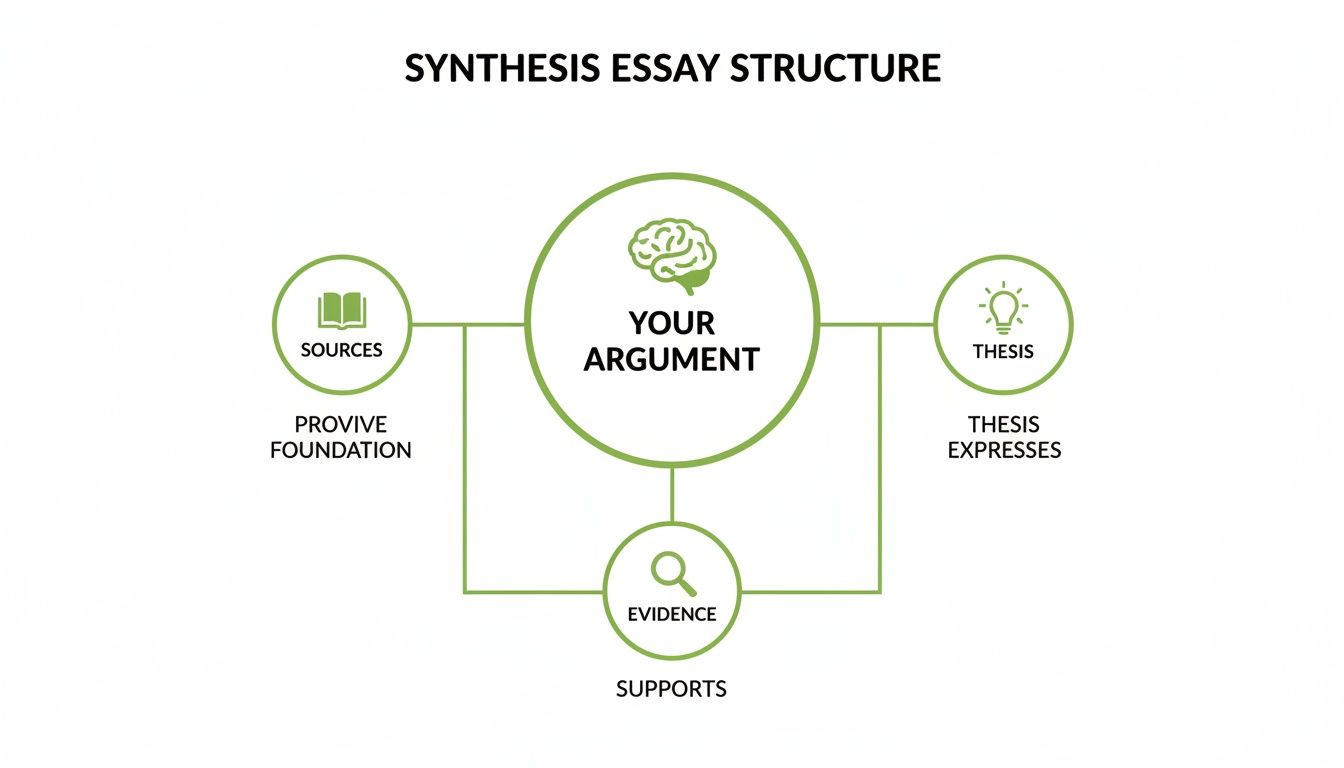
As you can see, a powerful essay doesn’t just list what your sources say. It strategically uses them to build and defend a unique idea that is entirely your own.
Go Beyond Highlighting with Active Annotation
Passive highlighting feels productive, but it’s a trap. It creates a false sense of security. A much better approach is to treat your sources like you're having a conversation with them. Annotate with purpose. Whether you're working on a screen or with physical copies, mark up the text to flag components you know you'll need later.
As you read, keep an eye out for these elements:
- The Main Claim: What’s the author's core argument? Don't just underline it—summarize it in the margin in your own words.
- Key Evidence: What data, stories, or examples does the author use to back up their claim? Mark these clearly.
- Authorial Bias: Can you spot a particular slant or perspective? Make a note of any potential biases that might be shaping their argument.
- Connections to Other Sources: Does a point here directly support or contradict something you read in another text? Jot down a quick note like, "Conflicts with Source B's point on regulation."
This kind of detailed annotation turns each source into a set of ready-to-use building blocks. It’s an investment upfront that pays off big time. In fact, getting this step right can cut your revision time by as much as 40%—a massive advantage when you're tackling a complex topic.
The Source Matrix: Your Secret Weapon
Once you’ve annotated everything, it's time to organize your findings visually. This is where a source matrix becomes your best friend. A source matrix is just a simple grid or table you create to map out how different sources weigh in on specific themes or subtopics.
It's a surprisingly powerful tool for seeing the bigger picture and identifying the key points of conversation that will drive your essay.
A source matrix forces you to stop thinking about your sources as individual summaries and start seeing them in terms of the broader themes that connect them. This is the mental shift required for true synthesis.
To build one, just set up a simple table. List your sources down the first column and your main themes or questions across the top row. For an essay on urban development, your themes might be "Economic Impact," "Environmental Concerns," and "Community Displacement."
Then, go through and fill in the grid with quick notes summarizing what each source says about each theme. You'll immediately see where sources agree, where they clash, and where there are gaps in the conversation. This matrix basically becomes the preliminary outline for your body paragraphs, making the actual writing process incredibly focused and efficient.
Properly tracking these ideas also sets you up for accurate attribution later on. If you need a refresher, you can check out our guide on how to cite sources in a research paper. This groundwork ensures that when you do start writing, you can weave in your evidence smoothly and ethically.
How to Craft a Strong Synthesis Thesis
Your thesis is the most important sentence in your entire essay. Period.
Think of it as the engine driving your whole argument. A weak thesis means a sputtering, lost-on-the-backroads kind of essay. But a strong one? That’s a clear, confident roadmap that tells your reader exactly where you’re going and how you’ll get there.
Forget about just stating the topic. A powerful synthesis thesis makes a specific, debatable claim that’s born from your interpretation of the sources. It’s the conclusion you’ve personally drawn after connecting all the dots.
From Vague Idea to Sharp Argument
Getting to a great thesis usually starts with a simple framework: Topic + Your Position + Key Themes. This helps you move past just summarizing what the sources say and start staking your own claim in the conversation.
Let's watch this play out.
- Weak Start: "All the sources discuss climate change." (This is just a fact, not an argument.)
- Getting Warmer: "The sources show different solutions for climate change." (Closer, but you're still just an observer.)
- Strong Synthesis Thesis: "While the sources agree on the urgency of climate change, they fundamentally diverge on whether market-based solutions or government regulation offers a more viable path forward, revealing a deep ideological split in environmental policy."
See the difference? That final version is specific, it's debatable, and it lays out the key themes (market solutions vs. regulation) that will structure your essay. It tells your reader exactly what's coming. For a deeper dive into the mechanics, our guide on how to write a thesis statement is a perfect next step.
Your thesis is a promise to your reader. It's not just a statement of fact but a claim you will spend the rest of your essay defending with evidence from your sources.
Thesis Statement Strength Test
Not all thesis statements are created equal. Before you commit, run yours through a quick strength test. A truly strong thesis is arguable, focused, and complex enough to sustain an entire essay. It moves beyond simple observation to offer an insight that is entirely your own.
This isn't just for academic essays; developing a strong central argument is key for all kinds of writing. Check out these powerful personal statement examples to see how a compelling core idea is conveyed, whether for college applications or a job.
To help you see what works, here’s a quick comparison of weak thesis statements versus strong ones.
| Characteristic | Weak Thesis Example | Strong Thesis Example |
|---|---|---|
| Arguable Claim | Social media has both positive and negative effects on teenagers. | While social media platforms offer teenagers vital social connections, their algorithm-driven nature fosters a toxic culture of comparison that outweighs the benefits. |
| Specific Focus | The sources discuss the use of AI in the workplace. | Although many sources celebrate the efficiency gains from workplace AI, they often overlook the significant risk of de-skilling the human workforce. |
| Essay Roadmap | There are many opinions on remote work. | The debate over remote work is not simply about productivity but reveals a deeper tension between employee autonomy and corporate control. |
Notice how the strong examples all present a tension or a specific, interpretive angle? They don’t just state facts; they analyze them. That’s the heart of a synthesis essay. Your thesis is your unique contribution to the conversation—make it a clear and compelling one.
Structuring Your Essay for a Cohesive Argument
A brilliant argument can completely fall apart if it's poorly organized. Your essay's structure is the roadmap that guides your reader through your ideas, and it's what holds all that critical thinking together.
The biggest mistake I see students make is structuring their essay around the sources. They'll write one paragraph about Source A, the next about Source B, and so on. That’s not a synthesis—it’s just a list of summaries.
True synthesis means you organize the essay around your own points or themes. The sources are just the evidence you use to prove those ideas.
This thematic, point-by-point approach shows you're in control of the conversation. You aren't just reporting what others have said. You're the architect of the argument, and the sources are your building materials.
The Blueprint for a Strong Body Paragraph
Think of each body paragraph as a mini-argument that proves one small piece of your overall thesis. It needs to be a self-contained unit of persuasion. A powerful body paragraph always has the same basic anatomy.
Here’s a breakdown of the essential parts:
- Topic Sentence: This is your first sentence, and it has one job: state the specific point you're about to prove. It must connect directly back to your thesis.
- Evidence Integration: Next, you need to skillfully weave in evidence from at least two different sources. You might use a direct quote from one source and then a paraphrased idea from another that builds on it or complicates it.
- Your Analysis: This is where you come in, and it's the most important part. After you present the evidence, you have to explain how it proves your topic sentence. Connect the dots for the reader and show them why this evidence matters.
- Concluding/Transition Sentence: The last sentence should wrap up the paragraph's point and smoothly guide the reader into your next idea.
This structure ensures every paragraph is focused, backed by evidence, and clearly tied to your central claim. It’s how you build a powerful argument from start to finish.
A Flexible Outline You Can Adapt
While every essay is unique, a solid outline is non-negotiable. Don't think of it as a rigid cage—it’s more like a flexible skeleton that gives your ideas shape and direction.
The goal of your structure is to create a logical "line of reasoning." Each paragraph should build on the last, progressively strengthening your thesis until the conclusion feels both inevitable and well-earned.
A typical high-scoring essay often has 3-4 body paragraphs, each around 200 words, synthesizing evidence from 2-3 sources. In fact, research into top-scoring AP essays reveals that this kind of balanced source integration can boost grades by 25%. Plus, using effective transitions between these paragraphs can improve coherence scores by as much as 18%. You can explore more about these essay examples and their scoring to see just how much structure makes a difference.
Example Paragraph: Thematic Synthesis in Action
Let's see what this looks like in practice. Imagine our thesis is: “While AI integration promises increased workplace efficiency, it simultaneously threatens to devalue the uniquely human skills of creative problem-solving and critical thinking, creating a long-term risk for innovation.”
Here’s a body paragraph that supports that thesis:
A primary risk of over-reliance on AI in the workplace is the gradual erosion of employees' creative problem-solving abilities. When AI tools provide instant answers and automate complex tasks, they can inadvertently short-circuit the messy, iterative process of human innovation. As author David Espinoza argues, efficiency-focused AI is "optimized for the known, not the novel," meaning it excels at refining existing processes but struggles to generate truly groundbreaking ideas (Source C). This creates a workplace culture where employees become passive implementers of AI-driven directives rather than active problem-solvers. This concern is echoed in a recent industry report, which found that teams heavily dependent on AI for project management were 30% less likely to deviate from initial plans, even when faced with unforeseen challenges (Source E). My analysis is that by offloading the cognitive heavy lifting to machines, companies risk creating a workforce that is excellent at execution but poor at adaptation, ultimately stifling the very creativity that drives long-term growth and market leadership. Therefore, this dependency on AI poses a direct threat to a company's innovative capacity.
See how that works? The paragraph starts with a clear point, blends evidence from two different sources, and ends with original analysis that ties everything back to the thesis. That’s the engine of a successful synthesis essay.
Weaving in Evidence Without Losing Your Voice
This is where your essay really starts to sing. It’s one thing to have a great stack of sources; it’s another to weave them into your writing so they build up your argument without drowning you out. The goal is to make the sources work for you, not the other way around.
Your voice has to be the star of the show. Think of yourself as a tour guide in a museum. You’ve picked out the most compelling artifacts (your evidence), but they don't speak for themselves. You’re the one who arranges them and provides the insightful commentary that tells the real story.

Pulling this off means knowing exactly when to quote, when to paraphrase, and when to summarize. Each one is a different tool in your toolbox, and knowing which one to grab is key.
Choosing the Right Tool for the Job
A big part of mastering the synthesis essay is making smart, strategic choices about how you present what you’ve found. Don't just fall into the trap of quoting everything.
- Direct Quote: Use these like a scalpel—sparingly and with precision. A direct quote is perfect when an author’s phrasing is just too powerful, memorable, or distinct to change. But be careful. Overdo it, and your essay will feel like a Frankenstein's monster of other people's ideas.
- Paraphrase: This is your everyday workhorse. Paraphrasing means putting a specific point from a source into your own words. It proves you actually get the concept and lets you seamlessly blend the evidence into your own sentences.
- Summary: Pull this out when you need to give the big-picture view of an entire article or study without getting lost in the weeds. It's great for setting the stage and establishing a source’s general stance before you zoom in on the details.
By mixing these up, you stay in the driver's seat, keeping your analytical voice front and center where it belongs.
The Art of the Signal Phrase
Whatever you do, don't just drop a quote into a paragraph out of nowhere. It’s jarring. We call that a "hit-and-run" quotation, and it leaves your reader scratching their head, trying to figure out how the evidence connects to your point.
The fix? Signal phrases. These are little introductions that name the source and frame the evidence for your reader, creating a smooth and professional flow.
A signal phrase is more than just "So-and-so said..." It's your chance to shape how the reader interprets the evidence. Words like "argues," "insists," "contends," or "suggests" all have slightly different flavors that can subtly boost your own analysis.
Instead of a generic "A study found...," try something with a little more purpose.
- To show you agree or have backup:
- As Dr. Evans confirms...
- Corroborating this point, Johnson's research notes that...
- To introduce a different perspective:
- Williams, on the other hand, posits that...
- In a direct challenge to this idea, Chen argues...
- To stay neutral and report:
- According to the 2023 report...
- As the author explains...
Using signal phrases well makes your sources feel like part of a conversation you're leading, not just random facts you've thrown in. This smooth integration is the hallmark of a really sophisticated synthesis essay. It shows you’re in total command.
Taking Your Draft from Good to Great
The last big step isn't writing—it's rewriting. This is where a decent draft becomes a polished, persuasive essay. We're not just hunting for typos here. This is your chance to sharpen your arguments, deepen your analysis, and make sure your voice is what drives the piece.
Let's be real: a lot of students get a first draft going with help from AI. It's great for breaking through writer's block, but those initial drafts almost always feel a bit… off. They can sound generic, with clunky transitions and connections between sources that are way too surface-level.
Revision is how you take ownership of the essay. It's where you inject your own perspective, strengthen your claims, and move past the robotic patterns AI can fall into. You want the final product to reflect your critical thinking, not an algorithm's summary.
Giving Your AI Draft a Human Touch
If you used an AI tool to get started, your first editing pass should be all about fixing its common weak spots. AI-generated text often sounds correct but lacks a real argumentative edge. It might summarize your sources just fine, but it rarely builds a compelling case from them.
Your job is to actively "humanize" the text. That means refining its tone, improving its clarity, and, most importantly, adding analytical depth.
This is exactly what tools are now being designed to do—transform that robotic-sounding text into something that flows like a real person wrote it.
The main goal is to replace predictable phrasing and smooth out the flow. That's the secret to making an AI-assisted draft sound authentic and pass detection.
Scan the draft for spots where the analysis feels thin. Look for places where connections between sources are mentioned but never really explained. This is where you come in. Add your own interpretive layer, question the evidence, and explain its significance in your own words.
The single most important revision you can make is to deepen your analysis. After every piece of evidence, ask yourself: "So what?" If the AI draft doesn't answer that question, your job is to write the answer in.
The Final Polish: A Quick Checklist
Before you even think about hitting "submit," do one last, focused review. This final pass is your last line of defense against common mistakes and ensures your essay is as strong as it can be.
Here's a practical checklist to run through:
- Does your thesis still hold up? Look at your body paragraphs. Does your thesis statement still perfectly capture the argument you ended up making?
- Is the argument airtight? Read just your topic sentences. Do they flow logically from one to the next and all point back to the main thesis?
- Are your sources working together? Aim for at least two sources per body paragraph. Are your signal phrases varied? Are your citations on point?
- Does it sound like you? Have you cut out the generic, filler language and injected your own analytical voice?
- Is it clear and concise? Read the whole thing out loud. Your ears will catch awkward sentences your eyes miss. Trim any fluff to make your points hit harder.
Answering Your Top Synthesis Essay Questions
Even with a great outline, you're bound to run into a few tricky spots while writing. Let's tackle some of the most common questions that come up.
A big one is always, "How many sources do I need in a paragraph?" As a general rule, aim for at least two distinct sources in each body paragraph. If you only use one, the paragraph just becomes a summary of that single source. But when you bring two or more into the mix, you're creating a conversation—you can compare them, contrast them, and build a much more solid point.
Avoiding the Biggest Mistake
The single most common pitfall is structuring your essay around the sources. You know what I mean: a paragraph all about Source A, followed by a paragraph on Source B, and so on. That’s just a book report, not a synthesis.
Always organize your essay around your own thematic points. The sources are just the evidence you use to back up your ideas.
So, is it okay to include your own opinion? Yes! In fact, your opinion is the whole point. A synthesis essay is your informed argument. While you have to back up every claim with evidence from the texts, the thesis and the analysis are all you.
Conflicting sources are a gift, not a problem. They offer a golden opportunity for deep analysis. Instead of ignoring the disagreement, make it a central point of your discussion.
What to Do with Contradictory Sources
When you find two sources that completely disagree, don't run from the conflict—lean into it.
You can actually build a whole paragraph around exploring why they don't see eye to eye. Do they use different evidence? Are there hidden biases at play? Do they start from totally different assumptions? Once you figure that out, you can argue which viewpoint holds more weight or what the conflict itself says about the topic.
Getting comfortable with these situations is crucial, especially in a timed setting. For more strategies on handling the pressures of exam essays, this complete AP English Exam Study Guide is a lifesaver. Nail these common challenges, and you'll write a synthesis essay that truly stands apart.
Ready to turn your robotic AI draft into a polished, authentic essay? Natural Write instantly refines your text, ensuring it flows naturally and bypasses AI detection tools with ease. Try it for free at https://naturalwrite.com.