
A research proposal is your chance to make a case for your work. It's where you define a clear research question, lay out a practical plan to answer it, and argue persuasively that your project matters. The real goal is to convince a review board that your project is not only important but also completely doable with the resources you're asking for.
Understanding What Makes a Proposal Successful
Before you even think about writing, you need to get inside the head of the people who will be reading your proposal. What separates a project that gets funded from one that gets rejected? In today's hyper-competitive academic world, your proposal is much more than an explanation of a cool idea—it's a sales pitch. You have to convince a committee of experts that your research is essential, your plan is solid, and the potential payoff is huge.
This means shifting your mindset entirely. Stop thinking, "Here's something interesting I want to study." Start thinking, "Here's a critical problem, and I have a well-designed plan to solve it." Your proposal is a strategic document designed to win over a skeptical audience.
The Anatomy of a Winning Argument
Reviewers are trained to look for certain things that signal a strong, well-thought-out project. Think of these as the pillars holding up your entire argument. A successful proposal almost always nails these three areas:
- A Razor-Sharp Research Question: Is your main question crystal clear, focused, and actually answerable within your project's scope? Vague or overly ambitious questions are an immediate red flag.
- An Airtight Methodology: Does your plan for gathering and analyzing data directly map back to your research question? Reviewers want to see a logical, step-by-step process that is both rigorous and realistic.
- Justifiable and Realistic Budgeting: Every single dollar you ask for must be tied to a specific research activity. A padded or poorly explained budget instantly tanks your credibility.
A great proposal doesn’t just present information; it builds a compelling business case for your research. It anticipates reviewers' questions and answers them proactively, leaving no doubt about the project's value and your ability to execute it.
Let's quickly break down the core components you'll be building.
Core Components of a Research Proposal At a Glance
This table gives you a bird's-eye view of the essential sections you'll find in nearly every research proposal and the main question each part needs to answer.
| Section Component | Core Purpose |
|---|---|
| Title | What is the project about in a single, concise phrase? |
| Abstract/Summary | Can you summarize the entire project (problem, methods, impact) in under 300 words? |
| Introduction | What is the problem, and why does it matter right now? |
| Literature Review | What has already been done, and where is the gap your research will fill? |
| Research Question | What specific question(s) will your project answer? |
| Methodology | How, exactly, will you answer your research question? |
| Timeline | What is your realistic schedule for completing the project? |
| Budget | What resources do you need, and how will you use them? |
| Expected Outcomes | What will be the tangible results and broader impact of your work? |
Think of this table as your blueprint. Each section builds on the last, creating a coherent and compelling story for your research.
Navigating a Competitive Funding Environment
Getting this right has never been more important. The world of research funding is brutal, with success rates dropping steadily over the years. The data tells a tough story: far more proposals are being submitted than there is money to go around.
For example, at major research institutions, overall funding rates plunged from 38.13% in the early 2000s down to just 9.08% by the early 2010s. That trend highlights just how polished your application needs to be.
To really get a handle on how to secure funding, digging into a practical guide on how to get research grants can make a world of difference. This kind of foundational knowledge demystifies the process and helps you craft a proposal that stands out for all the right reasons.
Building the Core Sections of Your Proposal
Alright, you’ve got your big idea. Now comes the hard part: getting it down on paper in a way that’s coherent, logical, and persuasive. I always tell my students to stop thinking of a proposal as one giant, terrifying document. Instead, see it as a series of connected pieces, where each section hands the baton to the next.
Your intro hooks the reader, your literature review proves you've done your homework, and your research question gives the whole project a clear destination. It's about building a story, piece by piece. Let's walk through how to assemble these essential components without getting overwhelmed.
Ultimately, a winning proposal boils down to a simple, powerful narrative. You identify a problem, you propose a solution, and you explain the impact of that solution.
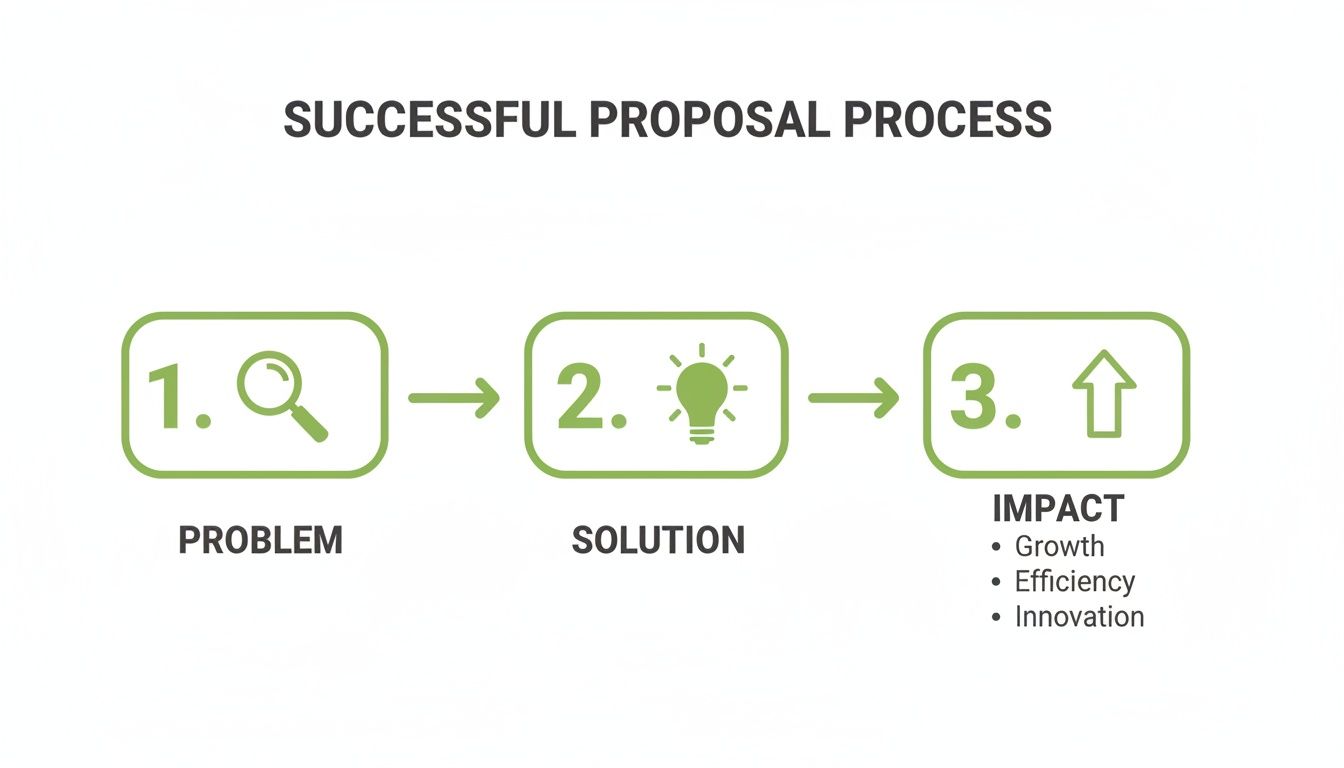
This Problem -> Solution -> Impact framework is the engine driving your entire document. Keep it in mind as you build out each section.
Crafting a Compelling Introduction
Think of your introduction as the first 30 seconds of a crucial meeting. You have a tiny window to grab your reader’s attention and convince them to keep listening. The goal here is simple: establish the problem and explain why it demands a solution right now.
Forget vague, generic openings. Get straight to the point with a compelling hook. For instance, if you're researching burnout in the tech industry, don't start with, "Remote work is a growing trend."
Instead, hit them with something concrete: "Since 2020, employee burnout rates in the tech sector have surged by 35%, a spike that coincides directly with the industry-wide pivot to remote work. This isn't just a morale issue; it's a direct threat to productivity and talent retention."
See the difference? You’ve presented a specific, data-backed problem, making it impossible to ignore. From there, you can wrap up the introduction with a clear thesis or purpose statement that telegraphs exactly what you plan to investigate.
The Literature Review as an Argument
Here’s where so many proposals fall flat. A literature review is not a book report. It’s not a laundry list of who said what. A great literature review is an argument that strategically guides the reader to a single, unavoidable conclusion: there’s a critical gap in our knowledge, and your research is designed to fill it.
Your job is to synthesize the existing conversation in your field, showing what’s known, what’s debated, and—most importantly—what’s missing.
- Organize by Theme, Not by Author: Instead of a chronological summary, group studies around key themes or competing theories. This demonstrates you understand the landscape on a deeper level.
- Critique, Don't Just Report: Move beyond "Smith (2019) found..." to something more analytical, like "While Smith's (2019) work provides a foundational understanding of X, it crucially overlooks the role of Y..." This frames your study as the necessary next step.
- Signpost the Gap: After you’ve built your case, make the gap explicit. For example: "Despite a wealth of research on remote work, no study has yet systematically examined how asynchronous communication tools impact burnout. This is the gap my research will address."
A well-executed literature review makes your research feel inevitable. It positions your work not just as "interesting" but as absolutely essential for the field to advance.
Defining Your Research Question
Your research question is the North Star of your project. Every single thing in your proposal—every methodological choice, every line in your budget—must serve the purpose of answering this one question. It has to be focused, specific, and answerable.
Let's go back to our burnout example. A vague question like "Is remote work bad?" is a non-starter. It's too broad and impossible to answer definitively.
Let’s sharpen it: "How do asynchronous communication practices in fully remote tech companies correlate with self-reported levels of employee burnout?"
This question works because it's specific (asynchronous communication), measurable (correlation with burnout levels), and scoped to a clear population (remote tech companies). It creates a well-defined container for your investigation.
The Abstract or Executive Summary
Even though it’s the first thing your audience will read, the abstract is the very last thing you should write. It’s your proposal in miniature, an "elevator pitch" that gives a busy reviewer everything they need in 250-300 words.
A strong abstract has five key ingredients:
- The Problem: What’s the issue you’re tackling? (1-2 sentences)
- Your Objective: State your core research question. (1 sentence)
- The Method: Briefly, how will you answer the question? (1-2 sentences)
- Expected Findings: What do you anticipate discovering? (1 sentence)
- The Impact: Why does it matter? Who benefits? (1 sentence)
This little paragraph carries a ton of weight. It’s often the gatekeeper that determines whether someone reads the rest of your proposal. For a deeper dive into making this section shine, our guide on how to write an executive summary is a great resource, as the core principles of brevity and impact are the same.
Nailing Your Methodology and Impact
A great idea gets you in the door. A bulletproof plan gets you the funding. This is where you prove your research isn't just a fascinating thought experiment but a well-oiled machine capable of producing real, meaningful results. You need to show your review committee how you’ll do the work and why it matters.
Think of this section as the bridge connecting your big question to its eventual answer. Every single step has to be clear, justified, and tied directly back to your research objectives.

Designing a Rock-Solid Research Plan
Your methodology is your playbook. It should be so crystal clear that another researcher in your field could pick it up and replicate your study. Vague hand-waving like, "I will interview participants," just won't cut it. You need to get into the weeds and show you’ve thought this through.
Break your plan down into its essential parts:
- Research Design: What kind of study is this? Qualitative, quantitative, or mixed-methods? Is it experimental, correlational, or descriptive? More importantly, explain why this design is the absolute best fit for your research question.
- Participants or Data Sources: Who (or what) are you studying? Get specific about your target population, how you'll determine your sample size, and your exact sampling strategy (e.g., random, stratified, convenience). If you’re working with existing data, describe the dataset and where it came from.
- Data Collection Instruments: What are your tools of the trade? This could be anything from surveys and interview guides to observation checklists or highly specific lab equipment. If you’re building your own tool, like a new questionnaire, you have to explain how you’ll ensure it's both valid and reliable.
- Procedures: Walk the reader through your process, step by step. How will you find and recruit people? How will you handle informed consent? What does a typical data collection session look like? This level of detail proves you've considered the real-world logistics.
If you want to dive deeper into building out this crucial section, our guide on how to write a research methodology is packed with more detailed frameworks and examples.
Justifying Every Single Choice
Don't just list your methods; defend them. A strong proposal shows you have a clear plan for making sense of the data you collect. For example, if you plan to conduct interviews, you must specify your approach to analysis. Will you use thematic analysis? Grounded theory? Showing you’re already thinking about the finish line is key. For more on this, mastering qualitative data analysis techniques can help you articulate a concrete strategy.
Think of it this way: your methodology section isn't just a list of steps. It's an argument defending why your chosen steps are the best possible ones for this specific project.
For instance, don't just say you'll use a T-test. Explain why a T-test is the right statistical tool for your specific data and research question, maybe even mentioning why other tests, like an ANOVA, aren't appropriate. This demonstrates foresight and a deep understanding of your field.
Quantifying Your Expected Impact
Once the "how" is clear, you have to connect it to tangible outcomes. Funders want to see a return on their investment. It’s no longer enough to say your project will "contribute to the literature." You need to spell out its real-world value, often with hard numbers.
This is especially true in the health sector, which dominates research funding. With the U.S. National Institutes of Health (NIH) alone investing $26.1 billion annually, the pressure to show measurable results is immense. Proposals in this arena often need to forecast specific improvements in health outcomes or cost savings.
Framing Your Project's Significance
To build a compelling case, think about impact on multiple levels. Here’s a simple way to structure your argument:
| Impact Category | Example Statement |
|---|---|
| Theoretical Contribution | "This study will challenge the existing X model by introducing a new variable, Y, offering a more nuanced understanding of the phenomenon." |
| Practical Implications | "The findings could directly inform new training protocols for ER nurses, potentially reducing patient wait times by an estimated 15%." |
| Policy Recommendations | "Our results will provide policymakers with the data needed to support evidence-based legislation on urban green spaces and public health." |
| Future Research | "By establishing a reliable method for measuring Z, this project will pave the way for subsequent longitudinal studies in this field." |
Be specific and confident, but don't over-promise. Ground every prediction in the logic and evidence you've already laid out in your literature review. This shows your project isn't just an academic exercise—it's an investment with a clear and valuable payoff.
Sidestepping the Traps That Can Sink Your Proposal
Even the most groundbreaking research idea can get shot down because of a few simple, avoidable stumbles. Think of this as your guide to navigating the minefield—a way to spot and sidestep the common mistakes that get proposals tossed into the "no" pile. After reviewing enough of these, you start to develop a sixth sense for red flags, and catching them in your own work is a game-changer.

This isn’t just a list of things not to do. It’s about understanding why these errors are so damaging and how to give your proposal a thorough audit before you even think about hitting "submit."
The Unfocused Research Question
This is the big one. The single most common fatal flaw I see is a research question that's either way too broad or frustratingly vague. If a reviewer has to squint to figure out what you’re actually trying to discover, you've already lost them. This usually happens when a fascinating topic hasn't been sharpened into a specific, testable hypothesis.
Let's look at the difference:
- Too Vague: "How does social media affect mental health?"
- Laser-Focused: "To what extent does daily exposure to algorithm-driven fitness content on Instagram correlate with body dysmorphia symptoms in female users aged 18-24?"
See the difference? The second question is specific, measurable, and has a clearly defined scope. It paints a picture. The first is a philosophical rabbit hole with no clear end.
Mismatching Your Methods and Objectives
Another classic pitfall is when your research goals and your proposed methods just don't line up. Your methodology is the set of tools you'll use to answer your question. If you show up with the wrong tools for the job, it immediately signals that you haven't thought through the practical side of your work.
For example, you wouldn't propose a multiple-choice survey to explore the deep, nuanced personal experiences of trauma survivors. That’s a clear mismatch. An approach using qualitative, in-depth interviews would be far more insightful and appropriate for the question at hand.
Think of your proposal as a story. The research question sets the stage, the literature review gives the context, and the methodology is the plot that logically drives the narrative forward. If those pieces don't connect, the whole story falls apart.
The Unrealistic Budget or Timeline
Nothing broadcasts inexperience louder than a budget or timeline that seems completely detached from reality. Asking for way too much money without a rock-solid justification is just as bad as underestimating your costs—the latter suggests you don’t really grasp what your project entails.
Here are a few common ways this goes wrong:
- Ignoring Hidden Costs: People often forget to budget for things like institutional overhead, data storage fees, compensation for participants, or open-access publication charges.
- Vague Justifications: A line item that just says "$5,000 for equipment" won't cut it. You need to specify what equipment and explain precisely why it's essential.
- Impossible Timelines: Don't propose a multi-year longitudinal study if you're applying for a one-year grant. A well-designed Gantt chart is your best friend here; it proves you've realistically mapped out every phase of the project.
Ignoring the Funder's Guidelines
This seems like a no-brainer, but you’d be shocked how often it happens. Funding bodies create specific guidelines for a reason. They have their own mission, their own priorities, and, yes, their own formatting rules. Sending a generic, one-size-fits-all proposal is a fast track to the rejection pile. It's disrespectful and a waste of everyone's time.
Always, always tailor your proposal to the funder. Speak their language, connect your project to their stated goals, and follow every formatting rule to the letter—from font size to page limits. It shows you're a serious, professional applicant who has done their homework.
Polishing Your Proposal Until It Shines
Think of your first draft as a block of marble. All the right material is there, but the real artistry comes from chipping away the excess to reveal the masterpiece inside. Revision is where you transform a solid plan into a persuasive pitch that a review board wants to get behind.
This is your chance to sharpen your arguments, clarify your vision, and make your case so compelling that funding it feels like the only logical choice. You're moving beyond simply explaining your work to actively selling it.
Getting a Fresh Perspective: Who to Ask and What to Ask
You've lived with this proposal for weeks, maybe months. You're too close to it now. You know what you meant to say, so your brain will automatically fill in any logical gaps or unclear phrasing. That’s why getting an outsider’s view isn’t just a good idea—it’s non-negotiable.
But you have to be smart about who you ask. Different people provide different kinds of value.
- Your In-Field Expert: This is a trusted professor or senior colleague. They're the ones who can really pressure-test your methodology, question your assumptions, and spot if you’ve overlooked a critical study in your literature review.
- The Smart Non-Specialist: Find a friend or colleague from a different department. Their job is to be your jargon detector. If they can't grasp the "so what?" of your project, there's a good chance a multidisciplinary review panel won't either.
- The Grammar Guru: We all have that one friend who cringes at a misplaced comma. They won’t critique your hypothesis, but they will save you from the small, embarrassing mistakes that can subtly chip away at your credibility.
Don’t just hand it over and ask, “So, what do you think?” That’s too vague. Guide your reviewers with specific questions like, “Is my core research question obvious by page two?” or “Which part of my argument felt the least convincing to you?” This approach gives you concrete, actionable feedback you can actually use.
From Clunky to Confident: Sharpening Your Language
With feedback in hand, it's time to get surgical with your sentences. The goal is a tone that's confident without being arrogant, and language that's direct, clear, and powerful. It’s about making every single word earn its place on the page.
Start by hunting down weak and passive language. Phrases like "It is believed that..." or "It would seem that..." sound hesitant. Swap them for active, assertive statements like "Current research indicates..." or "The data suggests..."
Next, be ruthless with jargon. You might be used to the technical shorthand of your field, but your reviewers might not be. If a simpler term exists, use it. Your job is to make their decision easy, and clear, accessible language is a huge part of that. It shows respect for their time and lets your great ideas shine through.
Using AI as a Tool, Not a Crutch
Let's be realistic: AI is a part of the writing process now. With AI adoption hitting 75% in industries like marketing and advertising, it's clear these tools are effective at speeding up complex writing tasks. For academics, the trick is to blend AI’s efficiency with your own expert judgment. A recent report from Loopio on proposal trends digs into how automation is changing the game, and the same principles apply here.
AI writing assistants can be fantastic for spotting awkward sentences, suggesting stronger verbs, or checking for consistency across a long document. But they are a scalpel, not a sledgehammer. Relying on them too heavily can strip your writing of its authentic voice and, in the worst-case scenario, lead to serious academic integrity issues.
Here’s how to use these tools ethically and effectively:
- Brainstorm, Don’t Author: Use AI to generate an outline or help you rephrase a clunky paragraph. Never let it create your core arguments or perform the analysis. That intellectual heavy lifting has to be yours.
- Polish, Don’t Replace: Treat AI like the world’s most advanced spell-checker. It’s there to help you refine your prose, not write it for you. The proposal's value comes from your unique perspective.
- Verify Everything: AI tools are notorious for "hallucinating"—making up facts, figures, and even citations. Never, ever trust a piece of information from an AI without independently verifying it from a reliable, primary source.
By following these guidelines, you can use technology to your advantage without compromising the integrity of your work. Once you've done all that, a final pass with a good checklist can be a lifesaver. Grab our ultimate writing revision checklist to make sure no detail slips through the cracks before you hit "submit."
Got Questions? We’ve Got Answers.
When you're deep in the weeds of proposal writing, a few nagging questions always seem to pop up. Don't worry, you're not alone. Let's tackle some of the most common hurdles researchers face when putting together a proposal.
How Long Should My Research Proposal Be?
There’s no magic number here. The right length is whatever the funder’s guidelines say it is. Seriously, find that page or word count limit first. Ignoring it is the fastest way to get your proposal tossed out before it's even read.
Just for a general idea, though:
- A PhD dissertation proposal often lands in the 15-25 double-spaced page range.
- A major federal grant application can balloon to over 50 pages once you tack on all the required extras.
The real goal is to be concise yet thorough. Your reviewers are reading dozens of these, and they'll thank you for getting straight to the point. Never add fluff just to hit an imagined page count.
What Is the Single Biggest Mistake to Avoid?
If there’s one fatal flaw that sinks more proposals than any other, it’s an unclear or unfocused research question. If the reviewer has to squint and reread the first page just to figure out what you’re trying to do, you've already lost them. A fuzzy question signals a fuzzy project.
Think of your research question as the foundation of a house. If it's cracked or unstable, everything you build on top of it—your methods, your budget, your projected impact—is at risk of collapsing in the eyes of the review committee.
Spend whatever time it takes to sharpen that question. It needs to be specific, measurable, and aimed squarely at a gap in the current research. An expert in your field should be able to grasp your project's core purpose in a single sentence.
How Do I Make My Budget Seem Realistic?
A believable budget comes down to one word: justification. This isn't just a wish list of things you want to buy. It’s a financial story that shows how every single dollar is essential for carrying out your research. You have to do the legwork and research every single cost.
Make sure you account for everything:
- Personnel: Salaries and benefits for you, your research assistants, and anyone else on the team.
- Equipment and Supplies: This could be anything from specialized software to lab consumables.
- Travel: Costs for getting to your field site, collecting data, or presenting at that all-important conference.
- Indirect Costs: Don't forget your institution's overhead! This can be a hefty percentage.
Never just list a number. Instead of "Travel - $2,000," explain why: "Travel - $2,000 to support two researchers conducting 20 in-person interviews in the target region, as detailed in our methodology." See the difference?
Can I Submit the Same Proposal to Multiple Funders?
Yes, you can—and often should—apply to multiple funding sources. But you absolutely cannot just copy and paste the same proposal. That’s like sending the exact same cover letter to every job you apply for. It just doesn’t work.
Each funding agency has its own mission, its own priorities, and its own peculiar formatting rules. A generic, one-size-fits-all proposal screams "I didn't do my homework." You have to customize your proposal for each and every submission.
Focus on tailoring these key areas:
- The Introduction: Frame your research problem so it directly connects with the funder’s specific interests.
- The Impact Statement: Highlight the outcomes that they care about most.
- The Budget: Tweak your costs and justifications to align with their funding limits and guidelines.
Taking the time to personalize your proposal shows respect for the funder and makes you look like a much more serious and dedicated candidate.
A great proposal isn't just about good data; it's about clear, confident, and authentic communication. After using AI to help organize your thoughts, a tool like Natural Write can be your final polish, turning any stilted or robotic phrasing into compelling language that sounds genuinely human. Give your proposal the edge it deserves at https://naturalwrite.com.