
When you're asked to write a reflection paper, it’s about so much more than just summarizing what happened. The real goal is to build a bridge between an experience you had and what you’ve been learning in the classroom.
You'll need to describe an event, dig into your reactions to it, and clearly explain what you learned as a result. Think of it as connecting the dots between theory and your own personal or professional growth.
Understanding What a Reflection Paper Really Is

It’s a common misconception that a reflection paper is just a diary entry or a play-by-play of an event. While it can feel personal, it's a serious academic exercise.
Your professor isn't just looking for a good story. They want to see your thought process. Can you take a concept from a lecture or a reading and apply it to a real-world situation? That's the core of the assignment.
Ultimately, you’re trying to show self-awareness and critical thinking. It’s not enough to say what happened. You have to explore why it happened, how you reacted, and what it means for how you’ll think or act in the future. You’re making meaning out of your experiences.
Beyond Simple Description
The key difference between a diary and an academic reflection lies in the analysis. A diary might be all about your feelings. A reflection paper, on the other hand, demands that you connect those feelings back to what you’re learning.
This means you have to move past a simple retelling of events. If you want to paint a clear picture for your reader, our guide on what is descriptive writing can help you set the scene effectively.
"A reflection is not a window into your soul. It’s a window into your mind. The aim is not to confess, but to demonstrate your learning."
Why Reflective Writing Matters
This isn't just busy work. Reflective writing is a powerful and proven method for making learning stick. For decades, educators have seen its value in deepening a student's understanding.
In fact, a significant 2004 meta-analysis that looked at dozens of studies found that these kinds of reflective exercises consistently improve learning outcomes for students. The evidence is clear: this process works.
To get it right, you need to understand that reflection happens on different levels.
Types of Reflection at a Glance
This table breaks down the different levels of reflection to help you understand the depth of analysis expected in your paper.
| Reflection Type | Focus | Example Question to Ask |
|---|---|---|
| Descriptive Reflection | What happened? (The basic facts) | "Who was involved and what did each person do?" |
| Analytical Reflection | Why did it happen this way? (Connecting the dots) | "What theories or concepts from class explain this outcome?" |
| Critical Reflection | What does this mean for me and others? (Challenging assumptions) | "How did my own biases or values influence my perception of this event?" |
As you can see, the real magic happens when you push beyond just describing things. Pushing for that analytical or critical level of thought is what will take your paper from good to great.
Finding Your Focus Before You Start Writing
A great reflection paper starts with a spark, not a blank page. If you're staring at a blinking cursor, it’s usually a sign that you haven’t yet locked onto the one thing that truly clicked—or clashed—with you.
Before you even think about outlining, your first job is to pinpoint a specific moment, idea, or experience that genuinely stuck with you. Don’t try to boil the ocean and cover an entire semester's worth of material. Zoom in.
Was it a single lecture slide that completely flipped your understanding of a topic? A specific chapter that challenged a belief you've held for years? Maybe it was a tense moment in a group project that taught you something unexpected about collaboration. Find that one thing that made you feel something: confusion, excitement, frustration, or a sudden "aha!" moment.
Brainstorming Your Gut Reactions
Once you have that moment in mind, it’s time to get your initial thoughts down on paper, completely unfiltered. This isn't about writing well; it's about thinking clearly.
Here are a couple of my favorite ways to do this:
- Freewriting: Seriously, set a timer for 10 or 15 minutes and just write. Don't stop, don't edit, and don't worry about grammar or making sense. Let the words flow. The goal is to capture your raw, immediate reactions and questions before your inner critic takes over.
- Mind Mapping: If you're a visual thinker, this one's for you. Put your core idea in the center of a page and start branching out. What feelings, questions, or other course concepts connect to it? You’d be surprised by the connections your brain makes when you map it all out.
Think of this step as creating an inventory of your own thoughts. You're interviewing yourself to figure out why that specific thing stood out from everything else. This process turns vague feelings into tangible ideas you can actually work with.
A reflection paper's power is in its specificity. A generic paper on "the importance of leadership" is forgettable. A reflection on how a single decision in a case study shattered your preconceived notions of what a good leader is? That's compelling.
Go Back to the Source with a Mission
With your brainstormed ideas in hand, it's time to revisit the original material—the lecture notes, the textbook, the project brief. But this time, you're not just rereading. You’re on a mission, hunting for evidence.
Look for the exact quotes, data points, or details that support the reactions you just unearthed.
For example, if you were frustrated by a character's choice in a novel, find the specific passages that reveal their motivations. If a business theory from a lecture seemed totally impractical, highlight the parts of the theory that just didn't sit right with you.
Doing this accomplishes two crucial things. First, it anchors your personal feelings in concrete, objective evidence, which is what separates a reflection paper from a diary entry. Second, it almost always deepens your own understanding and helps you see nuances you missed the first time around. This is the prep work that makes the actual writing of your reflection paper feel focused and authentic, rather than like you're just trying to hit a word count.
Giving Your Reflection a Solid Structure
So, you've sifted through your thoughts and have a focus for your paper. Now what? The next challenge is to shape those raw ideas into a coherent, convincing piece of writing. A solid structure is what separates a rambling journal entry from a powerful reflection paper.
Think of it as building a house. You wouldn't just start throwing up walls randomly; you need a blueprint. Your outline is that blueprint, guiding your reader through your experience and the insights you gained from it. A logical flow helps your analysis build on itself, making your final conclusions feel earned and impactful.
This process involves moving from your brainstorming notes to a structured outline that will serve as the backbone of your writing. The following visual breaks down the mental workflow from experiencing an event to analyzing its significance.
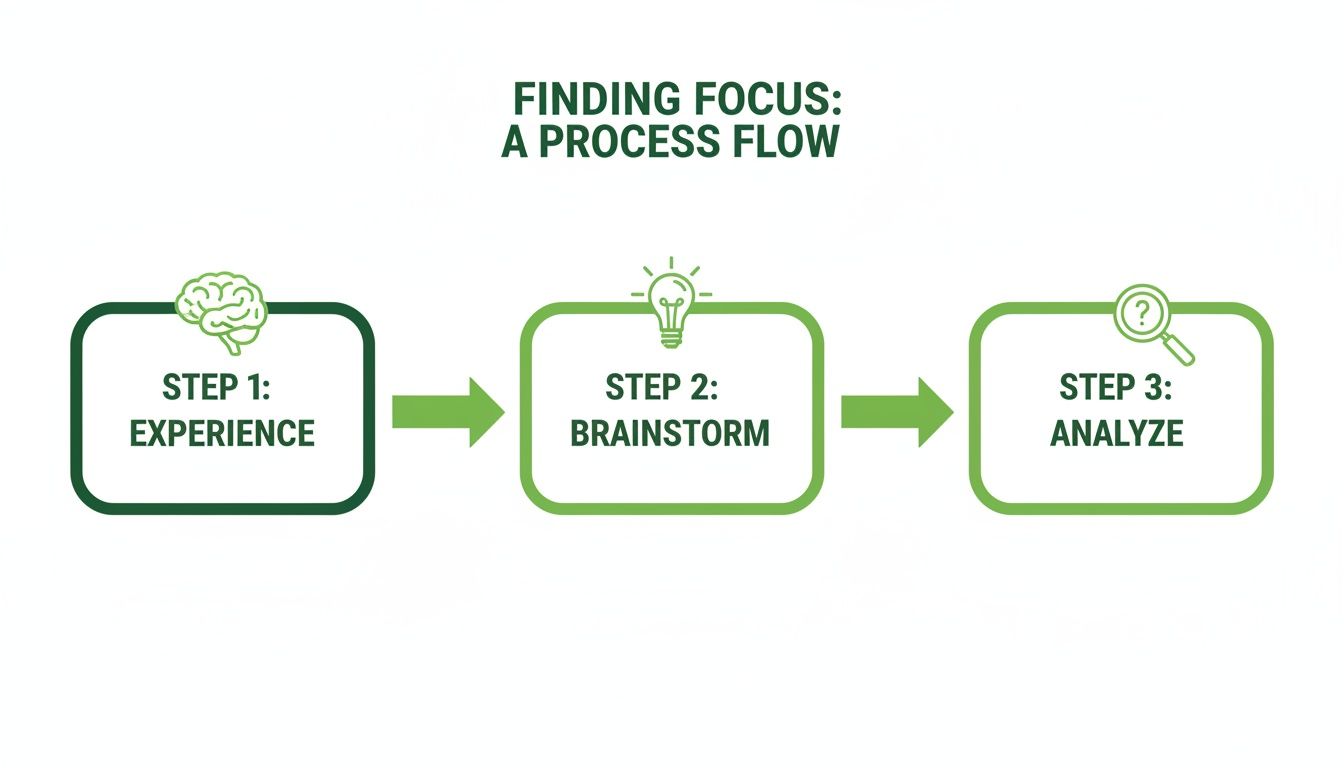
As you can see, reflection isn't just one thing. It's a deliberate process of experiencing something, actively thinking about it, and then breaking down what it all means. This is how you create a paper that truly matters.
Crafting an Introduction That Hooks the Reader
Your introduction has two jobs: get your reader interested and tell them what you're going to talk about. It’s your first and best chance to make them care.
Start with a hook. This could be a surprising observation, a relatable short story, or a thought-provoking question tied to your experience. After you've grabbed their attention, give them just enough background to understand the context of your reflection.
Finally, state your thesis. In a reflection paper, a thesis isn't an argument you have to prove; it’s a clear statement of the main lesson or insight you learned. For example, instead of a flat "I will reflect on a group project," try something with more substance: "I used to think leadership was about being in charge, but a difficult group project taught me it’s really about knowing how to listen and find common ground." See the difference?
Building Body Paragraphs That Dig Deeper
This is where you do the heavy lifting. The body of your paper is where you explore your thesis, with each paragraph zooming in on a specific piece of your reflection.
The magic formula here is to blend description with analysis. You need to explain what happened, but more importantly, you need to explore why it matters. Don't just give a play-by-play. Constantly ask yourself questions like, "Why did I react that way?" or "What does this moment reveal about my assumptions?"
A great tool for this is a reflective framework, and Gibbs' Reflective Cycle is one of the best. It gives you a clear sequence to follow:
- Description: What actually happened? Be objective.
- Feelings: What were you thinking and feeling at the time?
- Evaluation: What went well? What didn't?
- Analysis: What sense can you make of the situation?
- Conclusion: What else could you have done?
- Action Plan: If this happens again, what will you do differently?
Using a framework like this isn't just about organizing your thoughts—it genuinely improves the depth of your writing. A 2023 study with 68 high school students found that using Gibbs' cycle led to a significant jump in their reflective writing scores. For more on building strong paragraphs, our guide on what is paragraph structure has some great tips.
You can even dedicate a paragraph to each stage of the cycle. This ensures you move logically from simply describing an event to truly understanding its long-term impact on your perspective.
Writing a Conclusion That Leaves a Lasting Impression
Your conclusion is your final word. It needs to tie everything together neatly without just repeating yourself. Start by restating your thesis in a fresh way, reminding the reader of the main insight you've discussed.
But the real power of a conclusion is in its forward-looking statement. Don't just end in the past. Answer the question: "What now?" How has this experience changed the way you'll approach things in the future? This final thought shows that your reflection wasn't just an academic exercise—it was a genuine learning experience that will stick with you.
Bringing Your Reflection to Life on the Page
Alright, you’ve got your plan. Now comes the part where you actually translate those brilliant thoughts onto the page. This is the moment you shift from outlining to the real craft of writing a reflection paper that feels both authentic and academic.
The big challenge here is striking the right tone. You're aiming for something professional, but it has to sound like you. It’s not a sterile lab report, but it’s definitely not a diary entry either. Think of it as finding a thoughtful, measured voice that conveys genuine insight.
Weaving Evidence into Your Narrative
One of the fastest ways to give your paper some serious academic muscle is to ground your personal reflections in concrete evidence. Don't let the word "evidence" throw you off—we're not trying to prove a scientific theory. We're just illustrating your thought process.
This evidence can come in a few different forms:
- A direct quote from a book or article that sparked a particular idea.
- Specific details from an experience, like a memorable conversation or a key moment.
- Data points or core concepts from a lecture that you’re connecting back to your own story.
So, instead of just saying a chapter was "challenging," quote the exact sentence that tripped you up and explain why. This simple move proves you’re truly engaging with the material, not just passively reacting to it. When your insights are tied to specific, verifiable details, they instantly become more credible.
A reflection paper gains its academic weight not from the emotion it describes, but from the analysis it builds around that emotion. Evidence is the bridge between feeling and thinking.
From Description to Thoughtful Analysis
The most common trap in reflective writing is getting stuck in pure description. You spend the whole time explaining what happened without ever getting to the important parts: so what? and what now?
To make that leap, sentence starters can be your best friend. They act as a prompt, pushing you to move beyond simple observation and into deeper analysis.
Check out how a small shift in phrasing changes everything:
| From This (Description) | To This (Analysis) |
|---|---|
| "The article discussed leadership styles." | "Initially, the article's focus on autocratic leadership seemed outdated, but it forced me to reconsider..." |
| "My group had trouble communicating." | "This communication breakdown highlighted my own assumptions about teamwork, specifically that..." |
| "I found the film's ending to be sad." | "The film’s tragic ending prompted me to question the very definition of success presented in the first act, leading me to believe..." |
See the difference? These phrases force you to unpack your reactions and explore the underlying reasons and future implications.
Maintaining Objectivity While Writing Personally
Writing about your feelings while staying objective sounds like a paradox, but it’s the key to a powerful paper. In this context, objectivity simply means being a fair and critical observer of your own experience.
Try to step back and analyze your own reactions as if you were looking at a case study. Ask yourself questions like, "Were my initial feelings colored by my own biases?" or "What other perspectives might I have missed in that moment?" To really make your reflection connect, consider using proven vocabulary learning techniques to articulate your thoughts with more precision.
It's also worth noting the tools available today. With AI like ChatGPT hitting 1.8 billion monthly visits, the academic world is changing. Platforms like Natural Write can help you refine a draft that sounds a bit too robotic, ensuring your unique voice shines through while still meeting the standards of AI detectors like Turnitin, which is used by over 70% of universities. These tools can help strike that crucial balance between personal storytelling and critical depth. This kind of self-awareness shows intellectual maturity and makes your insights far more compelling.
Polishing Your Paper From Good to Great

Getting that first draft down is a massive win, but don't close the laptop just yet. The real magic happens in the editing and revision stage. This is where you sharpen your ideas and transform a decent draft into a truly compelling reflection.
I like to think of this phase as a two-part mission. First, you'll put on your editor hat and look at the big picture—the argument, the flow, the overall impact. After that, you’ll switch to your proofreader glasses for a final sweep to catch any pesky errors.
Enhancing Your Paper Through Self-Editing
Before you get lost in commas and spelling, take a deep breath and read your draft with fresh eyes. Right now, your only job is to evaluate the substance of what you've written.
Here are the questions I always ask myself at this stage:
- Is my main point clear? Does the thesis I laid out in the introduction actually hold up and resonate through the entire paper?
- Did I analyze, not just summarize? It's easy to fall into the trap of just retelling what happened. The key is to explain why it mattered and what you took away from it.
- Is my reflection well-supported? Are my big ideas backed up with specific examples from the experience or solid connections to what we've discussed in class?
- Does the conclusion stick the landing? Does it wrap everything up neatly and leave the reader with a final, insightful thought?
A common mistake I see is a reflection that stays on the surface. Real revision isn't just about correcting typos—it's about digging deeper and challenging your own initial thoughts to find a more profound insight.
If you want a more structured way to tackle this, our comprehensive self-editing checklist is a great resource. It walks you through a complete review to make sure the core of your paper is as strong as it can be.
The Final Polish: Proofreading for Perfection
Okay, once you feel good about the content, it's time to zoom in on the details. Meticulous proofreading is what gives your work that final layer of professionalism. Even the most brilliant reflection can lose its impact if it's full of distracting typos.
On this final read-through, you're hunting for errors in:
- Spelling and punctuation
- Grammar and sentence structure
- Formatting (margins, font, spacing)
- Citation style, if your instructor requires it
As you polish your writing, it can be helpful to differentiate between line editing and copy editing, as each process targets different levels of refinement.
Here’s a pro tip: read your paper out loud. It’s an almost foolproof way to catch awkward sentences and clumsy phrasing that your eyes might skim right over. This last step is your chance to ensure your hard-earned insights are presented as clearly and professionally as possible.
Still Have Questions About Reflection Papers?
Even with a solid plan, it's totally normal for questions to bubble up once you start writing. Reflection papers are a different beast than most academic assignments—they're a mix of your personal thoughts and serious academic analysis. It’s no wonder the "rules" can feel a little fuzzy.
Let's clear up some of the most common hangups so you can get back to writing with confidence.
What's the Real Difference Between a Summary and a Reflection?
This is a big one. Think of it this way: a summary sticks to the facts. It’s all about the "what." You're just objectively reporting the main points of a book, a lecture, or an event. It’s a dry, neutral account of what happened, with zero personal opinion.
A reflection paper, on the other hand, dives deep into the "so what?" You move way past simply describing something and start exploring your own thoughts, reactions, and connections. You might include a little bit of summary to set the scene, but the real meat of the paper is you analyzing the experience and figuring out what it all means.
A summary reports information. A reflection creates meaning. One is a photograph of the experience; the other is the story behind it.
Is It Really Okay to Use "I" in a Reflection Paper?
Yes! Not only is it okay, it's essential. The whole point of the assignment is to explore your personal perspective and insights. Using the first person ("I," "my," "me") is how you take ownership of your analysis and let your authentic voice come through.
Honestly, trying to write a reflection paper without "I" would be incredibly awkward and clunky. It would sound distant and defeat the entire purpose. This is one of the few times in academic writing where your voice is meant to be front and center. Embrace it.
How Do I Keep My Reflection from Sounding Like a Diary Entry?
Fantastic question. This is probably the trickiest part of writing a great reflection paper. The secret is to constantly build a bridge between your personal feelings and the academic concepts from your course. A diary entry might say, "I felt angry." An academic reflection explains why you felt angry and connects that feeling to a larger idea.
Here’s how to make that leap:
- Tie It to Course Concepts: Always link your personal experiences back to the theories, readings, or big ideas you've been discussing in class.
- Back It Up with Evidence: Don't just make a claim; support it. Instead of saying a documentary was "unsettling," point to a specific scene and explain how it challenged a particular ethical framework you studied.
- Analyze, Don't Just State: Put your own reactions under the microscope. Ask yourself, "Why did that particular comment make me so uncomfortable?" or "What does my confusion about this theory reveal about my own biases?"
For example, a diary entry might say, "That group project was so frustrating." An academic reflection takes it a step further: "The communication breakdown in our group project was a classic example of the 'storming' phase of group development we read about. It made me realize how my own impatience gets in the way when clear roles haven't been established yet." See the difference? That analytical move turns a simple complaint into a powerful insight.
Ready to transform your ideas into polished, natural-sounding writing? Natural Write helps you refine your drafts, ensuring your personal voice shines through with academic clarity. Humanize your text for free at Natural Write