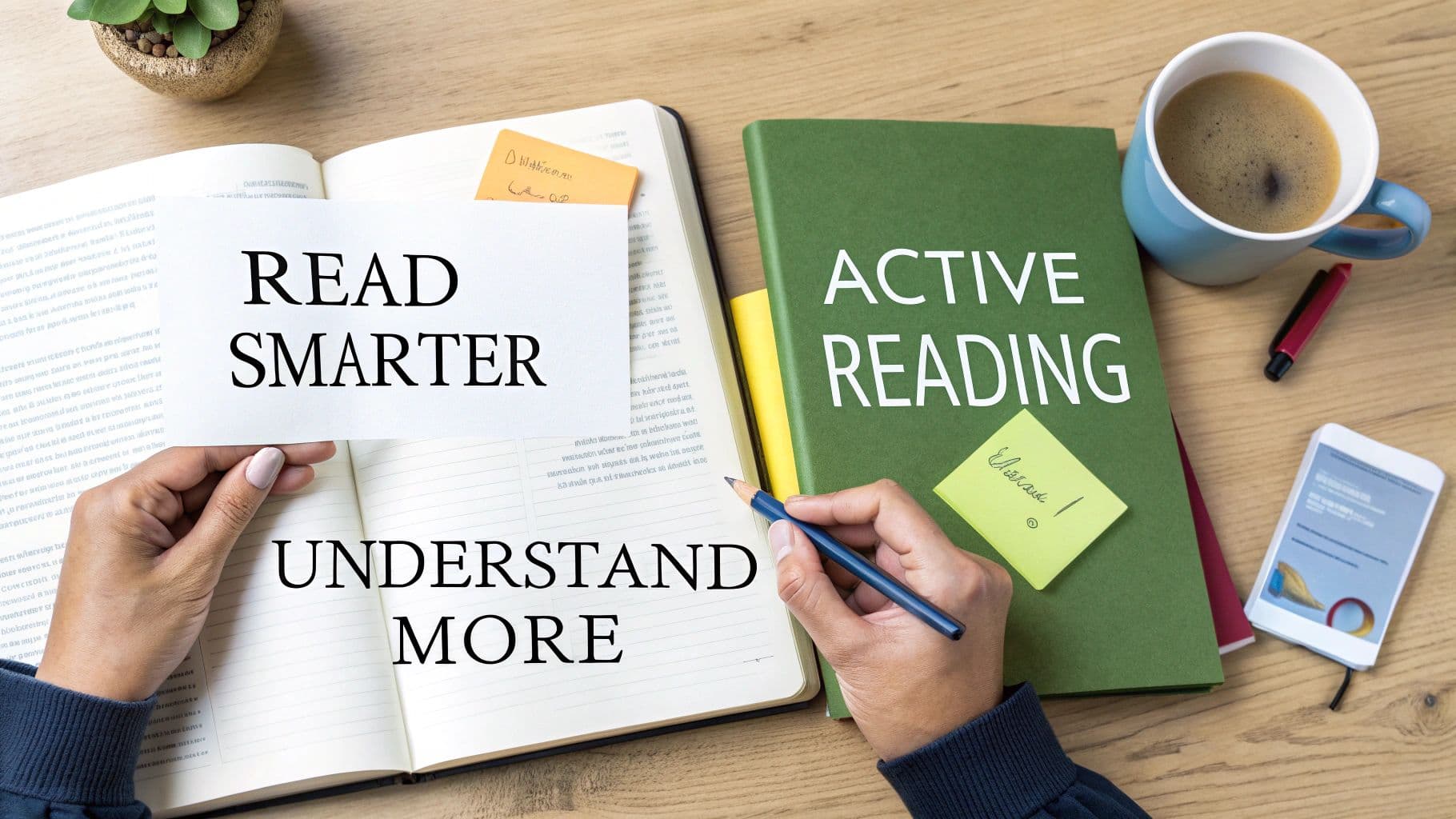
To really get better at reading comprehension, you have to stop thinking of reading as a one-step action. It’s not. True understanding comes from a three-part process: the work you do before you read, how you engage with the text during reading, and what you do to lock in that knowledge after you’re done.
This approach shifts reading from a passive skim to an active, strategic exercise. The result? You’ll remember more and understand things on a much deeper level.
Why Strong Reading Comprehension Is Your Superpower
We're swimming in a sea of information. The ability to truly grasp what you read is more than just a skill for school—it's essential for growing your career and developing as a person. Good comprehension isn't about plowing through pages at lightning speed. It's about depth. It’s about being able to pull out the main ideas, connect the dots, and actually use what you've learned.
But let's be real: a lot of people find this difficult. A 2024 study revealed that a staggering 54% of U.S. adults have literacy skills below a sixth-grade level, which points to a huge gap in deep comprehension. This doesn't just hold individuals back; it has a massive economic impact.
The Three Pillars of Effective Reading
Mastering reading comprehension isn’t about some single, magical trick. It’s a structured process built on three core pillars, each one tackling a different phase of your reading journey.
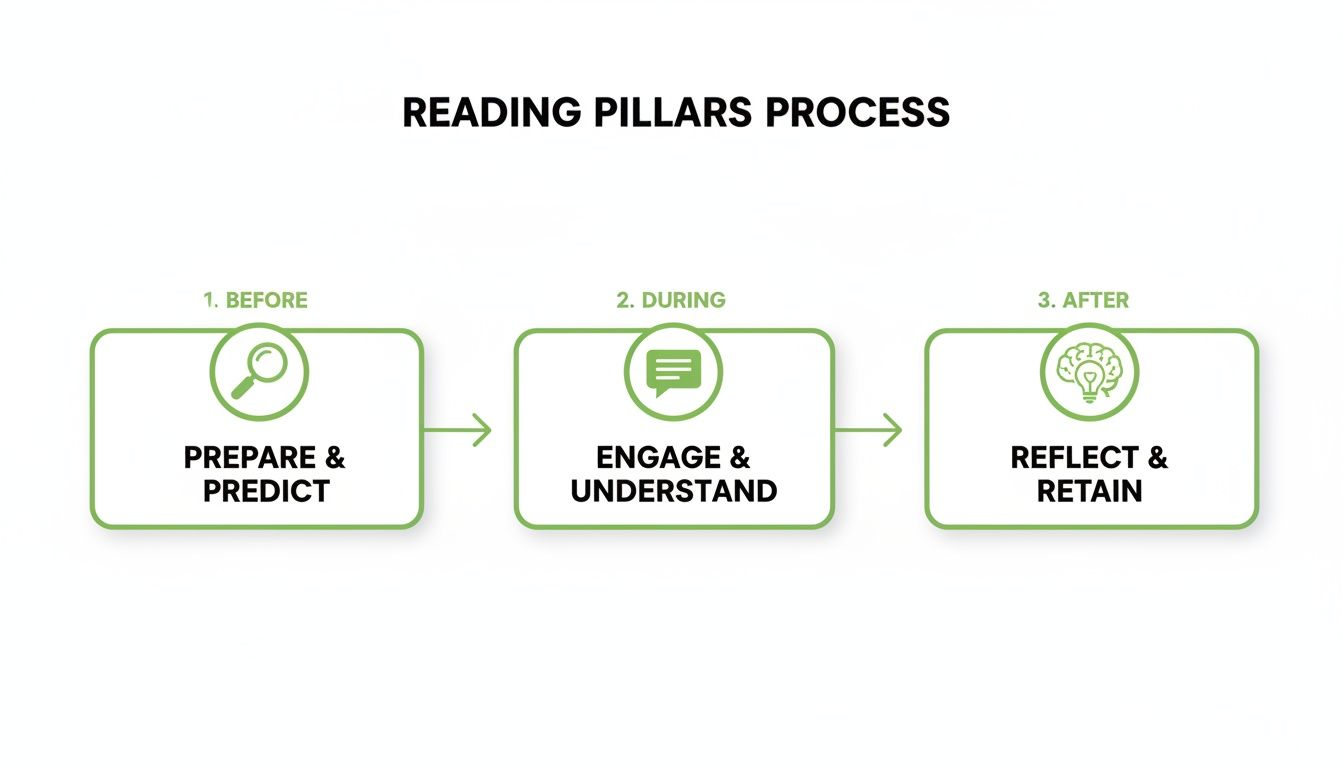
The flowchart above lays it out perfectly. Comprehension isn’t a one-and-done event; it's a cycle where each stage builds on the last to create a rock-solid understanding.
To make this framework crystal clear, here’s a simple breakdown of what each phase involves.
The Three Pillars of Effective Reading Comprehension
| Phase | Primary Goal | Key Actions |
|---|---|---|
| Before Reading | Prime the brain for learning | Preview text, set a purpose, activate prior knowledge. |
| During Reading | Actively construct meaning | Ask questions, visualize, make connections, monitor understanding. |
| After Reading | Consolidate and retain information | Summarize, discuss, reflect on what you’ve learned. |
This table serves as a quick cheat sheet for the entire process. By intentionally focusing on what happens before, during, and after, you transform the passive act of seeing words into an active process of creating meaning.
This foundation is especially critical for young readers. A huge milestone in a child's education is when they make the pivotal transition from learning to read to reading to comprehend. The strategies in this guide will give you practical tools for each of these three pillars, helping you read smarter, remember more, and think more critically.
Prepare Your Mind Before You Start Reading
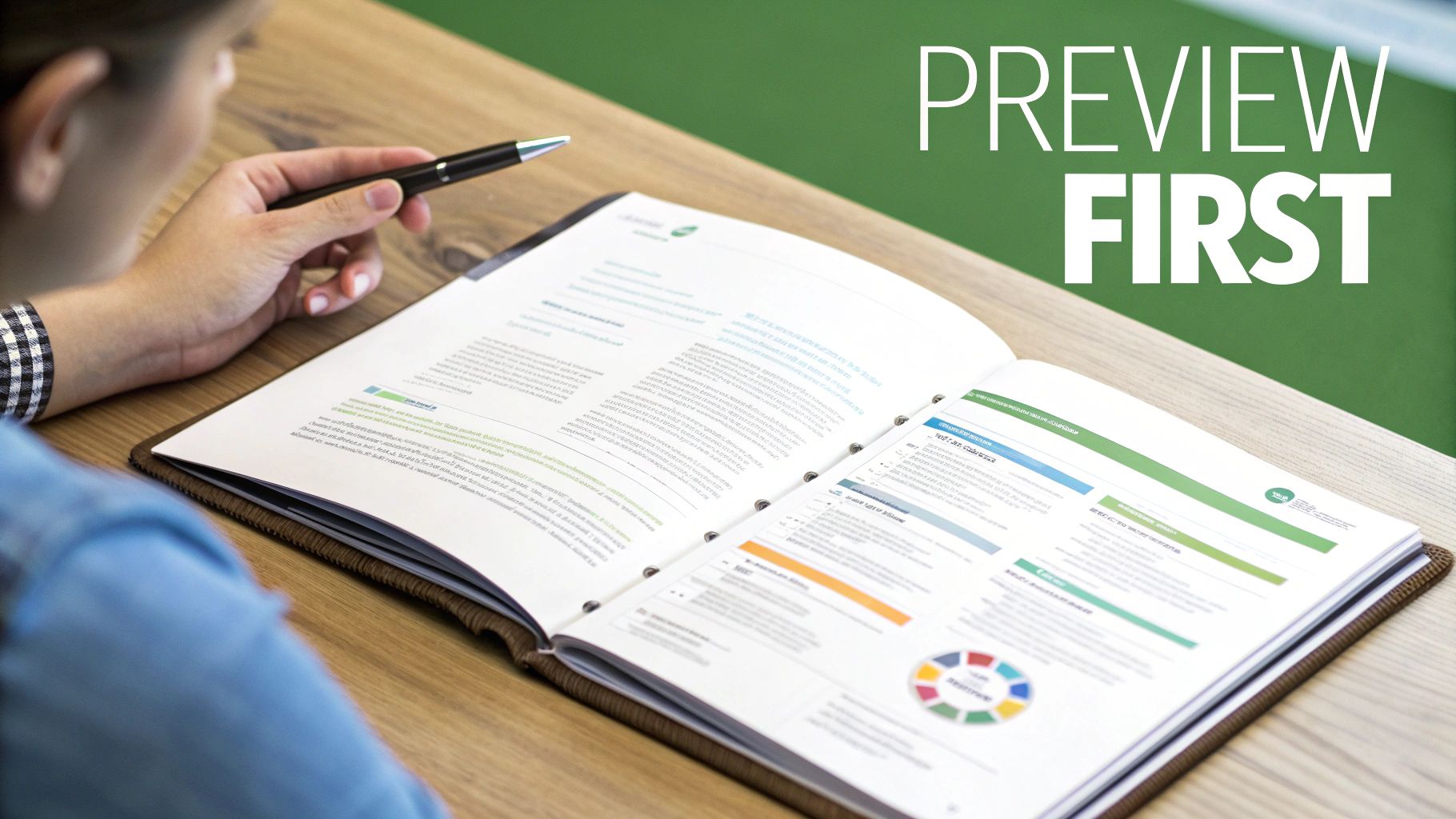
The secret to better comprehension often has less to do with the reading itself and more to do with the five minutes you spend before you even start. Most of us just dive right in, but that’s like setting off on a road trip without a map. A few moments of prep work can give you a sense of direction, making the whole journey a lot smoother.
This isn't about a quick skim. It’s a deliberate survey of the text to build a mental framework. Before you get lost in the details, you need to understand the lay of the land.
Create a Mental Map
Your first move is to get a feel for the structure of the information. Think of it like being a detective, looking for clues about where the author is trying to take you.
- Scan the headings and subheadings. These are the signposts. They spell out the main topics and show you the logical flow of the argument, giving you a bird's-eye view right away.
- Read the intro and conclusion first. This is a classic for a reason. Authors almost always state their core argument in the introduction and wrap it up in the conclusion. Reading these bookends gives you the "big picture" before you get bogged down.
- Look for bold or italicized words. These are visual cues the author is using to flag important concepts or key vocabulary. Pay attention to them.
When you do this, you’re not just passively looking at words; you’re building a preliminary outline in your head. This simple act primes your brain, making it much easier to slot in the details as you read.
Ask Guiding Questions
Once you have a sense of the structure, it's time to get curious. Instead of just being a passive reader, become an active participant. Start forming questions based on what you saw in the headings and intro. This simple shift turns reading from a chore into a mission.
For example, you’re tackling a dense business report with a section titled "Q4 Market Penetration Challenges." Right away, you can form questions like: "What exactly were the biggest challenges?" or "Which strategies didn't work, and why?"
See what a difference that makes? Now, you're not just reading—you're actively searching for answers. This targeted focus is a powerful way to boost comprehension because it keeps your mind engaged and stops it from wandering.
Let's walk through a real-world example. Imagine you’ve got to get through a long article about AI's impact on digital marketing.
- Survey the structure: You spot headings like "AI in Content Creation," "Predictive Analytics for Campaigns," and "Ethical Considerations."
- Formulate questions: Based on those, you might ask yourself: "Okay, how does AI actually change how content is made?" "What kind of data does predictive analytics even use?" "What are the biggest ethical traps here?"
With these questions in your back pocket, you’re ready to read with purpose. You have a clear mission, and every paragraph becomes a potential source for the answers you need. Your engagement and retention will skyrocket from the very first sentence.
Turn Reading into an Active Conversation
Passive reading is a lot like listening to a lecture with your eyes half-closed. The information is technically there, but it's not going to stick. If you really want to improve your reading comprehension, you have to stop being a passive audience and start having a dialogue with the author.
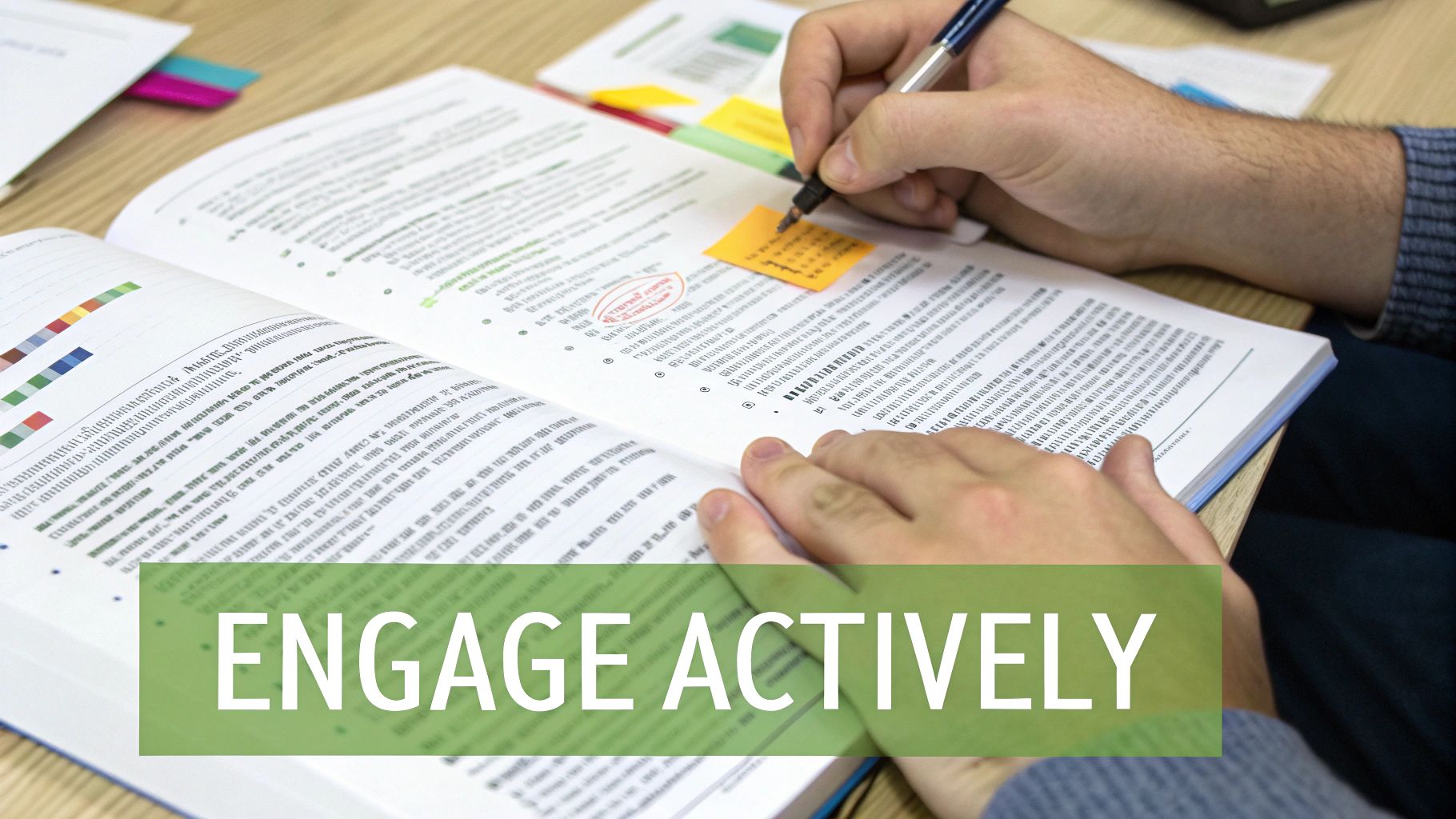
This is about engaging with the material directly—questioning it, challenging it, and connecting it to what you already know. The goal is to turn the page into a space for a real back-and-forth, not just a place for you to consume words.
Go Way Beyond Highlighting
Let's be honest, covering a page in yellow highlighter feels productive, but it rarely helps you remember anything important. Strategic annotation, on the other hand, is a game-changer. It forces you to actually think about what you’re reading and why it matters.
Instead of just coloring in sentences you like, try this instead:
- Scribble questions in the margins. If the author makes a big claim, write "Proof?" or "So what?" It keeps your brain switched on and actively looking for answers.
- Boil down paragraphs into a few words. Forcing yourself to condense a complex idea makes you process it on a deeper level. It’s a key step toward true understanding.
- Create your own symbol system. It doesn't have to be complicated. An exclamation mark (!) for a surprising fact, a star (⭐) for a main idea, and a question mark (?) for something that’s confusing you.
This simple process turns your book into a living document—a record of your own thought process. And when you need to write about what you've read, all that active engagement makes the task a whole lot easier. If you need a little help getting started, our post on https://naturalwrite.com/blog/how-to-write-a-response-paper has some great tips.
Master the Art of Checking In With Yourself
One of the most powerful skills a strong reader has is something called comprehension monitoring. It’s just a fancy term for noticing when you've lost the plot. You know that feeling—you get to the bottom of a page and realize you have absolutely no idea what you just read.
Catching that moment is the first step. Knowing how to get back on track is the real skill.
This isn't just theory. UK trials found that students who were taught to self-question while reading showed a 28% jump in understanding. It’s proof that this kind of internal check-in really works.
The next time you feel your focus drifting, don’t just plow ahead. Stop and ask yourself a few questions:
- What’s the last thing I actually understood? Pinpoint that spot and start rereading from there.
- What is this section trying to say? If you can’t answer that, you haven’t quite got it yet.
- Are there any words tripping me up? Don't skim over them. A single unknown word can derail your understanding of an entire paragraph.
This kind of self-awareness is what separates a passive reader from a strategic one. It also leans heavily on your ability to hold information in your head as you go. Exploring some strategies for improving working memory can give you a real edge here and supercharge your active reading efforts.
Build Your Vocabulary and Background Knowledge
You can't really get what a text is saying if you don't know the words or the world it's describing. Think of it like this: a strong vocabulary gives you all the different LEGO bricks you could ever need, while background knowledge is the instruction manual showing you how they all click together.
Without both, even the best reading strategies will only get you so far.
This isn't about memorizing the dictionary. It's about building a mental library so that when you encounter new information, it has a familiar place to land. Experts call this your "schema," and consciously growing it is a huge part of improving your reading comprehension.
It's a virtuous cycle, really. The more you know, the more you can pull from what you read. The more you read, the more you expand what you know. This is especially true for people who are naturally curious; new data shows that 51.6% of them make a point to build their world knowledge just to help them focus better when reading. You can see more fascinating reading score statistics if you're interested.
Learn New Words From Context
Forget the flashcards. Seriously. The best way to actually learn a new word is to find it in its natural habitat—inside a sentence. The next time you hit a word you don't recognize, don't just blow past it.
Try this instead:
- Read the sentence before and the one after. The surrounding text is packed with clues about the word’s meaning and tone.
- Break the word apart. Look for prefixes, suffixes, or root words you already know. They can give you a big hint.
- Make an educated guess. Based on your detective work, what do you think it means? Form your own definition before you look it up.
This approach forces your brain to engage with the word, creating a much stickier memory than just memorizing a definition ever could.
Diversify Your Reading Diet
Your background knowledge only grows when you step outside your usual territory. If you only read about one thing—say, 18th-century French history—you’re building a very deep but narrow schema. To get better at understanding all sorts of material, you have to broaden your horizons.
A rich mental library doesn't just help with nonfiction. Understanding historical context, cultural norms, or even basic scientific principles can completely change your interpretation of a novel or a piece of poetry.
Make a real effort to read outside your comfort zone. Love fiction? Pick up a popular science book. Only read business articles? Try a historical biography. Every new topic you dive into adds another layer to your background knowledge, giving you more context to draw from for everything else you read. For those who want to get into the nitty-gritty of how we pull meaning from writing, check out our detailed guide on text analysis.
Don't Just Finish the Page—Solidify What You've Learned
The real learning doesn't happen when you read the last word. It happens after. So many people close the book or tab and just move on, but that's a huge missed opportunity. If you want what you read to actually stick, you need a plan for what comes next.
This is where you turn fleeting information into knowledge you can actually use. Think of it as consolidating your gains. Instead of just hoping you’ll remember the good stuff, you take a few simple, active steps to lock it in.
Explain It Like I'm Five
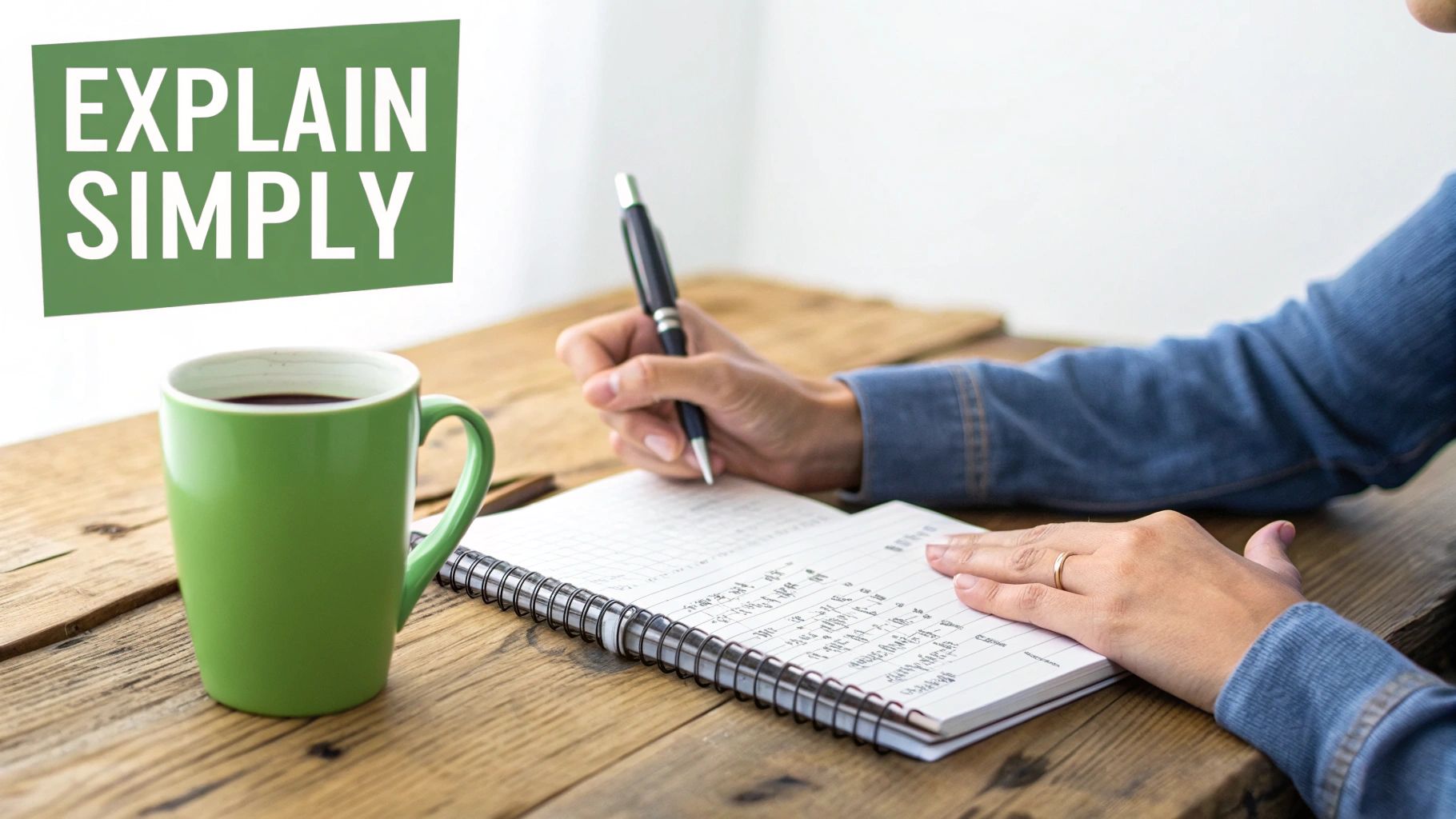
One of the most powerful litmus tests for understanding is something called the Feynman Technique, named after the brilliant physicist Richard Feynman. The idea is wonderfully simple: take whatever you just read and try to explain it in the simplest terms you can muster.
Pretend you're talking to a kid.
If you find yourself tripping over words, reaching for jargon, or just getting stuck, that’s a red flag. It’s a signal that you haven’t quite grasped that piece of the puzzle. That’s your cue to jump back into the text, reread that section until the lightbulb goes on, and then try your simple explanation again. This forces you out of passive recognition and into genuine understanding.
The real test of knowledge is not whether you can remember it, but whether you can communicate it. If you can't explain it simply, you don't understand it well enough.
This little exercise of retrieval and simplification forges stronger connections in your brain, making the info far easier to recall down the road.
Summarize to Synthesize, Not Just to Shorten
Summarizing is another game-changer, but most people get it wrong. A good summary isn't just a shrunken-down version of the original text. It’s a synthesis of the main ideas, rebuilt from the ground up in your own words.
It's the ultimate test: can you pull out the core argument and separate it from all the fluff?
After you read something, put it away. Seriously, hide it. Then, from memory, jot down a short paragraph that answers these questions:
- What was the author really trying to say?
- What were the main bits of proof or key examples they used?
- What's the one thing I absolutely need to remember from this?
This isn't just about repetition; it's about forcing your brain to process the material on a much deeper level. If you want to get better at crafting summaries that truly capture the essence of a text, you might find some useful tips in our guide on how to write a summary.
To put these strategies into practice, you need consistency. Here are a few simple exercises you can work into your routine to actively build and track your skills.
Actionable Reading Comprehension Exercises
| Exercise | Frequency | Primary Skill Targeted |
|---|---|---|
| The 5-Minute Feynman | Daily | Recall & Simplification. Explain the day's most important article or chapter to an imaginary beginner. |
| One-Paragraph Summary | 3-5 times a week | Synthesis. After reading an article or chapter, write a one-paragraph summary from memory. |
| "Teach a Friend" Session | Weekly | Verbal Processing & Articulation. Schedule a brief call with a friend to explain what you've learned. |
| Question Generation | Daily | Critical Thinking. After reading, write down 3-5 questions the text didn't answer. |
These aren't meant to be burdensome. Just a few minutes dedicated to these small habits can compound into significant gains in your comprehension over time.
Talk It Out to Find the Blind Spots
Finally, never, ever underestimate the power of a good conversation.
Talking about what you’ve read with someone else—a colleague, a friend, a study partner—is an incredible way to cement what you've learned and, more importantly, see what you missed.
When you explain the concepts to another person, you're reinforcing your own understanding (just like the Feynman Technique). But the real magic happens when they start asking questions. Their perspective can poke holes in your logic, reveal gaps in your knowledge, or introduce a totally new interpretation you never would have considered on your own.
It transforms reading from a solo activity into a dynamic, collaborative experience, deepening your comprehension in ways that are often surprising.
Got Questions About Reading Comprehension?
As you start putting these strategies into practice, you're bound to run into some common roadblocks. Let's tackle a few of the questions I hear most often and get you some practical advice to stay on track.
How Long Until I See Real Improvement?
This is the big one, isn't it? Everyone wants to know the timeline.
If you practice consistently, you can start feeling a real difference in your focus and how much you remember in as little as four to six weeks.
The secret here is consistency, not intensity. Carving out just 20-30 minutes a day for focused, active reading—like jotting down a quick summary or asking yourself questions as you go—beats a long, occasional cram session every time. It's all about building a habit that sticks.
Can Technology Actually Help Me With This?
Absolutely, but with a big caveat: use it as a tool to help you think, not to do the thinking for you. When used right, tech can be a fantastic partner.
Here are a few smart ways to bring it in:
- Vocabulary Apps: Spaced repetition tools like Anki are brilliant for getting new words to stick in your long-term memory.
- Digital Annotation: Highlighting, commenting, and questioning a text on a tablet or in a note-taking app is a great way to stay engaged with digital material.
- AI Writing Assistants: Sometimes a sentence is just poorly written. An AI assistant can help you rephrase a confusing idea so you can get to the core message without getting bogged down.
The goal is to use tech to make your active reading process smoother, not to outsource the mental work.
Just remember, the real magic isn't in the medium—it's in your engagement. A screen or a page, it doesn't matter. Active participation is what builds understanding.
Is It Better to Read on a Screen or From a Book?
The research usually gives a slight edge to physical books, mostly because they have fewer built-in distractions. It’s hard to stay focused when a notification or a tempting browser tab is just one click away.
But let's be realistic. The medium matters way less than your method.
You can get just as much out of a digital text if you're disciplined. The key is to build a distraction-free zone, no matter the format. Turn off your notifications, close those extra tabs, and give your digital reading time the same respect you'd give a physical book.
What if I Just Can’t Stop Getting Distracted?
Distraction is completely normal, but you can definitely fight back with a structured plan.
First, take control of your environment. That might mean leaving your phone in another room or using a browser extension that blocks distracting websites for a set period.
Second, give the Pomodoro Technique a shot. Read with intense focus for 25 minutes, then take a mandatory five-minute break to stretch or grab some water. This trains your brain's "attention muscle" in short, manageable bursts.
Finally, start with a clear "why." Before you read a single word, ask yourself, "What do I need to get out of this?" Giving your reading session a mission makes it much harder for your mind to wander.
If you're using AI to generate drafts, ensuring they sound natural and human is the next step. Natural Write can help you refine AI-generated text into clear, engaging content that bypasses AI detectors, making your writing ready for any audience. Polish your next piece at https://naturalwrite.com.