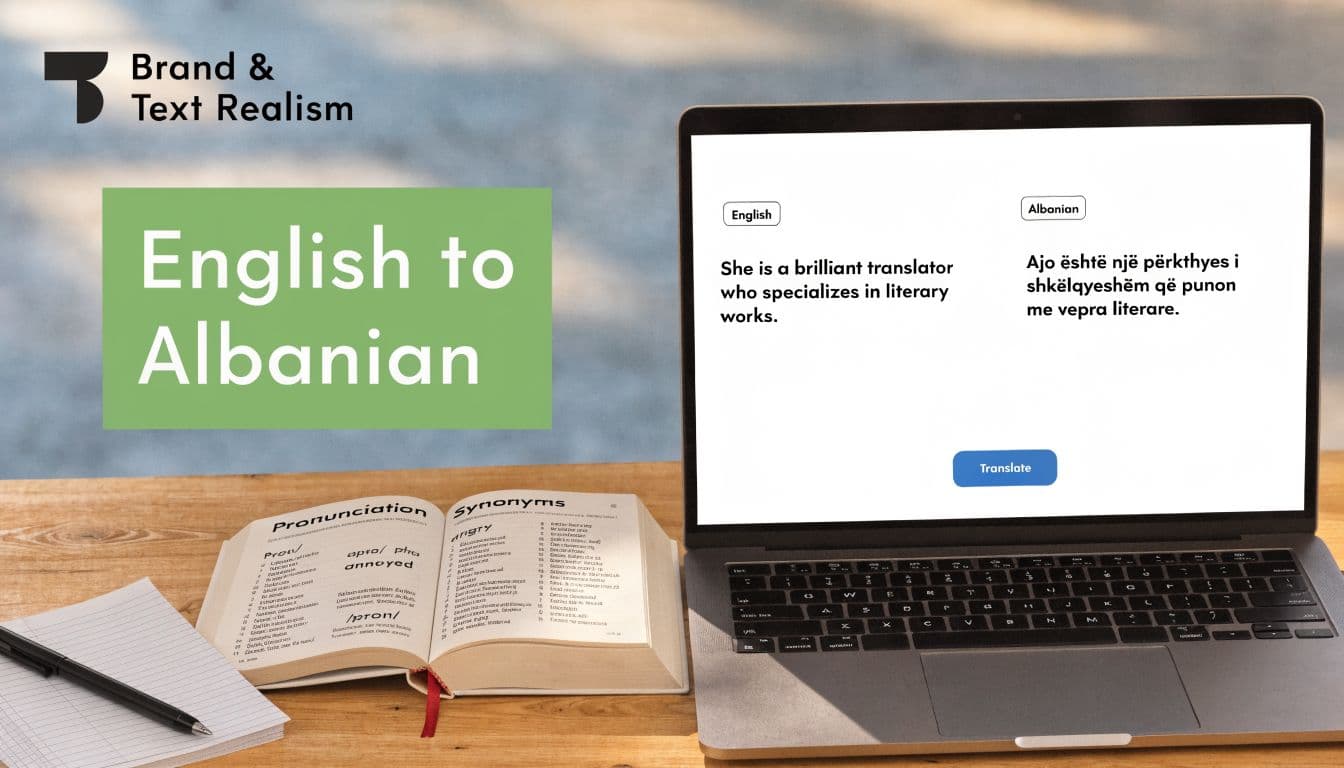
You’ve got English copy that needs to work in Albanian. Maybe it’s a report, a landing page, an academic draft, a product manual, or AI-generated marketing content that sounded fine in English until you tried to localize it. That’s usually when difficulties emerge.
English to Albanian translation looks straightforward until you hit syntax, terminology, tone, and layout. A sentence that reads cleanly in English can come out stiff, inflated, or subtly wrong in Albanian. If the source text came from AI, the risk gets worse. Translation can preserve the surface meaning while keeping the same machine-like rhythm underneath.
The workflow that works is not “paste into a tool and hope.” It’s source-text cleanup, controlled machine assistance, expert post-editing, structured QA, and a final humanization pass when AI-authored source text is involved. That’s the standard I’d use for any professional english to albanian translation project that has real consequences.
Prepare Your English Source Text for Flawless Translation
Bad source text creates bad translations. That’s the rule that saves the most time and the most budget.
Before anyone opens DeepL alternatives, machine translation platforms, or CAT tools, fix the English. If your source copy is vague, overloaded, or full of English-native assumptions, the Albanian version won’t magically improve it. It will carry those weaknesses forward in another language.

A good pre-flight pass has less to do with grammar and more to do with translatability. I strip out ambiguity first. Pronouns without a clear referent, stacked clauses, and sentences trying to do three jobs at once are where errors start.
Clean up the English before translation starts
Use this sequence:
- Shorten long sentences. If a sentence has multiple commas, exceptions, and parenthetical ideas, split it.
- Replace idioms. “Move the needle,” “low-hanging fruit,” and “on the same page” rarely survive translation well.
- Resolve ambiguity. Name the product, policy, team, or feature directly instead of using “it,” “this,” or “they.”
- Standardize terminology. Decide whether a key concept should stay in English, be translated, or be explained.
- Remove cultural shorthand. Sports metaphors, humor, and local references usually need adaptation, not literal transfer.
If you’re editing AI-written English first, readability work matters even more. Tightening structure before translation reduces the number of awkward decisions a linguist has to fix later. A practical starting point is this guide on improving readability in drafts.
Practical rule: Every unclear sentence in English becomes an expensive sentence in Albanian.
Build a glossary before the first draft
For serious work, I create a project glossary before translation begins. That sounds tedious until you’ve reviewed a document where one key term appears three different ways.
Your glossary should include:
- Core terms: Product names, legal terms, medical terms, technical labels
- Preferred phrasing: Whether a phrase should be formal, neutral, or public-facing
- Terms to avoid: Literal translations that are technically possible but wrong for the audience
- Approved untranslated items: Brand names, interface labels, internal codes
This matters most in technical and institutional content. A 2025 UNICEF-related project in Albania required professional English to Albanian translation for the “Census 2023 – Secondary Analysis” report and specified experience in statistical and technical content so critical data on children and youth, who represent over 30% of the population, would be accessible to policymakers and other stakeholders, according to this report on the Albania translation project.
Write for the Albanian reader, not the English original
The source text should tell the translator what the sentence means, not force them to guess what the writer intended. That’s a big difference.
If your English sentence is “The initiative supports scalable, community-led interventions with flexible implementation pathways,” a translator can produce something formally accurate. But if you rewrite it as “The program helps local groups run projects in ways that fit their communities,” the Albanian version has a much better chance of sounding natural.
That’s the part many teams skip. It’s also the part that prevents rework.
Choose Your Tools A Hybrid AI and Human Approach
The smartest workflow today is hybrid. Use AI for speed. Use humans for trust.
That doesn’t mean every tool is equal, and it definitely doesn’t mean the first machine output is ready for delivery. In english to albanian translation, AI is useful as a drafting engine. It’s weak as a final decision-maker.

Since the 2020s, some AI-driven services have aggregated 22 AI models and produced English to Albanian output at 85% of professional human quality while reducing costs by 90%, and Lingvanex supports up to 3,000 characters for real-time translation, as described in this overview of English-Albanian translation tools.
What AI is good at
Machine translation earns its place when you need a fast first pass on:
- Large text volumes: Product catalogs, support articles, internal documentation
- Repetitive content: Standard descriptions, templated copy, recurring sections
- Low-risk drafts: Internal review versions before human refinement
- Terminology seeding: Early drafts that help translators work from something tangible
For freelancers and editors, AI also helps expose source-text problems early. If the machine output collapses, that often means the English was unstable to begin with.
Prompting matters here. Generic prompts produce generic output. If you use AI for a draft, give it instruction on audience, register, term preservation, and whether the translation should sound formal or conversational. A solid set of AI translation prompts can make the first pass more usable and reduce cleanup work later.
What AI is bad at
AI fails in predictable ways with Albanian. It mishandles subtle register, over-translates common business language, and tends to flatten tone. It also loves symmetry. Human writing usually doesn’t.
I treat raw machine output as pre-translation, not translation. That distinction keeps expectations realistic.
A useful benchmark when evaluating the draft is this: does the output preserve meaning, maintain terminology, and sound like something an Albanian speaker would write? If the answer is only “mostly,” the draft is not ready.
Raw output is a working file, not a deliverable.
The tool stack that works in practice
The best setup is usually simple:
| Stage | Tool type | Purpose |
|---|---|---|
| Drafting | AI translation engine | Generate a first version quickly |
| Terminology control | Glossary and term list | Lock key vocabulary before edits spread |
| Editing | Native Albanian linguist | Fix grammar, syntax, tone, and context |
| Final refinement | Humanization and style cleanup | Remove residual machine patterns |
If your source text started with AI, the last layer matters more than typically expected. Tools focused on rewriting robotic phrasing can then help shape cleaner inputs and outputs. For background on that side of the workflow, this piece on the best AI to human text converter is worth reviewing.
The hybrid model works because it puts each tool in the role it can handle. AI drafts. Humans decide.
Mastering the Nuances of Human Post-Editing
Post-editing is where professional english to albanian translation is either saved or exposed.
Anyone can compare source and target sentences and fix obvious mistakes. Skilled post-editors do more than that. They make the Albanian text feel written, not converted. That requires grammar knowledge, register control, and a strong instinct for when literal accuracy is damaging the message.

Where machine drafts usually break
Albanian has features that routinely trip up raw AI output. Definite noun suffixes can be mishandled. Evidential forms can sound off. Word order often ends up technically understandable but stylistically rigid.
That’s why machine output in Albanian often feels “translated” even when the basic meaning is right. Native editors catch this immediately. Non-native reviewers often don’t.
Common failure points include:
- Literal clause structure: English syntax dragged directly into Albanian
- Flat tone: Everything sounds equally formal, regardless of audience
- Weak cultural adaptation: The words are translated, but the intent isn’t localized
- Terminology drift: A key term starts consistent, then changes halfway through
- False fluency: The sentence reads smoothly but says the wrong thing
Light editing and heavy editing are different jobs
I separate post-editing into two passes.
Light post-editing fixes fluency, grammar, and obvious mistranslations. This is the minimum needed to make AI output readable.
Heavy post-editing is where quality happens. That pass adapts tone, adjusts sentence rhythm, changes examples if needed, and rewrites stiff sections so they sound native. For marketing, academic, and public-facing content, heavy editing is usually the actual requirement even when the client thinks they only need “proofreading.”
If the Albanian sounds like a polished translation, you’re halfway there. If it sounds like it was originally drafted in Albanian, the editor did the hard part well.
In structured workflows, translators often use translation memory tools such as SDL Trados Studio or memoQ to keep terminology stable across files. The wider methodology described in this analysis of English to Albanian translation workflows is close to what I’d consider workable in production: AI first draft, human post-editing, and dedicated QA. The same source notes that text expansion from English to Albanian can reach 15% to 30%, hybrid workflows can reduce turnaround by 40%, and pure AI has idiomatic error rates exceeding 30% in less-resourced pairs.
Watch the layout, not just the wording
Text expansion often causes many otherwise good projects to fall apart. Albanian often takes more space than English. A headline, button label, slide title, infographic caption, or PDF table may no longer fit.
That means post-editing has to include DTP awareness. A translator can’t just choose the most complete wording. They may need the most accurate wording that still fits the design.
Practical checks during this phase:
- UI strings: Make sure labels don’t overflow buttons or menus
- Slides and PDFs: Check text boxes, charts, captions, and footnotes
- Marketing assets: Confirm headlines still work visually
- Tables: Watch for line breaks that change readability
- Forms: Review field limits and validation messages
A useful companion to this stage is a disciplined editing routine. This self-editing checklist for tightening draft quality maps well to the final human pass before sign-off.
A short explainer on translation quality control can also help teams understand why this stage takes time:
Idioms, tone, and audience need a human decision
Idioms are where weak workflows get exposed fast. If the English says “we’re not out of the woods yet,” a machine may preserve the image without preserving the meaning. A human editor asks the better question: what should the Albanian reader understand here? Caution? Partial progress? Ongoing risk?
That’s also true for audience. Academic Albanian, public-sector Albanian, e-commerce Albanian, and ad copy don’t sound the same. Human post-editing isn’t optional because machines are imperfect in theory. It’s essential because real audiences notice when language doesn’t belong to their context.
Your Final Quality Assurance Translation Checklist
Good post-editing improves the text. Good QA protects the project.
By the time a translation reaches QA, the creative decisions should already be made. This is not the stage for rewriting paragraphs unless something is clearly wrong. QA is where you verify consistency, catch production mistakes, and stop preventable errors from reaching the client, the classroom, or the public.
Run QA with a fresh brain
If possible, the person doing final QA should not be the same person who did the heavy post-editing. Fresh reviewers catch repeated words, dropped phrases, inconsistent capitalization, and formatting damage much faster.
I also recommend checking the Albanian alone first, then doing a source-target comparison. If you compare line by line too early, your brain can miss awkward Albanian because it keeps leaning on the English.
Final check: If a native Albanian reader saw only the target text, would anything feel imported, stiff, or suspiciously literal?
English-to-Albanian Translation QA Checklist
| Check | Task | Notes |
|---|---|---|
| Accuracy | Compare source meaning against the Albanian version | Focus on omissions, overtranslation, and reversed meaning |
| Terminology | Verify every key term against the approved glossary | Check headings, recurring labels, and repeated concepts |
| Names and labels | Confirm names, titles, brands, and interface labels | Keep approved untranslated items exactly as specified |
| Numbers and dates | Check all figures, dates, and references | Make sure nothing changed during editing |
| Grammar and spelling | Proofread the Albanian as a standalone text | Look for agreement errors and awkward punctuation |
| Tone | Confirm the register fits the audience | Academic, legal, marketing, and public information need different voices |
| Layout | Review text fit in PDFs, slides, ads, and UI | Expansion can break tables, buttons, and text boxes |
| Links and references | Check visible link text, citations, and cross-references | Ensure nothing points to the wrong section or label |
| Final readthrough | Read the full piece without the source open | This catches rhythm problems and leftover machine phrasing |
Don’t skip the delivery format review
Translation teams often sign off on text that looked fine in a Word file and broke as soon as it hit design. Final QA should happen in the target format whenever possible. That means the actual PDF, the actual webpage draft, the actual presentation, or the actual app screen.
If the client is publishing in multiple formats, spot-check each one. A paragraph that fits in a document may fail in email, mobile, or social placements.
That extra review takes time, but it’s cheaper than fixing visible mistakes after release.
Avoiding AI Detection in Your Translated Content
Many people assume translation hides AI fingerprints. That assumption is shaky.
If the English source was generated by ChatGPT or a similar tool, the Albanian version can still inherit the same structural habits. The wording changes, but the predictability often stays. That matters if the final text will be reviewed by academic systems, internal compliance teams, or anyone suspicious of machine-authored writing.

A documented gap in current translation discourse is that almost no content addresses whether AI-generated English, once translated into Albanian, retains AI-detection signatures. That concern is especially relevant for students and marketers using AI-written source text, as noted in this discussion of the detection gap in English-Albanian translation.
Why translated AI can still look like AI
Detection risk isn’t only about vocabulary. It can come from pacing, repetition, symmetry, and sentence predictability.
Typical signs include:
- Uniform sentence length
- Overly tidy paragraph structure
- Repeated transitional logic
- Generic abstraction instead of concrete detail
- Safe, flattened tone with little variation
Translation can preserve those patterns. A clean Albanian sentence can still feel machine-organized rather than human-authored.
Humanization is a separate pass
This is not the same as translation QA. A text can be accurate, grammatical, and still trigger suspicion because it sounds too regular.
The fix is a final humanization pass focused on style:
- Vary sentence length: Mix short and medium sentences naturally
- Break predictable patterns: Don’t let every paragraph follow the same logic
- Replace abstract filler: Choose concrete wording where the context allows it
- Adjust rhythm: Native writing has asymmetry. Machine text often doesn’t
- Restore writer intent: Add specificity that generic AI source text removed
Translation can change language without changing authorship signals.
For academic and professional use, this distinction matters. If the Albanian was translated from AI-written English, treat it as potentially machine-readable until a human editor reshapes it. That doesn’t mean forcing slang or making the prose overly casual. It means making it sound like a person made choices sentence by sentence.
When risk is highest
I’m most cautious with translated AI content in these cases:
- Student work: Formal essays and papers where tone consistency is scrutinized
- Thought leadership: Posts that are supposed to reflect a specific expert voice
- Marketing copy: Campaign language that needs natural persuasion, not polished blandness
- Client-facing deliverables: Anything that can affect trust if it feels synthetic
If the source began as AI, don’t assume Albanian translation solves the problem for you. Sometimes it softens the pattern. Sometimes it doesn’t. The safe approach is to edit as if the signal may still be there.
The Human Element in Modern Translation
The strongest english to albanian translation workflow today is not anti-AI. It’s anti-shortcut.
AI is useful for draft generation, speed, and volume. It helps translators start faster and helps teams process material that would otherwise stall. But Albanian is not a language pair where you can ignore nuance and expect professional results. Grammar, cultural framing, register, and idiomatic judgment still depend on a person who knows what the text should sound like to its audience.
That’s why the human role keeps expanding rather than disappearing. The machine handles repetition. The linguist handles meaning. The reviewer protects consistency. The final editor makes the text believable.
If you work across lower-resource language pairs, this principle shows up everywhere. The specifics differ, but the lesson is the same. This broader reflection on the human element in modern translation captures that reality well from another language context.
The practical standard is simple. Prepare the English carefully. Use AI as a controlled first pass. Post-edit with a native Albanian linguist. Run formal QA. If the source started with AI, do one more humanization pass before submission or publication.
That’s the workflow that protects quality. It’s also the one that saves you from having to fix the same mistakes twice.
If you’re working with AI-generated drafts and need them to read naturally before translation or after localization, Natural Write can help you humanize robotic phrasing, improve readability, and refine text for more confident academic and professional use.